Physical Address
304 North Cardinal St.
Dorchester Center, MA 02124
Physical Address
304 North Cardinal St.
Dorchester Center, MA 02124
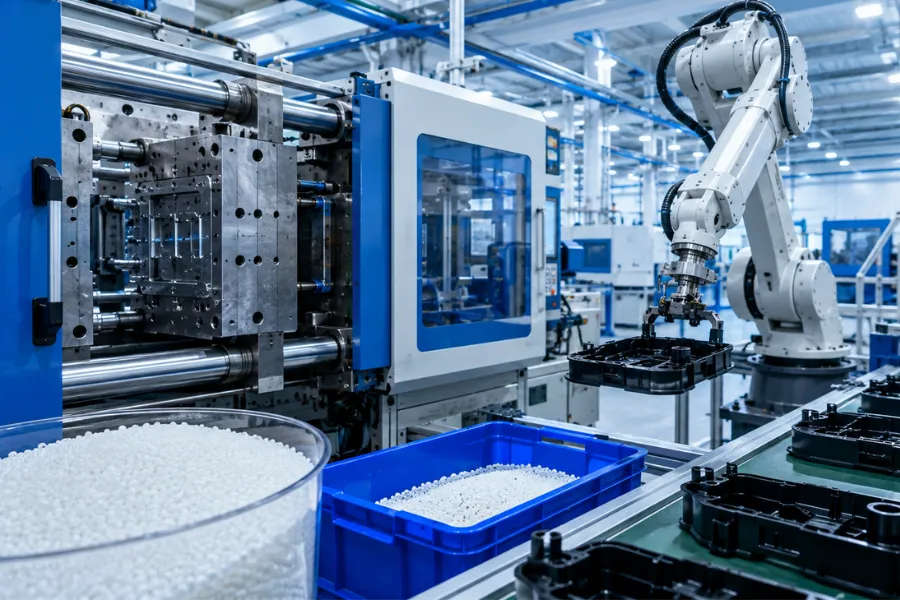
ABS plastic is one of the most widely used engineering thermoplastics in modern product development—not because it delivers the highest strength, heat resistance, or chemical resistance, but because it provides one of the best overall balances of mechanical performance, manufacturability, surface quality, and production cost. From automotive interior trim and consumer electronics to industrial equipment housings and medical device enclosures, ABS has become a preferred material wherever reliable injection molding and consistent product quality are required.
However, choosing ABS is not simply a material selection decision. Engineers must also evaluate the operating environment, product geometry, mold design, processing conditions, dimensional tolerances, and long-term production capability. A material that performs well in one application may become the wrong choice in another if these engineering factors are ignored.
This guide explains what is ABS plastic, how its material composition influences engineering performance, when ABS is the right material, when it is not, and how proper design and manufacturing practices can maximize product quality while minimizing production risk.
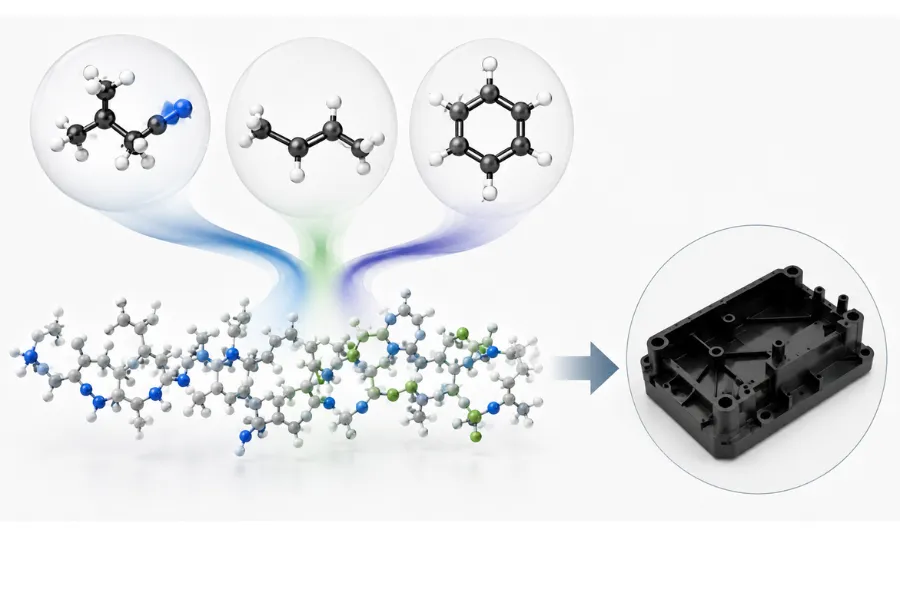
ABS (Acrylonitrile Butadiene Styrene) is an amorphous thermoplastic engineering polymer produced by combining three monomers: acrylonitrile, butadiene, and styrene. Each contributes different mechanical and processing characteristics, creating a material that balances strength, toughness, appearance, and manufacturability.
Unlike plastics designed to maximize only one performance characteristic, ABS was developed to achieve balanced engineering performance. This makes it suitable for products that require structural integrity, attractive appearance, stable dimensions, and efficient high-volume manufacturing.
Today, ABS is primarily processed through injection molding, although it is also compatible with CNC machining, extrusion, thermoforming, and FDM 3D printing during prototype development.
| Component | Primary Function | Engineering Benefit |
|---|---|---|
| Acrylonitrile | Hardness and chemical resistance | Improves rigidity, surface hardness, and resistance to many chemicals |
| Butadiene | Toughness | Increases impact resistance and reduces brittle failure |
| Styrene | Processability and appearance | Improves melt flow, surface gloss, dimensional consistency, and coloring capability |
Rather than acting independently, these three components complement each other.
For example, increasing butadiene generally improves impact strength but may reduce stiffness, while increasing acrylonitrile enhances chemical resistance at the expense of moldability. Material suppliers optimize these proportions to produce grades suited for different engineering applications.
Material selection is rarely about maximizing a single property.
A consumer electronic enclosure, an automotive dashboard, and a laboratory instrument housing all have different design priorities, yet all may successfully use ABS because the material provides an effective balance of:
This balanced performance allows manufacturers to produce high-quality components without the processing complexity associated with many higher-performance engineering plastics.
A common misconception is that stronger materials automatically produce better products.
In reality, excessive material performance often increases manufacturing cost without creating additional customer value.
For example, replacing ABS with polycarbonate in a household appliance housing may improve heat resistance, but if the product never exceeds normal room temperature, the higher material cost and more demanding processing requirements provide little practical benefit.
Successful engineering therefore focuses on selecting the right material—not simply the highest-performance material.
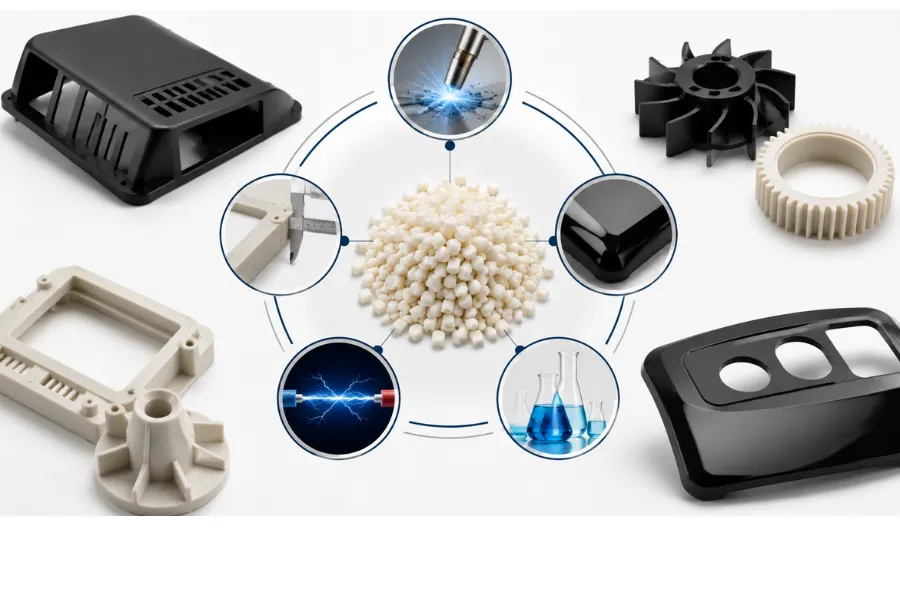
ABS has remained one of the industry’s most widely used engineering plastics because it provides consistent performance across multiple engineering requirements rather than excelling in only one category.
Its density typically ranges from 1.02 to 1.05 g/cm³, making it relatively lightweight while maintaining sufficient rigidity for structural housings and functional components.
The rubber phase introduced by butadiene gives ABS excellent impact resistance. Even under relatively low-temperature conditions, ABS retains much of its toughness, making it suitable for products exposed to accidental drops, repeated handling, or vibration during service.
Another important advantage is dimensional stability. Typical molding shrinkage ranges from 0.3% to 0.8%, allowing manufacturers to produce parts with predictable dimensions and excellent repeatability during mass production.
ABS also produces smooth molded surfaces that readily accept painting, texture etching, screen printing, laser marking, vacuum metallization, and electroplating. These finishing capabilities make it especially attractive for products where appearance directly influences perceived quality.
| Property | Typical Value | Engineering Significance |
|---|---|---|
| Density | 1.02–1.05 g/cm³ | Good balance between weight and rigidity |
| Molding Shrinkage | 0.3–0.8% | Excellent dimensional consistency |
| Continuous Service Temperature | Around 70°C | Suitable for most indoor engineering products |
| Heat Deflection Temperature | Approximately 93°C | Moderate thermal capability |
| Chemical Resistance | Good against water, inorganic salts, and many dilute acids | Suitable for many industrial applications |
| Electrical Insulation | Good | Commonly used for electrical housings |
| Surface Finish | Excellent | Supports cosmetic molded products |
| Processability | Excellent | Stable production with conventional injection molding equipment |
Many engineers focus only on published shrinkage values when evaluating dimensional stability.
In production, however, wall thickness variation, gate location, packing pressure, mold cooling balance, and machine consistency often influence dimensional accuracy far more than the shrinkage specification itself.
It is common to see two molds processing the same ABS grade produce noticeably different dimensional results because of differences in cooling channel design or gate balance rather than material properties.
For precision molded components, process stability is often more important than selecting the ABS grade with the lowest published shrinkage.
One reason manufacturers continue selecting ABS is its ability to achieve stable production over long manufacturing runs.
Compared with materials requiring narrow processing windows, ABS generally allows engineers to establish repeatable molding conditions more quickly.
When combined with:
ABS can consistently achieve high process capability (Cp/Cpk), reducing dimensional variation between production lots while improving assembly consistency.
No engineering plastic performs well in every environment. Selecting ABS should always involve balancing product requirements, manufacturing capability, and long-term operating conditions.
ABS is widely recognized because it successfully combines mechanical performance with manufacturing efficiency.
Its excellent processability allows manufacturers to mold complex geometries while maintaining attractive cosmetic surfaces and predictable dimensions.
Major engineering advantages include:
Rather than maximizing a single property, ABS minimizes compromises across the entire product development process.
Consider two injection-molded electronic housings.
One is manufactured from polypropylene because of its lower resin cost. The second uses ABS.
Although the polypropylene housing saves material cost, additional mold tuning is required to control dimensional variation, and painted surfaces show poorer adhesion.
The ABS housing costs slightly more per kilogram but reaches dimensional qualification faster, requires fewer cosmetic corrections, and achieves more consistent assembly during production.
In this situation, ABS reduces the total manufacturing cost, even though its raw material price is higher.
This illustrates why experienced engineers evaluate manufacturing efficiency—not just resin cost.
Despite its versatility, ABS has several limitations that should be considered during material selection.
Standard ABS has moderate heat resistance, with a continuous service temperature around 70°C and a heat deflection temperature of approximately 93°C. Products exposed to continuous elevated temperatures may require heat-resistant ABS, PC/ABS alloys, or polycarbonate.
Outdoor durability is another limitation. Standard ABS gradually loses toughness under prolonged ultraviolet exposure, resulting in discoloration and embrittlement. UV-stabilized materials or ASA are generally better choices for long-term outdoor applications.
Engineers should also consider environmental stress cracking. Certain oils, solvents, or cleaning chemicals can initiate cracking when residual molding stress is present.
Every engineering material involves compromise.
For example:
Experienced engineers therefore optimize the entire manufacturing system rather than focusing on a single material property.
ABS is typically an excellent choice when a project requires:
Conversely, alternative engineering plastics should be evaluated when the application requires continuous high-temperature service, prolonged outdoor exposure, exceptional chemical resistance, or severe wear under continuous mechanical loading. These engineering trade-offs should always be reviewed during the earliest stages of product development rather than after tooling has been released.
ABS is not a single standardized material. Manufacturers produce a wide range of ABS grades by adjusting the ratio of acrylonitrile, butadiene, and styrene or by incorporating additives such as flame retardants, reinforcing fillers, UV stabilizers, or plating modifiers. Although these materials belong to the same polymer family, their mechanical properties, processing windows, and long-term performance can differ significantly.
For product designers, selecting the appropriate ABS grade is often more important than deciding whether to use ABS itself. A general-purpose grade may perform perfectly for an office printer housing but fail to satisfy the thermal requirements of an automotive dashboard or the fire safety requirements of an electrical enclosure.
Instead of choosing the highest-performance material available, experienced engineers define the product’s functional requirements first and then select the simplest grade capable of meeting them. This approach reduces unnecessary material costs while improving manufacturing stability and qualification efficiency.
| ABS Grade | Primary Characteristics | Typical Applications |
|---|---|---|
| General-Purpose ABS | Balanced mechanical performance and easy processing | Consumer products, household appliances, office equipment |
| High-Impact ABS | Increased toughness and improved low-temperature impact resistance | Power tool housings, automotive trim, protective covers |
| Heat-Resistant ABS | Higher heat distortion temperature | Automotive interior components, industrial equipment |
| Flame-Retardant ABS | Improved fire resistance | Electrical enclosures, electronic products |
| Electroplating Grade ABS | Excellent plating adhesion and cosmetic quality | Automotive decorative trim, sanitary fittings |
| Transparent ABS | Improved transparency while maintaining good toughness | Display covers and specialty consumer products |
| Glass-Filled ABS | Increased stiffness and dimensional stability | Structural engineering components |
Selecting a higher-performance ABS grade does not automatically produce a better product.
Each material modification improves one characteristic while introducing new manufacturing considerations.
For example:
Successful material selection therefore depends on balancing product performance, manufacturing efficiency, tooling life, and total production cost rather than maximizing one property.
In many manufacturing projects, the first engineering discussion is not about mechanical strength—it is about production consistency.
For example, two grades may both satisfy the required impact strength, yet one produces fewer cosmetic defects, shorter mold qualification time, and more stable Cp/Cpk during mass production. Over hundreds of thousands of molded parts, these manufacturing advantages often generate greater cost savings than a small reduction in raw material price.
For this reason, experienced molding engineers frequently evaluate material suppliers based on long-term production consistency in addition to published technical data.
Avoid specifying specialty ABS grades simply as a safety margin.
If a product never operates above 50°C, selecting heat-resistant ABS may increase material cost and processing complexity without improving product performance.
Likewise, specifying glass-filled ABS for a cosmetic enclosure may reduce surface quality while accelerating mold maintenance requirements.
Material grades should always be selected according to actual operating conditions, not theoretical worst-case scenarios.
ABS has become one of the world’s most widely processed engineering plastics because it supports multiple manufacturing methods while maintaining excellent dimensional consistency and attractive surface finishes.
Although injection molding dominates commercial production, ABS is equally valuable during prototype development because it can be machined, thermoformed, extruded, and 3D printed with relative ease.
Rather than selecting a manufacturing process based solely on available equipment, engineers evaluate production volume, tooling investment, dimensional requirements, cosmetic quality, and expected product life cycle.
Injection molding remains the primary manufacturing process for ABS because it provides the highest productivity, best dimensional repeatability, and lowest unit cost for medium- and high-volume production.
Once molten ABS fills the mold cavity, controlled cooling allows the material to solidify with relatively low shrinkage and good dimensional consistency. Combined with excellent surface finish, this makes ABS particularly suitable for products containing snap fits, screw bosses, textured surfaces, and decorative features.
Injection molding is typically preferred for:
From an engineering perspective, one of ABS’s greatest advantages is its relatively forgiving processing window, which helps manufacturers establish stable production more quickly than many high-performance engineering plastics.
One of the most common mistakes during product development is assuming that a successful prototype guarantees successful mass production.
For example, an ABS housing machined from billet material may assemble perfectly, yet the injection-molded version could experience weld lines across snap fits, localized sink marks above screw bosses, or warpage caused by uneven cooling.
These issues are not material failures—they are manufacturing issues.
For this reason, experienced product development teams perform DFM reviews and Moldflow analysis before releasing tooling rather than relying solely on prototype evaluation.
ABS machines cleanly using conventional milling and turning equipment, making it an excellent material for engineering prototypes, assembly fixtures, and low-volume production.
Compared with injection molding, CNC machining offers several advantages:
However, machining removes material rather than forming it, leading to longer production times, greater material waste, and significantly higher unit costs.
Consequently, CNC machining is generally reserved for functional verification rather than commercial production.
ABS remains one of the most widely used materials for FDM additive manufacturing because it combines reasonable strength with good machinability after printing.
Typical applications include:
However, printed ABS parts should not be assumed to behave identically to molded components.
Layer orientation, internal infill, residual stress, and cooling characteristics differ significantly between additive manufacturing and injection molding.
As a result, critical features such as snap fits, living hinges, and threaded bosses should always be validated using injection-molded samples before production approval.
Depending on product geometry and production volume, ABS can also be processed through:
This manufacturing flexibility allows engineering teams to use the same material family throughout product development, pilot production, and commercial manufacturing.
| Process | Best Application | Advantages | Primary Limitation |
|---|---|---|---|
| Injection Molding | Mass production | Excellent repeatability and lowest unit cost | High initial tooling investment |
| CNC Machining | Prototypes and low-volume production | High precision and rapid modifications | Higher machining cost |
| FDM 3D Printing | Early design verification | Fast iteration with minimal setup | Lower mechanical consistency than molded parts |
| Thermoforming | Large thin-wall products | Lower tooling cost | Limited part complexity |
| Extrusion | Continuous profiles | High production efficiency | Restricted to constant cross-sections |
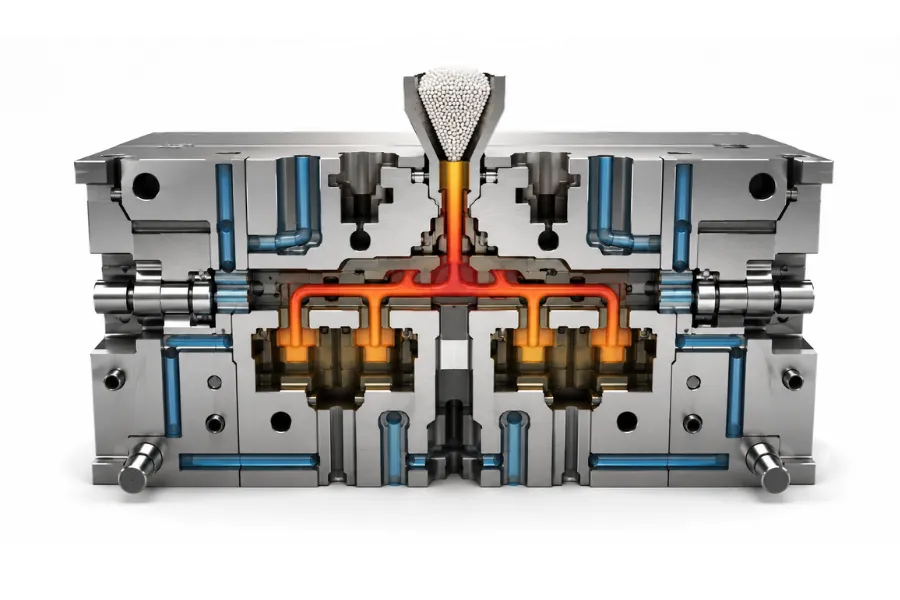
Although ABS is considered one of the easiest engineering plastics to process, achieving consistent production quality depends on much more than selecting the correct material grade.
Stable molding requires careful control of moisture, mold design, filling balance, cooling efficiency, and process capability. Many defects commonly attributed to ABS actually originate from poor process control or inadequate tooling rather than limitations of the material itself.
ABS readily absorbs moisture during storage and transportation.
If this moisture is not removed before molding, it vaporizes inside the barrel during plasticization and produces defects including:
Proper resin drying should therefore be considered a standard manufacturing requirement rather than a corrective action after defects appear.
In many factories, resin is dried correctly before production begins but later reabsorbs moisture while sitting in open hoppers during humid conditions.
Operators sometimes respond by increasing barrel temperature or injection pressure, yet the silver streaks remain because the root cause has not been eliminated.
Many manufacturers therefore control not only drying parameters but also hopper residence time, material transfer procedures, and ambient humidity to maintain consistent molding quality throughout long production runs.
ABS generally requires relatively high injection pressure because its melt viscosity increases during processing.
Typical molding conditions include:
Rather than maximizing pressure, process engineers balance melt temperature, injection speed, packing pressure, gate design, and cooling conditions to establish a stable processing window.
Increasing mold temperature generally improves cosmetic quality by reducing visible weld lines and improving surface gloss.
However, this also increases cooling time, reducing machine productivity.
For consumer electronics, this trade-off is often justified because appearance directly influences product value.
For hidden industrial components, however, reducing cycle time may provide greater economic benefit than achieving the highest possible surface finish.
ABS typically exhibits molding shrinkage between 0.3% and 0.8%, contributing to excellent dimensional consistency during production.
Low shrinkage helps engineers achieve:
However, production experience shows that non-uniform wall thickness and poorly balanced cooling systems often have a greater influence on warpage than shrinkage itself.
Maintaining consistent wall sections is therefore one of the most effective methods for improving dimensional stability.
Gate design influences filling balance, weld line location, pressure loss, and cosmetic appearance.
ABS performs well with several gate styles, including:
Gate placement should also consider downstream assembly features. Weld lines should be kept away from snap fits, screw bosses, and other highly stressed areas whenever possible.
Proper venting is equally important.
ABS commonly requires approximately 0.03 mm vent depth at the parting line to evacuate trapped gases while preventing flash.
Insufficient venting frequently results in:
| Design Feature | Recommended Practice | Engineering Benefit |
|---|---|---|
| Wall Thickness | Keep wall thickness as uniform as possible | Reduces sink marks, warpage, and differential shrinkage |
| Ribs | Approximately 50–60% of nominal wall thickness | Improves stiffness while minimizing sink |
| Bosses | Support tall bosses with ribs where necessary | Improves screw retention and reduces stress concentration |
| Internal Corners | Use generous radii instead of sharp corners | Reduces stress concentration and improves flow |
| Draft Angle | Increase draft on textured or deep features | Improves ejection and protects surface finish |
| Parting Line | Keep away from visible cosmetic surfaces whenever possible | Improves appearance and reduces finishing requirements |
These recommendations should be reviewed during DFM meetings before tool steel is released. Identifying potential molding risks during the design phase is significantly less expensive than modifying hardened tooling after T0 trials.
Although ABS is regarded as one of the most process-friendly engineering thermoplastics, successful production depends on establishing a stable processing window rather than pursuing maximum injection pressure or the shortest possible cycle time. Processing parameters should always be optimized according to the selected ABS grade, wall thickness, mold design, cosmetic requirements, and production volume.
For example, electroplating-grade ABS requires tighter control of residual stress than general-purpose grades, while heat-resistant ABS typically operates at higher melt temperatures. During mold qualification, these parameters should be validated through DOE (Design of Experiments) rather than adjusted individually through trial and error.
| ABS Grade | Barrel Temperature | Mold Temperature | Injection Pressure | Typical Cycle Time |
|---|---|---|---|---|
| General-Purpose ABS | 180–230°C | 50–70°C | 70–90 MPa | 40–70 s |
| High-Impact ABS | 180–230°C | 50–80°C | 70–120 MPa | 40–70 s |
| Heat-Resistant ABS | 190–240°C | 60–85°C | 85–120 MPa | 40–70 s |
| Electroplating Grade ABS | 200–250°C | 40–80°C | 70–120 MPa | 40–90 s |
| Flame-Retardant ABS | 170–220°C | 50–70°C | 60–100 MPa | 30–70 s |
| Transparent ABS | 190–240°C | 50–70°C | 70–100 MPa | 30–80 s |
These values should be treated as engineering reference ranges rather than fixed production settings. Final process parameters should always be established during T0 and T1 mold trials and confirmed before mass production.
| Parameter | Recommended Value | Engineering Purpose |
|---|---|---|
| Injection Machine | Screw-type injection molding machine | Stable melt plasticization |
| Nozzle | Open (straight-through) nozzle | Smooth melt flow with minimal restriction |
| Screw Speed | 20–60 rpm | Uniform melting while limiting excessive shear heating |
| Material Drying | Mandatory before molding | Prevent moisture-related defects |
| Packing Pressure | Optimized during mold trials | Control sink marks and dimensional variation |
| Cooling Time | Determined by wall thickness and part geometry | Balance dimensional stability with production efficiency |
Many inexperienced processors attempt to solve molding problems by increasing injection pressure or melt temperature.
In production, however, unstable machine settings often create new problems instead of solving existing ones.
For example, increasing injection pressure may eliminate a short shot but also increase flash, residual stress, ejection force, and long-term cracking. Likewise, raising melt temperature may improve cavity filling while increasing thermal degradation and cycle variation.
Experienced process engineers therefore establish a stable process window first and then optimize productivity within that window.
Every processing adjustment introduces trade-offs.
| Adjustment | Potential Benefit | Potential Drawback |
|---|---|---|
| Higher Mold Temperature | Better gloss and weld line appearance | Longer cooling time |
| Higher Injection Pressure | Improved cavity filling | Increased flash and residual stress |
| Higher Melt Temperature | Better flow into thin sections | Greater material degradation risk |
| Longer Packing Time | Reduced sink marks | Longer cycle time |
| Shorter Cooling Time | Higher productivity | Increased warpage and dimensional variation |
Understanding these relationships is one of the key differences between troubleshooting and scientific molding.
Before production approval, experienced manufacturers typically validate more than part dimensions.
A complete production validation often includes:
For automotive or regulated industries, additional validation activities such as PPAP or IQ/OQ/PQ may also be required depending on customer and regulatory requirements.
Most ABS molding defects originate from interactions between material preparation, mold design, cooling balance, and processing conditions rather than from the material itself.
Changing machine settings without identifying the underlying cause often shifts defects instead of eliminating them.
Successful troubleshooting therefore begins with systematic root cause analysis.
| Defect | Primary Root Cause | Mold Improvement | Process Adjustment |
|---|---|---|---|
| Weld Lines | Low melt temperature, poor venting, interrupted flow fronts | Improve venting and relocate gates | Increase melt or mold temperature and optimize filling speed |
| Silver Streaks | Moisture contamination | Improve material handling | Thoroughly dry resin before molding |
| Warpage | Uneven cooling and wall thickness variation | Balance cooling channels | Increase cooling time and optimize packing pressure |
| Poor Surface Gloss | Improper mold temperature or rough cavity finish | Polish cavity surface | Maintain mold temperature around 60–80°C |
| Stress Cracking | Residual molding stress and insufficient draft | Improve draft angle and ejection system | Reduce packing pressure and optimize mold temperature |
Weld lines occur when two melt fronts meet after flowing around holes, bosses, ribs, or multiple gates.
While often treated as cosmetic defects, weld lines can significantly reduce mechanical strength when located in highly stressed regions.
Consider a handheld power tool housing containing several screw bosses.
If the gate is positioned opposite the fastening features, multiple melt fronts may converge directly around the bosses. Although the molded part appears acceptable during visual inspection, repeated screw tightening during assembly may eventually initiate cracking along the weld line.
Rather than increasing injection pressure after tooling is completed, relocating the gate during mold design or verifying flow patterns through Moldflow analysis generally provides a far more reliable solution.
Silver streaks are one of the easiest defects to recognize because they usually indicate excessive moisture in the material.
Since ABS is hygroscopic, moisture absorbed during storage vaporizes during plasticization and creates streak-like defects along the flow direction.
Silver streaks often appear during the first production cycle on Monday mornings after material has remained inside an open hopper over the weekend.
Many processors initially adjust injection pressure or barrel temperature without success.
The problem frequently disappears only after fresh, properly dried resin replaces the moisture-contaminated material.
This illustrates why material handling procedures are often as important as molding parameters themselves.
ABS exhibits relatively low shrinkage, but warpage can still occur when cooling is unbalanced.
Common causes include:
In many cases, improving part geometry provides a more permanent solution than repeatedly modifying machine settings.
ABS is frequently selected because of its excellent cosmetic appearance, yet achieving a Class-A surface requires both high-quality tooling and stable processing.
Surface defects are commonly associated with:
For decorative consumer products, specifying an appropriate SPI mold finish during tool design is often more effective than attempting to improve gloss through process adjustments alone.
Many production problems originate during product design rather than during molding.
Some of the most common engineering mistakes include:
| Common Mistake | Manufacturing Consequence |
|---|---|
| Selecting standard ABS for outdoor products | Premature UV degradation and embrittlement |
| Ignoring resin drying requirements | Silver streaks, bubbles, and reduced strength |
| Designing uneven wall thickness | Sink marks, differential shrinkage, and warpage |
| Locating weld lines across snap fits or bosses | Reduced assembly strength |
| Using excessive packing pressure to solve sink marks | Increased residual stress and stress cracking |
| Releasing tooling without DFM or Moldflow review | Expensive tooling modifications after T0 trials |
Avoiding these issues during product development is considerably less expensive than correcting them after production has started.
ABS continues to be widely specified because it supports efficient manufacturing while meeting the performance requirements of numerous industries.
Typical applications include:
Design priorities typically focus on cosmetic appearance, dimensional accuracy, and reliable snap-fit assembly.
ABS is commonly used for:
Automotive manufacturers often combine ABS with PC to improve heat resistance while maintaining excellent moldability and surface quality.
Typical industrial applications include:
Here, production repeatability and assembly accuracy are often more important than decorative appearance.
ABS is widely used for non-implantable medical products such as:
For regulated medical manufacturing, dimensional consistency, traceability, and process validation are generally more critical than maximizing mechanical strength.
Common applications include:
Across all these industries, ABS remains popular because it delivers a practical combination of impact resistance, attractive appearance, efficient processing, and reliable high-volume production.
After decades of industrial use, ABS continues to be one of the benchmark materials for injection molding—not because it is the strongest engineering plastic available, but because few materials achieve such a balanced combination of product performance, manufacturing efficiency, tooling compatibility, and commercial viability. This balanced profile is ultimately why ABS remains a preferred choice for engineers developing cost-effective, mass-produced plastic components.
Selecting a plastic material is rarely about choosing the one with the highest specification. In engineering practice, the better material is the one that satisfies functional requirements while minimizing manufacturing complexity, production cost, and long-term quality risks.
Although ABS is one of the most versatile engineering plastics, it should not automatically become the default choice for every injection-molded component. Engineers should evaluate operating conditions, product geometry, manufacturing methods, expected production volume, and lifecycle requirements before making a final decision.
| Property | ABS | Polycarbonate (PC) | Polypropylene (PP) | Nylon (PA) |
|---|---|---|---|---|
| Impact Resistance | Excellent | Excellent | Good | Very Good |
| Heat Resistance | Moderate | Excellent | Good | Excellent |
| Chemical Resistance | Good | Moderate | Excellent | Very Good |
| Surface Finish | Excellent | Excellent | Fair | Fair |
| Dimensional Stability | Excellent | Very Good | Moderate | Moderate (affected by moisture absorption) |
| Wear Resistance | Moderate | Moderate | Good | Excellent |
| Injection Moldability | Excellent | Good | Excellent | Good |
| Material Cost | Moderate | High | Low | Moderate to High |
| Outdoor Weather Resistance | Poor without UV stabilization | Good with UV grades | Good | Moderate |
ABS and PC are commonly evaluated for consumer electronics, automotive interiors, and industrial equipment housings.
ABS provides excellent moldability, lower processing temperatures, attractive cosmetic surfaces, and lower manufacturing costs. Polycarbonate delivers significantly higher heat resistance and structural strength but generally requires narrower processing windows and higher molding temperatures.
Many manufacturers select PC/ABS alloys when both impact resistance and thermal performance are required. These blends combine the dimensional stability and processability of ABS with the improved heat resistance of PC.
Selecting PC instead of ABS affects more than material cost.
Higher melt temperatures often increase cycle time, energy consumption, and mold temperature requirements. PC also tends to generate higher molding stress if processing parameters are not carefully optimized.
For products operating below normal ambient temperatures, these additional manufacturing costs often provide little functional benefit.
Polypropylene is frequently selected because of its excellent chemical resistance, low density, and economical material cost.
ABS, however, provides:
For chemical containers or living hinges, PP is generally the better choice.
For electronic housings, appliance covers, and precision assemblies, ABS often produces higher manufacturing quality despite its slightly higher material cost.
Nylon excels in applications requiring continuous mechanical loading and wear resistance.
Typical Nylon components include:
ABS cannot match Nylon’s wear resistance.
However, Nylon absorbs moisture during service, causing dimensional changes that may affect precision assemblies.
For cosmetic housings, instrument panels, and products requiring stable dimensions over time, ABS generally provides a more predictable manufacturing solution.
| Design Requirement | Recommended Material | Primary Engineering Reason |
|---|---|---|
| High-quality cosmetic housing | ABS | Excellent surface finish and moldability |
| Continuous operation above 90°C | PC | Superior thermal stability |
| Lowest manufacturing cost | PP | Low resin cost and excellent productivity |
| High-wear moving components | PA | Outstanding wear and fatigue resistance |
| Tight dimensional tolerances | ABS | Low shrinkage and excellent repeatability |
| Chemical storage applications | PP | Excellent chemical resistance |
| Automotive decorative trim | ABS or PC/ABS | Balanced appearance and heat resistance |
| Precision gears or bearings | PA | Superior mechanical durability |
The following decision sequence provides a practical starting point during material selection.
Is the product intended for long-term outdoor exposure?
Will continuous operating temperatures exceed approximately 70°C?
Will the component experience continuous wear or mechanical transmission?
Is cosmetic appearance, dimensional stability, and efficient injection molding the primary objective?
This engineering-first approach helps avoid unnecessary material upgrades while reducing tooling modifications later in the project.
Material selection should be integrated into the product development process rather than treated as an isolated purchasing decision. Successful projects evaluate material performance together with manufacturing capability, tooling strategy, quality control, and commercial objectives.
Begin by identifying the actual operating conditions.
Questions include:
These questions often eliminate unsuitable materials before detailed design begins.
Evaluate whether the design prioritizes:
ABS performs particularly well where appearance, assembly precision, and balanced mechanical performance are required.
Material selection should also consider production efficiency.
Review factors including:
ABS generally supports efficient automated injection molding because of its relatively wide processing window and stable molding behavior.
The total manufacturing cost of an ABS component depends on far more than resin price.
Major cost drivers include:
| Cost Driver | Manufacturing Impact |
|---|---|
| Part geometry | Influences mold complexity and tooling cost |
| Wall thickness | Affects cooling time and cycle time |
| Mold complexity | Determines tooling investment and maintenance |
| Surface finish | May require polishing, texturing, or secondary finishing |
| Production volume | Influences amortized tooling cost |
| Scrap rate | Directly affects overall manufacturing efficiency |
| Cycle time | One of the largest contributors to production cost |
Reducing wall thickness by improving structural design, for example, often produces greater long-term savings than selecting a cheaper material.
Before releasing tooling, engineering teams should confirm the following:
| Review Item | Engineering Objective |
|---|---|
| Uniform wall thickness | Minimize sink marks and warpage |
| Rib thickness verified | Prevent sink while maintaining stiffness |
| Bosses properly supported | Improve fastening reliability |
| Draft angles reviewed | Ensure smooth ejection |
| Gate location optimized | Reduce weld lines in critical areas |
| Vent layout confirmed | Prevent gas traps and burn marks |
| Cooling channels balanced | Improve dimensional consistency |
| Parting line reviewed | Minimize cosmetic defects |
| Moldflow analysis completed | Verify filling balance before tool manufacture |
Performing this review before steel is cut is significantly less expensive than modifying tooling after T0 trials.
Before mass production begins, manufacturers should also verify:
| Check Item | Purpose |
|---|---|
| Resin properly dried | Prevent silver streaks and degradation |
| Mold venting inspected | Avoid trapped gas and burn marks |
| Mold temperatures stabilized | Ensure repeatable cosmetic quality |
| Gate freeze time established | Optimize packing profile |
| Critical dimensions measured by CMM | Verify dimensional capability |
| First Article Inspection completed | Confirm design compliance |
| Cp/Cpk evaluated for key dimensions | Demonstrate process capability |
| Process window documented | Support long-term production consistency |
These activities reduce production variation and help establish a stable manufacturing process before volume production begins.
ABS is widely used for injection-molded housings, automotive interior components, consumer electronics, household appliances, industrial equipment covers, and non-implantable medical device enclosures. Its balanced combination of impact resistance, dimensional stability, and excellent surface quality makes it suitable for both structural and cosmetic applications.
Yes. Standard ABS typically exhibits a molding shrinkage of 0.3–0.8%. However, actual dimensional accuracy depends not only on shrinkage but also on wall thickness uniformity, gate design, cooling balance, packing pressure, and overall process stability.
ABS absorbs moisture from the surrounding environment. If molded without proper drying, moisture vaporizes inside the melt and can cause silver streaks, bubbles, poor surface finish, and reduced mechanical properties. Proper drying is therefore a standard requirement for consistent production quality.
Cracking is usually caused by residual molding stress combined with chemical exposure, insufficient draft, excessive packing pressure, or poor mold temperature control. In many cases, improving mold design is more effective than changing molding parameters alone.
Standard ABS has limited UV resistance and gradually becomes brittle after prolonged sunlight exposure. Outdoor products generally require UV-stabilized ABS or alternative materials such as ASA for improved weather resistance.
Yes. ABS is widely used for precision injection-molded components because of its relatively low shrinkage, stable processing characteristics, and good dimensional repeatability. Combined with scientific molding, Moldflow verification, and appropriate quality control, ABS can consistently achieve tight production tolerances.
ABS plastic remains one of the most practical engineering thermoplastics because it successfully balances mechanical performance, dimensional stability, cosmetic quality, processability, and manufacturing cost. Rather than excelling in a single property, it enables manufacturers to achieve reliable product performance with efficient, repeatable injection molding across a broad range of industries.
Successful ABS applications depend on more than selecting the correct resin grade. Product performance is equally influenced by DFM principles, mold design, moisture control, process optimization, cooling balance, and production validation. By evaluating these factors together—and understanding when alternative materials such as PC, PP, PA, or ASA are more appropriate—engineers can make informed material decisions, reduce manufacturing risk, improve process capability, and deliver consistent, high-quality products throughout the entire production lifecycle.