Physical Address
304 North Cardinal St.
Dorchester Center, MA 02124
Physical Address
304 North Cardinal St.
Dorchester Center, MA 02124
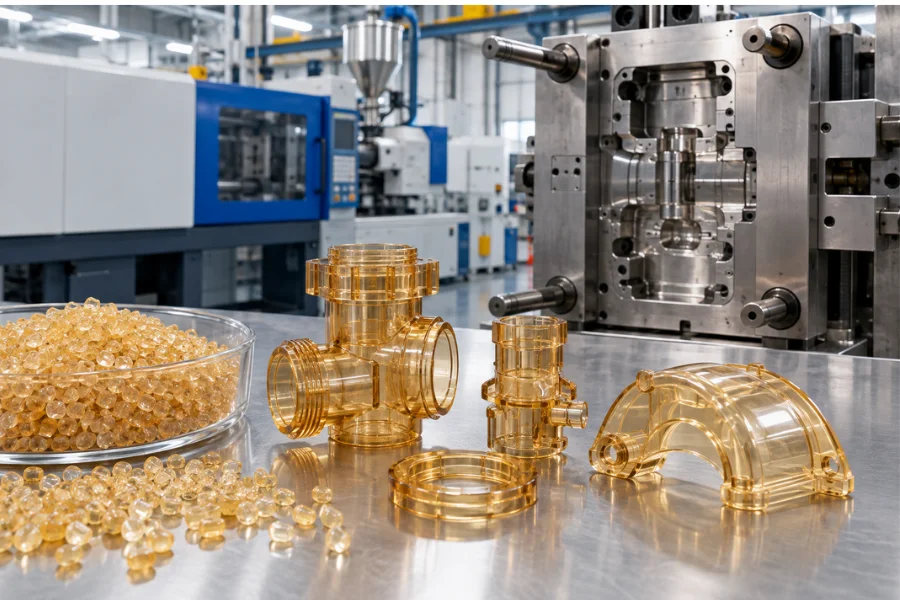
PPSU is a high-performance thermoplastic used when plastic parts must tolerate combinations of heat, steam, chemicals, and mechanical impact that can shorten the service life of conventional polymers. Reusable medical components, hot-water fittings, and sterilizable products are common examples.
For injection-molded parts, material performance is only part of the decision. PPSU also brings higher processing temperatures, demanding thermal control, and sensitivity to residual stress, making resin preparation, part geometry, mold design, and process stability important to final part performance.
PPSU stands for polyphenylsulfone, an amorphous high-performance thermoplastic in the polysulfone family. It combines high-temperature capability with impact toughness, hydrolytic stability, dimensional stability, and resistance to many chemicals.
Natural PPSU typically has a transparent to translucent amber appearance. Unlike semicrystalline polymers such as PP, PA, or PEEK, PPSU does not undergo crystallization during cooling.
Without crystallization-driven shrinkage, PPSU avoids one major source of dimensional variation found in semicrystalline polymers. Geometry, packing, molecular orientation, mold temperature, and cooling conditions can still produce warpage and molded-in stress, so amorphous structure should not be interpreted as automatic dimensional stability.
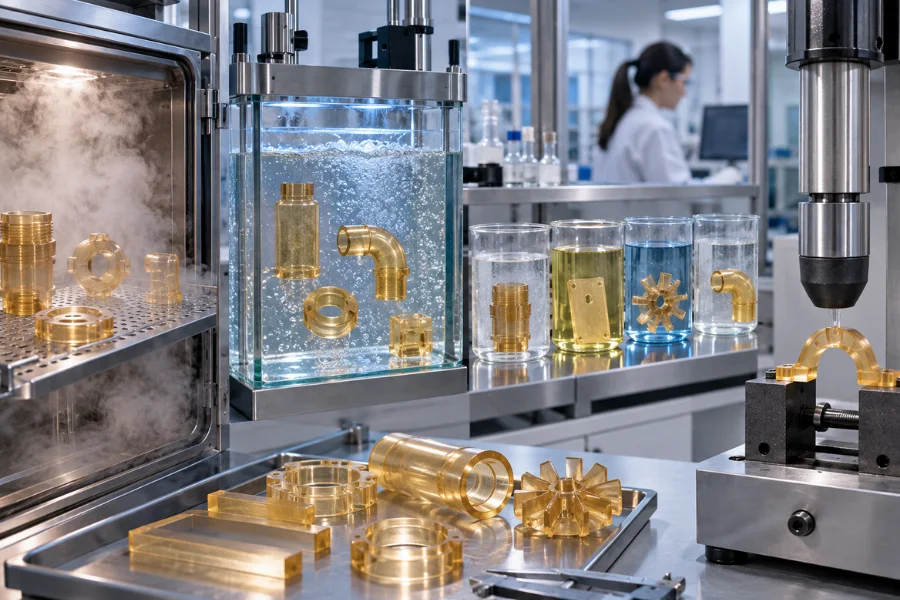
PPSU becomes most useful when several demanding requirements occur together rather than when a design needs only one high-performance property.
| Property | Engineering Significance |
|---|---|
| Amorphous structure | Avoids crystallization-driven shrinkage, although residual stress still requires control |
| High heat resistance | Supports elevated-temperature service and repeated thermal exposure |
| High impact strength | Helps resist cracking during handling, assembly, and service |
| Hydrolytic stability | Supports repeated exposure to hot water and steam |
| Chemical resistance | Provides compatibility with many cleaners, disinfectants, acids, and bases |
| Dimensional stability | Supports precision parts when geometry and processing are controlled |
| Low moisture absorption | Helps maintain dimensional consistency during service |
| Inherent flame resistance | Useful for selected aerospace, electrical, and transportation applications |
Exact properties vary with resin grade, reinforcement, conditioning, temperature, and test method. Engineering limits should be established from technical data for the specific PPSU grade.
Hydrolytic stability is a major reason for specifying PPSU. Repeated hot-water or steam exposure can progressively weaken, distort, or embrittle some thermoplastics, while suitable PPSU grades can retain useful mechanical performance under repeated sterilization conditions.
This behavior is particularly valuable for reusable medical and laboratory components. Sterilization capability is grade- and application-dependent, however, and should be validated against the actual temperature, cycle duration, sterilization method, and required end-of-life properties.
PPSU offers high toughness for an amorphous high-temperature polymer, reducing brittle-fracture risk in parts exposed to drops, assembly loads, repeated handling, or mechanical shock.
Its chemical resistance is broad but not universal. Compatibility depends on the chemical, concentration, temperature, exposure time, and stress state of the part, and certain solvents can increase environmental stress-cracking risk.
For molded components, this creates an important connection between processing and service performance. A resin may show acceptable chemical compatibility but still crack prematurely when chemical exposure acts on a gate region, sharp feature, assembly interface, or other area containing high residual stress.
PPSU can be processed by injection molding when the machine and tooling are capable of operating within the required thermal range. The manufacturing challenge is achieving complete filling and dimensional consistency without excessive thermal history or molded-in stress.
Drying, melt conditions, mold temperature, flow path, venting, packing, and geometry should therefore be considered as an interacting process system.
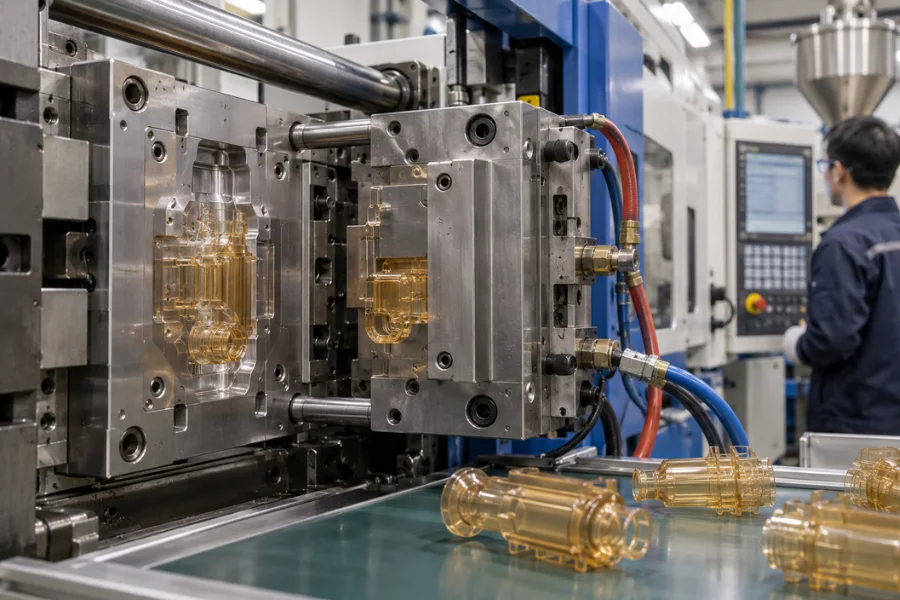
PPSU should be properly dried before melt processing. Low moisture absorption during service does not mean moisture can be ignored during injection molding; small amounts of moisture can still affect processing when the polymer is exposed to high melt temperatures.
Inadequate drying may contribute to splay, surface streaks, bubbles, and other quality problems. For reference, supplier processing guidance for certain PPSU grades targets moisture levels below approximately 0.05% before molding, but the required moisture level, drying temperature, and drying time should always be taken from the processing guidance for the specific grade.
PPSU requires substantially higher processing temperatures than commodity plastics. The molding machine, nozzle, hot-runner components, mold-temperature controller, seals, hoses, and related equipment must be compatible with these thermal requirements.
For reference, supplier guidance for certain PPSU grades places mold temperature roughly within the 120–160°C range. This should not be treated as a universal PPSU setting; the correct processing window depends on grade, part geometry, tooling, and quality requirements.
Mold temperature affects cavity filling, surface replication, dimensional behavior, and residual stress. Raising melt temperature or injection pressure to compensate for an inadequately heated mold may improve filling while increasing thermal exposure or stress elsewhere in the part.
Long thin flow paths, restrictive gates, and abrupt wall transitions can narrow the PPSU molding window. Gate size and location should support filling and packing without requiring excessive pressure through restrictive sections.
Expected weld-line locations also matter. A weld line crossing a mechanically loaded or chemically exposed region may become a durability concern, while insufficient venting near the end of fill can contribute to burns and incomplete filling.
PPSU does not experience crystallization-driven shrinkage, but uneven geometry, asymmetric packing, mold-temperature variation, and nonuniform cooling can still cause warpage. Dimensional control therefore depends on the complete relationship between resin behavior, part design, tooling, and processing.
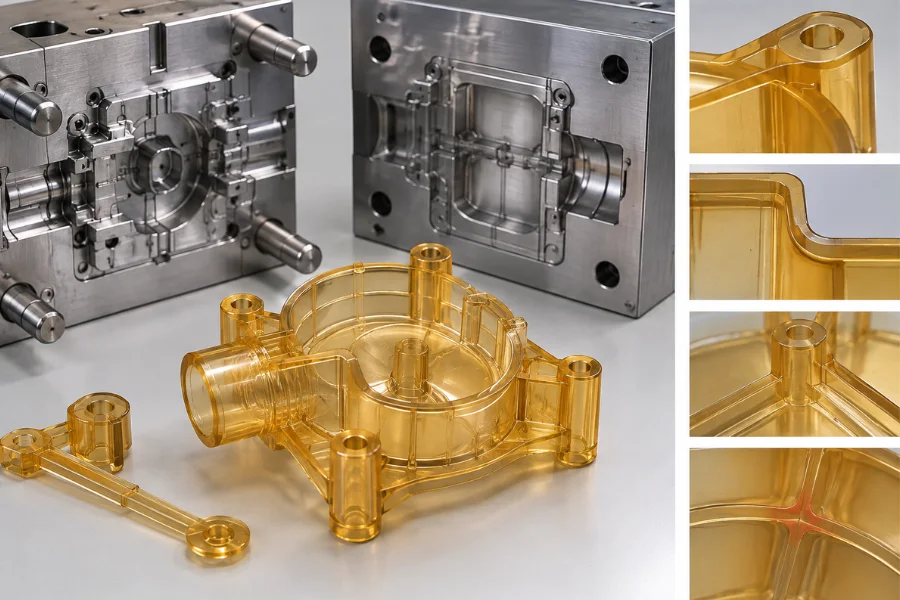
PPSU part design should minimize geometry that creates concentrated stress or forces the molding process into unnecessarily aggressive conditions.
Consistent wall sections and gradual thickness transitions support more uniform filling and cooling. Sharp internal corners deserve particular attention because geometric stress concentration can combine with molded-in stress, assembly loading, and later chemical exposure to increase cracking risk.
Gate position should be evaluated against both the filling pattern and the mechanical function of the part. Moving a weld line away from a highly loaded feature can be more effective than attempting to compensate for poor flow geometry through higher temperature or pressure.
Draft and ejection also matter where the geometry produces strong resistance to release. Excessive ejection force can damage the part or introduce localized stress, making adequate draft and a well-distributed ejection system part of the PPSU DFM strategy.
Finally, elevated mold temperatures require stable thermal control across critical cavity and core regions. Reaching a target mold temperature is not enough if large temperature differences remain across the tool.
PPSU defects should be diagnosed by separating resin preparation, part design, tooling, and processing causes rather than repeatedly adjusting machine settings.
Splay or surface streaks may indicate inadequate drying. Resin moisture should be checked before attempting to solve the appearance problem through injection-speed or pressure changes.
Burn marks or discoloration can result from trapped gas or excessive thermal history. Venting, residence time, melt conditions, and dead spots in the barrel, nozzle, or hot-runner system should be investigated.
Residual stress and stress cracking may originate from restrictive geometry, insufficient mold temperature, aggressive packing, difficult ejection, or assembly loads. Later chemical exposure can accelerate cracking in these stressed regions.
Warpage and dimensional variation often point to imbalances in wall thickness, mold temperature, packing, or cooling. When process adjustments only shift the problem rather than eliminate it, a DFM or tooling correction may be required.
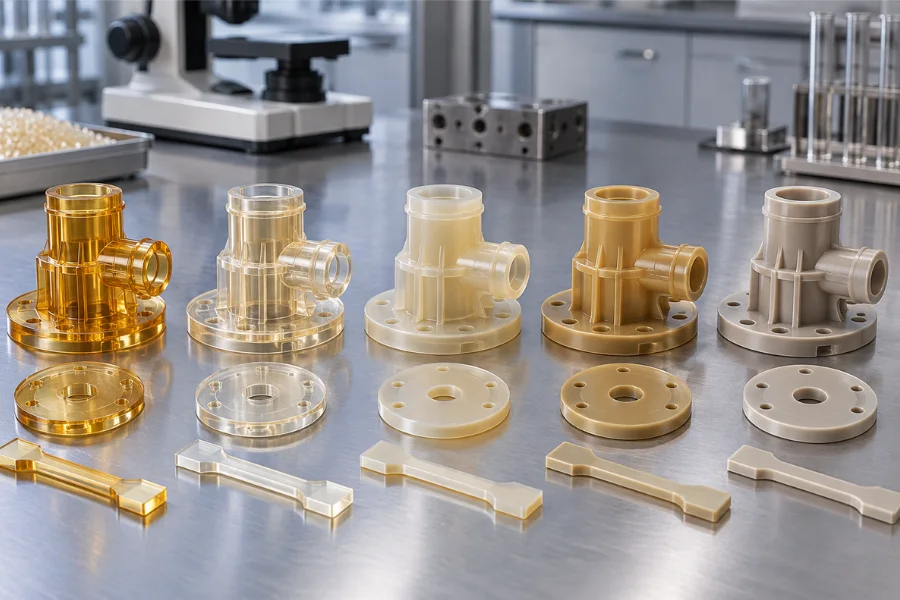
PPSU is commonly evaluated alongside PSU, PESU, PEI, and, for more demanding applications, PEEK. These polymers do not form a simple performance ranking; each offers a different balance of thermal capability, toughness, stiffness, chemical resistance, processability, and cost.
| Engineering Priority | Material Often Considered |
|---|---|
| Repeated steam sterilization combined with high toughness | PPSU |
| General high-temperature polysulfone applications | PSU |
| High thermal performance with stiffness and dimensional requirements | PESU |
| Heat, stiffness, flame resistance, and electrical performance | PEI |
| Very high temperature, chemical resistance, wear, or demanding mechanical service | PEEK may be considered |
PPSU is particularly attractive when toughness and repeated hot-water or steam exposure are central requirements. PSU or PESU may offer a more appropriate property-cost balance when the same level of impact or sterilization performance is unnecessary.
PEI is often considered when stiffness, thermal capability, flame behavior, and electrical properties carry greater weight. PEEK may enter the material-selection process when operating conditions exceed the practical performance envelope of polysulfones, although its substantially different cost and processing requirements also need consideration.
PP is another relevant comparison in reusable food-contact and baby-care products. It offers a much lower-cost solution for many applications, while PPSU becomes easier to justify when repeated high-temperature exposure and impact durability materially affect product life.
The engineering question is not which polymer has the highest overall performance, but which one meets the actual requirements without adding unnecessary material or manufacturing cost.
PPSU applications generally reflect the same combination of thermal exposure, mechanical durability, and hydrolytic stability that drives material selection.
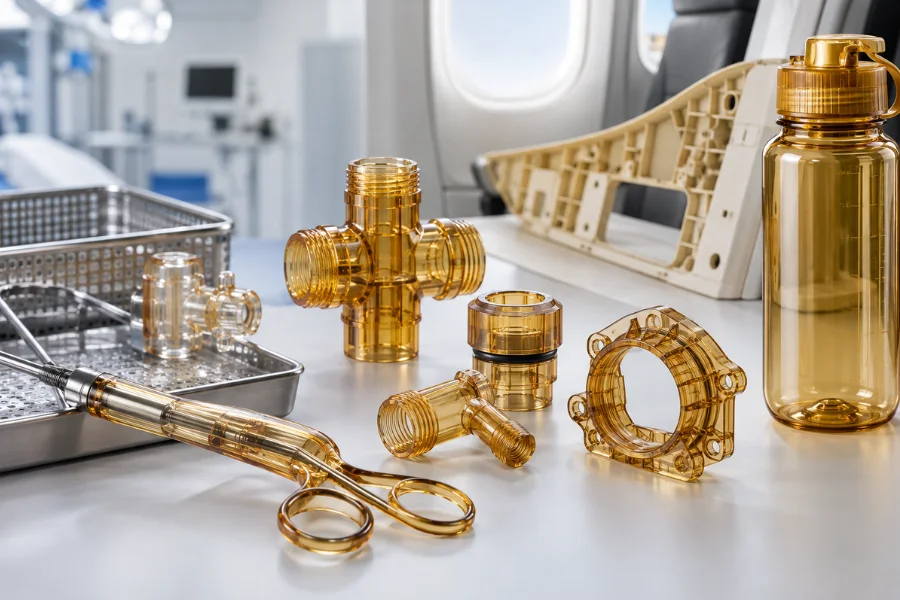
Reusable surgical instrument handles, sterilization trays and cases, trial components, and other medical parts can benefit from PPSU where repeated steam sterilization and mechanical durability are required.
Injection molding can integrate handles, housings, ribs, bosses, and other functional features into a single component, potentially reducing secondary machining or multi-part assembly. PPSU itself does not establish medical compliance; biocompatibility and regulatory suitability must be verified for the selected grade and finished application.
Hot-water fittings, manifolds, valves, and related fluid-handling components can combine temperature, pressure, chemical exposure, and sustained mechanical loading.
PPSU’s hydrolytic stability and toughness make it a candidate for selected molded components in these systems, including applications where polymers are evaluated as alternatives to metal.
Selected PPSU grades are used where toughness, elevated-temperature performance, low weight, and flame behavior are relevant to the component requirements.
Suitability depends on the applicable flame, smoke, toxicity, mechanical, and regulatory specifications. The polymer family alone is not sufficient to establish compliance.
Reusable bottles and food-contact components may experience repeated hot-water cleaning, sterilization, and mechanical handling.
PPSU can be considered when these service conditions justify greater thermal and impact durability than a lower-cost polymer provides. Food-contact suitability remains grade- and market-specific.
PPSU costs considerably more than commodity plastics and many conventional engineering thermoplastics. If PP, PC, PSU, or another polymer already satisfies the operating requirements, specifying PPSU may increase cost without producing a meaningful performance benefit.
Processing also requires high-temperature-capable equipment and elevated mold temperatures. These requirements can increase energy use, tooling demands, startup complexity, and the consequences of poor thermal control.
Chemical resistance should not be interpreted as universal solvent resistance. Compatibility needs to be evaluated under realistic combinations of concentration, temperature, exposure time, and mechanical stress.
Natural PPSU has an amber appearance rather than water-clear optical transparency. Unmodified grades may also have limitations under prolonged UV and outdoor weather exposure, so exterior applications require appropriate grade selection and validation.
PPSU deserves consideration when a component must handle several demanding conditions at the same time:
Its additional material and processing costs become easier to justify when a lower-cost polymer would otherwise crack, distort, embrittle, or require frequent replacement.
For disposable products, low-temperature applications, or parts without demanding hydrolytic and mechanical requirements, a less expensive polymer may be the more efficient choice.
Material selection should begin with operating temperature, sterilization method, chemical exposure, mechanical loading, dimensional requirements, regulatory needs, production volume, and expected service life. PPSU is justified when these requirements make its additional performance useful rather than merely desirable.
Yes. Polyphenylsulfone is an amorphous high-performance thermoplastic that can be melt processed using methods such as injection molding and extrusion.
Yes. PPSU can be injection molded, but its high processing and mold temperatures require suitable equipment and thermal control. Resin drying, gating, venting, geometry, and process conditions all influence production stability.
PPSU has strong hydrolytic stability and is widely used for products exposed to repeated steam sterilization. Actual sterilization capability depends on the resin grade, part design, sterilization conditions, and required end-of-life performance.
Both PPSU and PSU are amorphous high-temperature thermoplastics in the polysulfone family. PPSU is generally considered when greater impact toughness and repeated steam-sterilization performance are required, while PSU provides a different balance of thermal performance, mechanical properties, processing, and cost.
PPSU makes engineering sense when its combination of toughness, heat resistance, hydrolytic stability, and durability addresses a real service-life or failure requirement. For injection-molded parts, those material advantages still depend on grade selection, geometry, tooling, thermal control, and process validation; where less demanding polymers already meet the requirements, PPSU’s additional cost may not be justified.