Physical Address
304 North Cardinal St.
Dorchester Center, MA 02124
Physical Address
304 North Cardinal St.
Dorchester Center, MA 02124
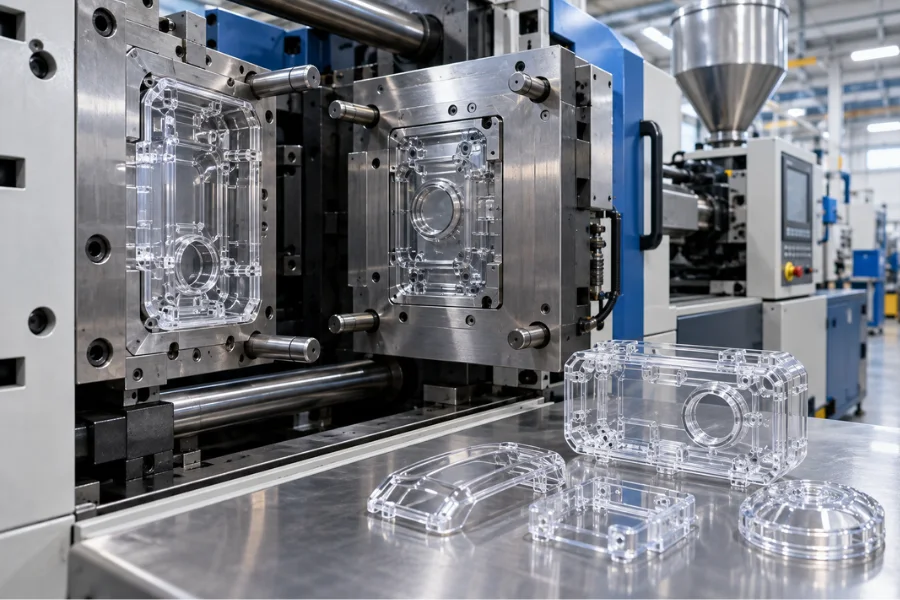
PETG is a transparent thermoplastic copolyester valued for its balance of toughness, clarity, and formability. Its molecular structure is modified to suppress crystallization, giving it different processing behavior from conventional PET.
For injection-molded parts, this difference affects moisture control, melt behavior, shrinkage, surface quality, and dimensional stability. It also influences practical mold decisions such as gate placement, venting, cooling, and ejection when appearance matters.
Understanding PETG starts with its polymer structure, but material selection ultimately depends on how that structure behaves during manufacturing and in the finished part.
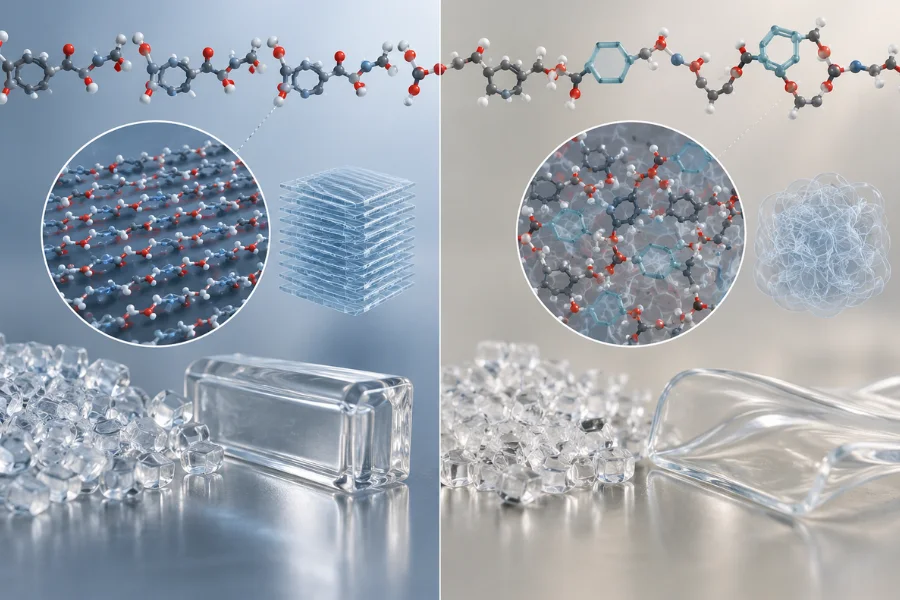
PETG stands for polyethylene terephthalate glycol-modified. It belongs to the thermoplastic polyester family and is generally classified as an amorphous copolyester.
Conventional PET can develop crystalline regions when its molecular chains organize under suitable thermal conditions. PETG uses glycol modification, commonly involving 1,4-cyclohexanedimethanol (CHDM), to disrupt chain regularity and make efficient molecular packing more difficult.
The resulting suppression of crystallization allows PETG to remain predominantly amorphous. This morphology supports its clear appearance and changes its thermal, forming, and molding behavior compared with crystallizable PET.
A simplified relationship is:
Glycol modification → reduced chain regularity → suppressed crystallization → predominantly amorphous structure → different processing behavior
Commercial PETG formulations can vary, so this relationship is more useful than treating PETG as one fixed resin formulation with universal properties or processing parameters.
| Category | PETG |
|---|---|
| Material family | Thermoplastic copolyester |
| Structure | Predominantly amorphous |
| Common modification | Glycol modification, often involving CHDM |
| Key characteristics | Clarity, toughness, and formability |
| Manufacturing methods | Injection molding, extrusion, thermoforming, and other suitable thermoplastic processes |
| Key processing consideration | Moisture and thermal-history control |
The “G” refers to glycol modification. It does not mean that finished PET is simply blended with glycol before processing.
The modification occurs during polymer production and becomes part of the copolyester structure. Depending on the formulation, the comonomer content changes how readily the polymer chains can organize and crystallize.
This distinction matters in manufacturing because polymer morphology influences more than transparency. It also affects how the material responds to heating, forming, cooling, and dimensional change.
PET and PETG belong to the same polyester family, but their crystallization behavior creates different processing priorities.
| Factor | PET | PETG |
|---|---|---|
| Polymer morphology | Crystallizable | Predominantly amorphous |
| Crystallization tendency | Can be significant under suitable conditions | Strongly suppressed |
| Transparency | Can provide high clarity depending on processing and structure | Well suited to clear applications |
| Thermal processing | Crystallization may need to be controlled | Less sensitive to crystallization during forming |
| Forming behavior | Thermal history can affect crystallization and appearance | Easier to form without crystallization-related haze |
| Dimensional behavior | Crystallinity can influence shrinkage | Crystallization-related shrinkage is less significant |
| Typical selection focus | PET-specific stiffness, barrier, or processing requirements | Clarity, toughness, and formability |
PETG should therefore be viewed as a different material option rather than an upgraded version of PET.
PET crystallization can be useful when a process and application are designed around it. PETG instead suppresses crystallization, which can simplify transparent forming while producing a different balance of mechanical, thermal, and dimensional behavior.
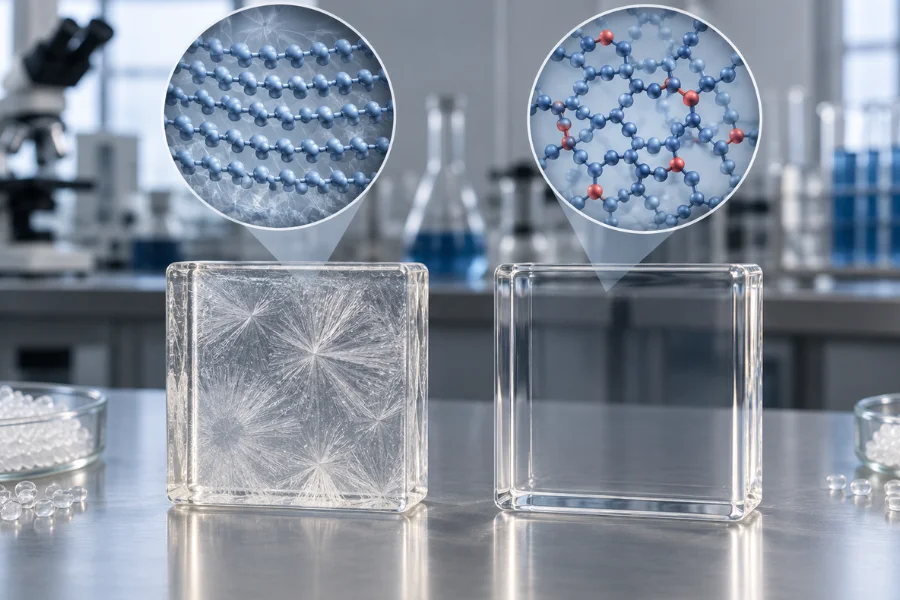
The amorphous morphology of PETG connects directly to several product and manufacturing characteristics.
PETG can maintain a clear appearance because its structure does not readily develop the crystalline regions that can produce haze.
For injection molding, clarity also exposes process defects. Weld lines, flow marks, gate blush, contamination, bubbles, scratches, ejector marks, and other imperfections may remain visible even when the part is dimensionally acceptable.
Transparent components therefore require early coordination between cosmetic requirements, mold finish, flow path, gate location, venting, material handling, and ejection.
PETG is commonly considered when a transparent component also needs resistance to cracking, handling damage, or moderate impact. This combination is useful for covers, housings, containers, guards, and similar parts.
The required stiffness, creep resistance, sustained load capability, temperature exposure, and safety factor still need to be checked against the selected grade. A material that survives impact is not automatically suitable for a highly loaded structural component.
PETG can provide useful chemical resistance, but chemical compatibility depends on more than the polymer name.
Concentration, temperature, exposure duration, applied stress, molded-in stress, and resin grade can all influence performance. Components exposed to cleaners, disinfectants, oils, process fluids, or other chemicals should be evaluated under representative service conditions.
Suppressed crystallization removes one potential source of dimensional variation, but PETG still contracts as it cools.
Wall-thickness changes, asymmetric geometry, uneven packing, residual stress, and nonuniform mold cooling can create differential shrinkage and warpage. Amorphous behavior makes crystallization less important to the shrinkage mechanism; it does not eliminate dimensional-control problems.
PETG can be converted through injection molding, extrusion, thermoforming, and other suitable thermoplastic processes. It is also widely used as filament in fused-filament 3D printing.
Processing parameters from one method should not be transferred directly to another. PETG filament nozzle temperatures, for example, are not injection molding specifications.
For molded production parts, the appropriate processing window depends on the resin grade, machine configuration, residence time, mold, geometry, surface requirements, and production conditions. Supplier processing data should be used as the starting point for a specific grade.
Successful PETG injection molding depends on controlling the resin before melting and managing its thermal and flow history through the molding cycle.
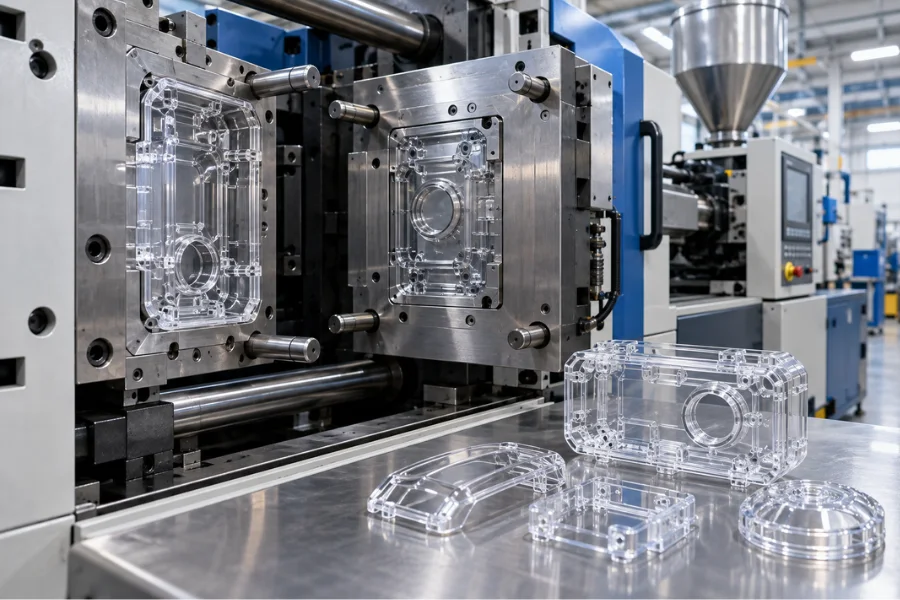
Moisture control is important when melt-processing PETG and other polyester materials.
Excessive moisture at processing temperature can contribute to hydrolytic degradation of the polymer chains. The resulting molecular-weight loss may affect material performance even when the pellets appeared normal before molding.
The mechanism can be summarized as:
Excess moisture → high-temperature melt processing → hydrolysis → chain degradation → reduced material performance
Drying should therefore be treated as part of material preparation rather than only as a way to prevent cosmetic defects.
Required drying temperature, time, dew point, and target moisture level vary by grade and drying system. The resin supplier’s processing recommendations should be confirmed for the actual production setup.
The PETG melt must have sufficient flow to fill the cavity without excessive pressure or premature freezing. Temperature is only one variable controlling this behavior.
Excessive thermal exposure or long residence time can increase degradation risk and may affect color, appearance, or performance. When filling becomes difficult, wall thickness, flow length, gate and runner restrictions, injection speed, venting, shot utilization, and melt condition should be evaluated together.
This is particularly important for clear parts, where changes in the melt history may become visible on the finished surface.
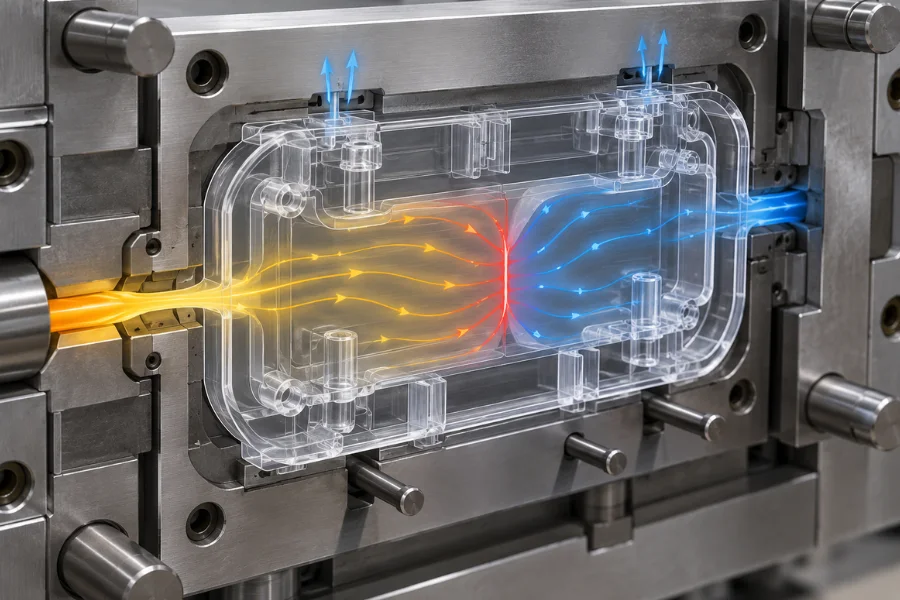
Gate location establishes the initial flow path through the cavity and influences where flow fronts meet.
For transparent PETG parts, a mechanically acceptable weld line can still be a cosmetic defect if it crosses a viewing surface. Gate vestiges and local flow marks can create similar problems.
Venting should also follow the expected flow pattern. Air trapped near the end of fill can interfere with complete filling and contribute to visible defects or localized burning.
Gate and vent decisions are therefore best made with both filling behavior and the part’s cosmetic zones in mind.
Cooling determines when the molded component can be ejected, but it also affects residual stress, shrinkage distribution, and warpage.
Large differences in section thickness create different cooling rates. A thick area can remain hot while an adjacent thin wall has already solidified, producing uneven contraction as the part approaches mold-ejection temperature.
Balanced wall sections and cooling help reduce this variation. PETG’s suppressed crystallization can simplify part of the dimensional-control problem, but geometry and mold thermal balance remain important.
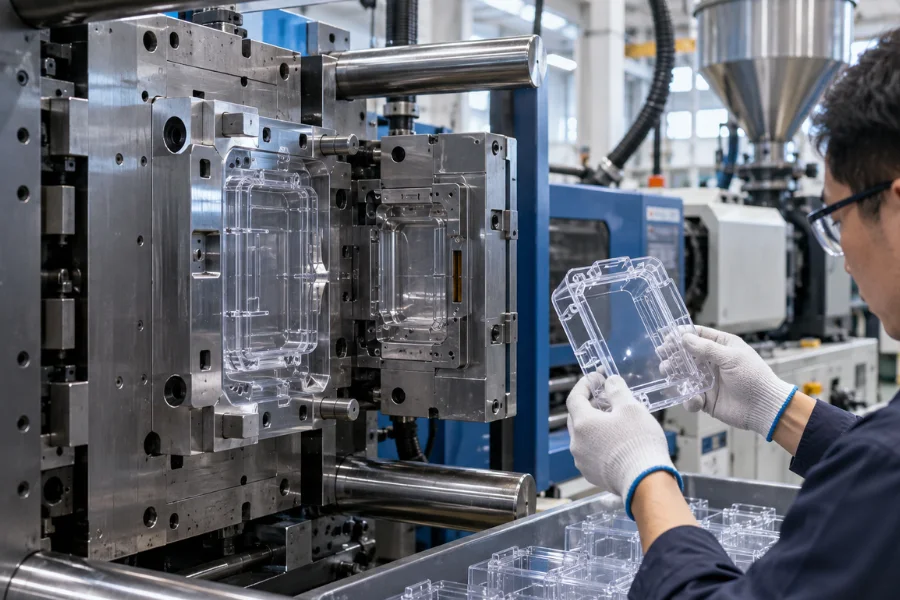
PETG uses many of the same basic DFM principles as other thermoplastics, so generic molding rules do not need to be repeated as material-specific requirements.
The priorities become more PETG-specific when transparency and cosmetic quality matter. Wall transitions should avoid unnecessary differences in cooling behavior, while gates, weld lines, ejector locations, and parting lines should be positioned with visible surfaces in mind.
Draft must support reliable release without scratching or scuffing critical surfaces. Ribs and bosses should provide the required function without creating thick local sections that cool differently from the surrounding wall.
For a clear PETG component, DFM should define not only whether the part can be molded, but also where unavoidable evidence of molding will be acceptable.
Quality criteria should reflect the function of the component. Transparent PETG parts often need visual acceptance standards alongside dimensional requirements.
Typical inspection concerns can include:
A visible defect should not automatically be treated as a machine-setting problem. Material condition, part geometry, gate and vent design, mold condition, and processing variables may all contribute.
For repeat production, visual standards should be defined clearly enough that cosmetic acceptance does not depend solely on individual operator judgment.
The practical value of PETG comes from a combination of properties rather than one exceptional characteristic.
| PETG Characteristic | Manufacturing Benefit | Engineering Consideration |
|---|---|---|
| Predominantly amorphous structure | Supports transparency and reduces crystallization-related haze | Does not eliminate thermal softening or shrinkage |
| Tough behavior | Helps reduce cracking and handling damage | Stiffness and sustained loading still require evaluation |
| Clear appearance | Useful for covers, packaging, displays, and visible components | Cosmetic defects and scratches are easier to see |
| Polyester chemistry | Provides a useful performance balance | Moisture control matters during melt processing |
| Formability | Supports several thermoplastic conversion methods | Processing conditions remain grade-specific |
| Suppressed crystallization | Reduces crystallization-related processing variability | Warpage can still result from geometry, stress, and cooling |
These trade-offs should be evaluated against the actual service environment rather than using a general list of PETG advantages.
PETG applications typically use some combination of clarity, toughness, and formability.
| Application | Why PETG May Fit | What Should Be Verified |
|---|---|---|
| Medical and pharmaceutical packaging | Clarity, toughness, and forming capability | Grade compliance and compatibility with the required sterilization method |
| Food and consumer packaging | Clear appearance and formability | Food-contact status of the specific resin and additives |
| Transparent guards and covers | Visibility with resistance to handling and impact | Load, temperature, chemical exposure, and scratch requirements |
| Displays and cosmetic components | Transparency and appearance flexibility | Surface durability and cosmetic acceptance criteria |
| Injection-molded housings | Toughness, appearance, and moldability | Geometry, dimensions, service temperature, and mechanical loads |
Regulated applications require particular care. Suitability for food contact, medical use, or sterilization depends on the specific resin grade and applicable requirements; it should not be inferred from the PETG material name alone.
PETG is often evaluated alongside acrylic (PMMA) and polycarbonate (PC). Their selection priorities are different.
| Material | Typical Selection Priority | Important Trade-Off |
|---|---|---|
| PETG | Clarity + toughness + formability | Heat capability, stiffness, and surface durability must be checked |
| PMMA | Optical appearance + surface properties | Typically less tolerant of impact than tougher transparent alternatives |
| PC | Higher impact and temperature demands | Different processing, stress, and cost considerations |
This table is a starting point rather than a universal ranking. Grade, geometry, environment, manufacturing method, and required certification can change the material decision.
PETG is a strong candidate when a component needs transparency, toughness, good formability, and compatibility with thermoplastic manufacturing. Its suppressed crystallization is particularly useful when clear appearance and predictable forming are important.
Alternative materials deserve consideration when the application requires very high service temperature, exceptional stiffness, severe chemical exposure, high surface hardness, or demanding structural performance.
For injection molding, the decision should include resin grade, moisture control, geometry, flow path, mold design, cosmetic requirements, dimensional tolerances, and service conditions. These factors determine whether PETG can move from a suitable material on paper to a stable production process.
No. PETG is a glycol-modified copolyester related to PET. The modification suppresses crystallization and gives PETG different forming and processing behavior.
PETG is generally classified as an amorphous copolyester. Glycol modification disrupts molecular regularity and strongly suppresses crystallization, which contributes to its clear appearance and forming behavior.
Yes. Suitable PETG grades can be injection molded into transparent and functional components. Drying and molding conditions should follow the specific resin supplier’s recommendations and be validated with the actual part, mold, and production equipment.
PETG is not the best fit for every transparent component. Service temperature, stiffness, long-term loading, surface scratching, chemical exposure, and dimensional requirements should be checked against the selected grade before production.