Physical Address
304 North Cardinal St.
Dorchester Center, MA 02124
Physical Address
304 North Cardinal St.
Dorchester Center, MA 02124
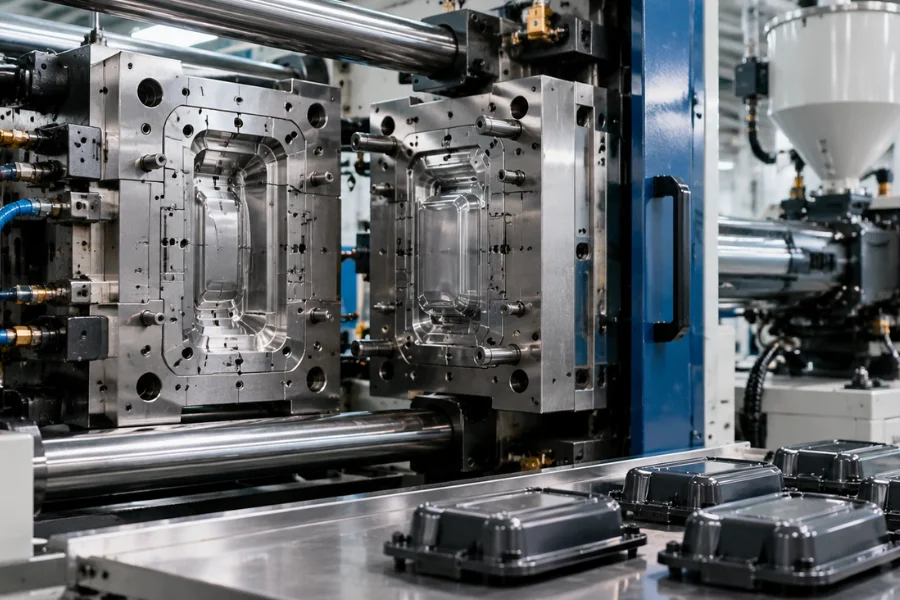
Injection molding cost consists of upfront tooling investment and recurring production expenses. A simple mold may cost several thousand dollars, while complex production tooling can require tens of thousands of dollars or more. Actual costs depend on part geometry, mold construction, material selection, production volume, and quality requirements.
To calculate injection molding cost per part, divide fixed project expenses by the planned production quantity, then add material, machine processing, and other manufacturing costs. Higher volumes spread tooling investment across more parts, but the savings depend on mold capacity, cycle time, and production yield.
Injection molding quotations typically separate tooling investment from recurring production costs. Total project cost combines these expenses with applicable engineering, inspection, and secondary processing charges.
| Cost Category | What It Includes | Main Cost Drivers |
|---|---|---|
| Tooling cost | Mold design, materials, machining, assembly, and testing | Mold complexity, size, cavity count, and expected service life |
| Production cost per part | Resin consumption, machine processing, and production-related expenses | Material price, shot weight, cycle time, machine rate, and yield |
| Total project cost | Tooling, production, and additional expenses | Production quantity, tooling investment, and manufacturing requirements |
The most economical manufacturing strategy depends on production volume and expected product life.
| Production Scenario | Primary Cost Consideration | Potential Strategy |
|---|---|---|
| Prototype or very low volume | Tooling may account for most of the project cost | Evaluate simplified tooling, CNC machining, or 3D printing |
| Low- to medium-volume production | Balance tooling investment against recurring costs | Compare mold complexity and cavity count |
| High-volume production | Cycle time, yield, maintenance, and tool life have greater cumulative effects | Evaluate durable tooling, multiple cavities, and automation |
These categories are relative rather than fixed volume thresholds. A more expensive mold may reduce lifetime costs if it increases production capacity, extends service life, or lowers the cost per acceptable part.
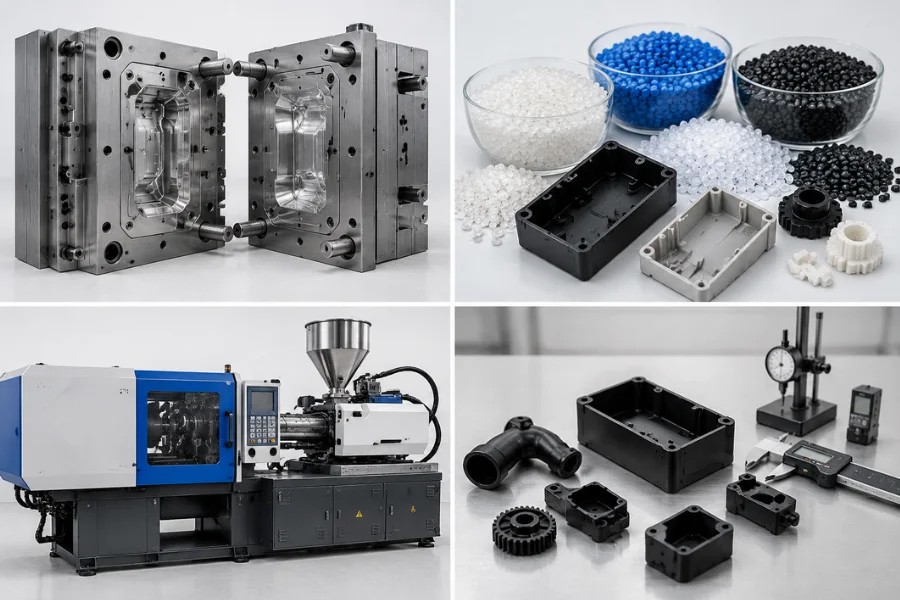
Injection molding expenses fall into two main groups. Fixed costs include tooling and one-time engineering activities, while recurring costs include material consumption, machine processing, quality control, and applicable secondary operations.
Tooling expenses cover mold design, material procurement, machining, assembly, fitting, sampling, and necessary adjustments. The largest cost drivers are usually mold complexity, dimensions, cavity count, material requirements, and surface finish.
Undercuts and complex internal features may require sliders, lifters, or other mechanisms that add machining and maintenance requirements. Tight tolerances and polished surfaces can also increase tooling work.
Mold material should match the expected production conditions. A limited production run may justify simpler tooling, while sustained production or abrasive, fiber-filled resins may require more wear-resistant mold components.
Expected tool life should be evaluated in molding cycles, not just finished-part quantity. A single-cavity mold requires at least 100,000 cycles to produce 100,000 acceptable parts. A four-cavity mold theoretically requires 25,000 cycles for the same output if all four cavities produce acceptable parts on every cycle.
These figures describe production requirements, not guaranteed mold life. Wear, maintenance, material abrasiveness, and operating conditions affect how long a mold remains serviceable.
Standard mold bases, ejector components, and guide elements can reduce custom machining and simplify replacement. Their use must still meet the mold’s mechanical, dimensional, and production requirements.
Material cost depends on resin price and the amount consumed per acceptable component. Total shot weight includes the molded parts and, where applicable, the sprue and runner system.
A simplified calculation is:
Material cost per part = Total shot weight × Resin price per kilogram ÷ Acceptable parts per cycle
In mathematical notation:
Cₘₐₜₑᵣᵢₐₗ = (Wₛₕₒₜ × Pᵣₑₛᵢₙ) ÷ n
Where:
For example, a two-cavity mold producing two 40 g parts with a 10 g cold runner consumes 90 g of material per cycle.
Total shot weight = (2 × 40 g) + 10 g = 90 g
Material weight allocated per part = 90 g ÷ 2 = 45 g = 0.045 kg
At a resin price of $3/kg:
Material cost per part = 0.045 kg × $3/kg = $0.135
This calculation assumes all molded parts are acceptable and runner material is not recovered. In actual production, material cost per good part should account for startup losses, rejected components, and any material recovered for reuse.
For production with variable yield or material recovery, calculate net material cost divided by the actual number of acceptable parts:
Material cost per good part = Net material cost consumed ÷ Number of acceptable parts
Material recovery must comply with the product’s quality requirements. Some applications restrict reprocessed resin because of mechanical performance, cleanliness, or traceability considerations.
Machine processing cost depends on the machine hourly rate and the time required to produce acceptable components.
The molding cycle includes mold closing, injection, packing, cooling, opening, and ejection. A 30-second cycle theoretically produces 120 cycles per hour. With two productive cavities, that equals 240 parts per hour before downtime or rejected parts.
The theoretical cycle rate is:
Cycles per hour = 3,600 ÷ Cycle time in seconds
For a 30-second cycle:
Cycles per hour = 3,600 ÷ 30 = 120
Theoretical parts per hour can be calculated as:
Parts per hour = Cycles per hour × Number of cavities
For a two-cavity mold:
Parts per hour = 120 × 2 = 240
These figures represent theoretical output, not guaranteed acceptable production. Downtime, rejected parts, and cavity-specific defects can reduce actual output.
Machine selection affects processing cost. The equipment must accommodate the mold dimensions, shot volume, plasticizing requirements, injection performance, and clamping force.
More cavities do not automatically reduce total unit cost. A larger mold may require a more expensive machine, a longer cycle, additional cooling capacity, or a different runner configuration.
Machine processing cost per acceptable part can be estimated as:
Processing cost per good part = Machine hourly rate × Cycle time in seconds ÷ (3,600 × Acceptable parts per cycle)
In mathematical notation:
Cₚᵣₒ꜀ₑₛₛᵢₙg = (Rₘₐ꜀ₕᵢₙₑ × t꜀ᵧ꜀ₗₑ) ÷ (3,600 × n₉ₒₒd)
Where:
This simplified formula assumes continuous production at the stated cycle time. If yield is below 100%, allocate machine costs across actual acceptable output rather than theoretical cavity output. Machine rates and efficiency assumptions must also be consistent to avoid counting downtime, labor, or overhead twice.
Additional expenses may include machine setup, material preparation, production monitoring, inspection, trimming, assembly, and packaging.
Medical plastic components may also require project-specific material traceability, documented process controls, inspection records, or validation activities, depending on their intended use and applicable quality requirements.
Avoid double-counting these expenses. If the machine hourly rate already includes operator labor, energy, depreciation, or allocated manufacturing overhead, do not add the same costs separately.
Injection molding cost per part combines allocated fixed expenses with recurring costs per acceptable component. The calculation must use consistent assumptions for production quantity, material consumption, machine rates, and yield.
Total project cost can be expressed as:
Total project cost = Fixed costs + Production quantity × Variable cost per good part
In mathematical notation:
Cₜₒₜₐₗ = C𝒻ᵢₓₑd + Q × Cᵥₐᵣᵢₐᵦₗₑ
Where:
The estimated unit cost is:
Cost per part = Fixed costs ÷ Production quantity + Material cost + Processing cost + Additional cost
In mathematical notation:
Cₚₐᵣₜ = (C𝒻ᵢₓₑd ÷ Q) + Cₘₐₜₑᵣᵢₐₗ + Cₚᵣₒ꜀ₑₛₛᵢₙg + Cₐddᵢₜᵢₒₙₐₗ
All unit-cost terms must refer to the same basis, such as cost per acceptable part.
Tooling allocation depends on the costing method. If the entire mold investment is assigned to the first order, divide it by that order’s quantity. If the mold will serve multiple orders, evaluate its cost over the planned lifetime production quantity.
Tooling cost allocated per part is:
Tooling cost per part = Total tooling investment ÷ Production quantity used for allocation
For example, a $12,000 mold contributes $0.60 per part when allocated across 20,000 parts, or $0.12 per part when allocated across 100,000 parts.
These are alternative allocation methods, not separate charges. If tooling is paid for separately, do not add it again to a production quotation that already includes tooling recovery.
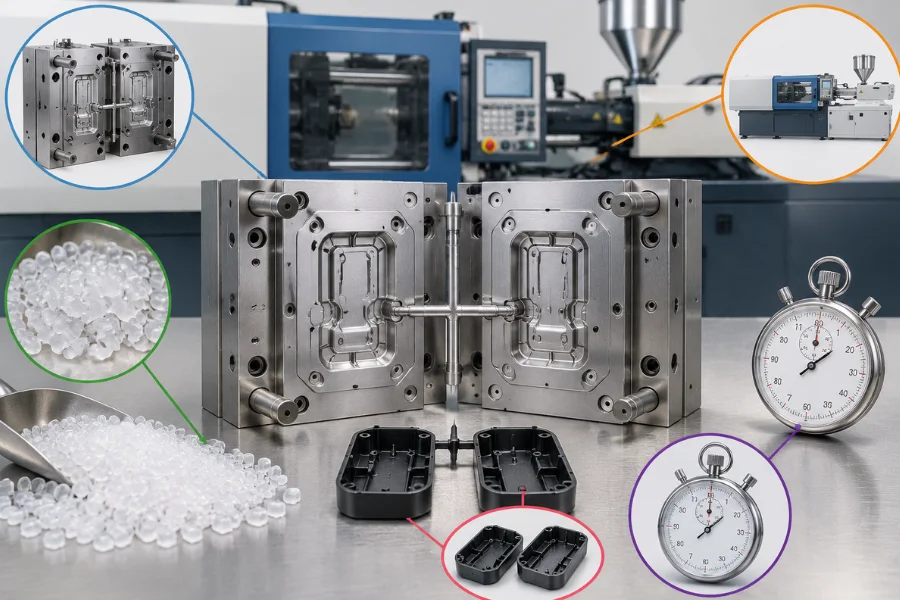
Consider a hypothetical production program requiring 20,000 plastic components. The entire tooling investment is allocated to this order.
| Cost Parameter | Assumed Value |
|---|---|
| Mold cost | $12,000 |
| Production quantity | 20,000 parts |
| Part weight | 40 g |
| Cold runner weight | 10 g per shot |
| Resin price | $3/kg |
| Mold cavities | 2 |
| Cycle time | 30 seconds |
| Machine hourly rate | $60/hour |
Assume all parts are acceptable, production runs continuously, no runner material is recovered, and no additional charges apply beyond those calculated.
Step 1 — Calculate tooling cost per part
Tooling cost per part = $12,000 ÷ 20,000 = $0.600
Step 2 — Calculate material cost per part
Total shot weight = (2 × 40 g) + 10 g = 90 g
Material weight per part = 90 g ÷ 2 = 45 g = 0.045 kg
Material cost per part = 0.045 kg × $3/kg = $0.135
Step 3 — Calculate machine processing cost
Processing cost per part = ($60/hour × 30 seconds) ÷ (3,600 seconds/hour × 2 parts)
Processing cost per part = $0.250
Step 4 — Calculate total estimated cost per part
Total cost per part = $0.600 + $0.135 + $0.250 = $0.985
The simplified manufacturing cost is approximately $0.99 per part.
| Cost Component | Cost per Part |
|---|---|
| Tooling allocation | $0.600 |
| Plastic material | $0.135 |
| Machine processing | $0.250 |
| Total estimated cost | $0.985 |
This estimate excludes separate setup charges, inspection, secondary operations, packaging, transportation, scrap, and other project-specific expenses. It illustrates manufacturing cost rather than a complete supplier selling price.
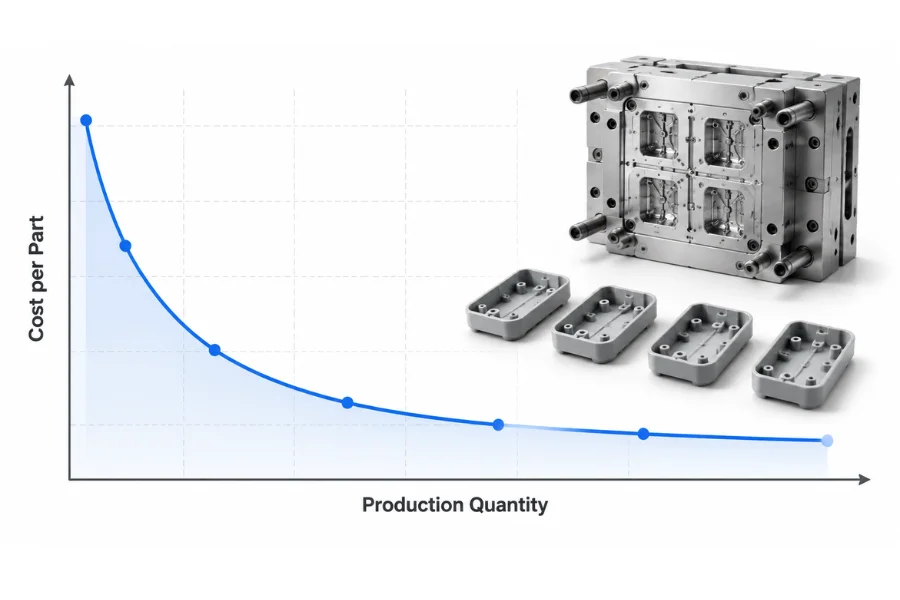
Production volume reduces the fixed tooling cost allocated to each component. Using the same $12,000 mold and assuming material and processing costs remain unchanged, the unit cost varies as follows.
| Production Quantity | Tooling Allocation per Part | Material and Processing Cost | Total Estimated Cost per Part |
|---|---|---|---|
| 1,000 | $12.000 | $0.385 | $12.385 |
| 20,000 | $0.600 | $0.385 | $0.985 |
| 100,000 | $0.120 | $0.385 | $0.505 |
This comparison assumes the same mold can meet all three production requirements without additional tooling, major repairs, or changes in production conditions. Higher volumes may justify different cavity counts, more durable tooling, or automation, which changes both fixed and recurring costs.
Part geometry, material behavior, tooling configuration, and production requirements affect either the initial investment or the cost of each acceptable component.
Thick sections consume more resin and may require longer cooling. They can also increase the risk of sink marks or internal voids when packing and cooling are insufficient.
Reducing unnecessary wall thickness can lower material consumption and cooling requirements, but excessively thin walls may increase filling pressure, cause short shots, or narrow the process window. Wall thickness should reflect structural requirements, flow length, resin behavior, and manufacturability.
Undercuts can require sliders, lifters, or collapsible cores because the part cannot be ejected through a straight mold-opening motion. These mechanisms increase tooling complexity and may add maintenance or cycle-time requirements.
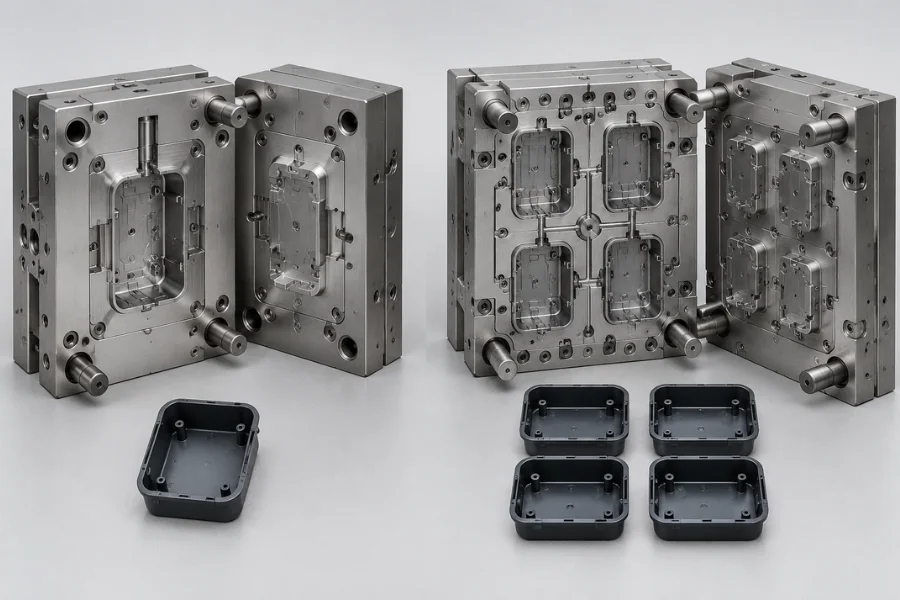
Increasing cavity count can lower machine processing cost per part, but it raises tooling investment and may require more complex filling, cooling, and ejection systems. The economic benefit depends on production quantity and the extra investment required.
Consider two hypothetical tooling options for the same component.
| Parameter | Single-Cavity Mold | Four-Cavity Mold |
|---|---|---|
| Tooling investment | $8,000 | $20,000 |
| Cycle time | 30 seconds | 36 seconds |
| Machine hourly rate | $50 | $80 |
| Parts per cycle | 1 | 4 |
| Machine processing cost per part | $0.416667 | $0.200000 |
The four-cavity mold reduces theoretical machine processing cost by approximately $0.216667 per part but requires an additional $12,000 in tooling investment.
The break-even production quantity is calculated by dividing the additional tooling investment by the processing-cost savings per part:
Break-even quantity = Additional tooling investment ÷ Processing-cost savings per part
Additional tooling investment = $20,000 − $8,000 = $12,000
Single-cavity processing cost per part = ($50/hour × 30 seconds) ÷ (3,600 seconds/hour × 1 part) ≈ $0.416667
Four-cavity processing cost per part = ($80/hour × 36 seconds) ÷ (3,600 seconds/hour × 4 parts) = $0.200000
Processing-cost savings per part = $0.416667 − $0.200000 ≈ $0.216667
Break-even quantity = $12,000 ÷ $0.216667 ≈ 55,385 parts
The theoretical break-even quantity is approximately 55,400 acceptable parts.
Under these assumptions, the four-cavity mold becomes more economical at approximately 55,400 acceptable parts. Below that quantity, the single-cavity mold has the lower combined tooling and machine processing cost.
This model excludes differences in material consumption, maintenance, yield, and other expenses. The selected cavity count must also meet machine clamping force, injection capacity, runner balance, cooling performance, and dimensional requirements.
Material selection affects resin cost, processing conditions, and tooling requirements. Different thermoplastics have different melt temperatures, shrinkage behavior, thermal properties, and moisture sensitivity.
Some engineering thermoplastics require controlled drying or higher processing temperatures, which can affect equipment requirements and production efficiency. Glass fibers and certain mineral fillers can increase abrasive mold wear, while some resin formulations may require greater corrosion resistance.
Mold material should therefore match expected production cycles, polymer characteristics, surface finish, and maintenance conditions. A higher initial tooling investment may be justified when it reduces wear-related repairs or premature replacement over the planned production life.
For a fixed machine hourly rate and cavity count, a shorter cycle generally reduces machine processing cost per part.
Cooling time depends on part thickness, polymer thermal properties, melt and mold temperatures, and heat transfer through the mold. Improving cooling channel effectiveness or reducing unnecessary thick sections may shorten the cycle.
However, ejecting parts before they have sufficient rigidity can cause deformation, dimensional instability, or surface damage. If a faster cycle increases rejection rates, the added scrap and processing losses may outweigh the time savings. The target is the shortest stable cycle that consistently meets part requirements.
Tight tolerances may require more precise mold machining, careful fitting, stable processing conditions, and additional inspection. Highly polished or textured surfaces can also increase mold finishing costs.
Applying demanding surface finishes only to functional or visible areas can avoid unnecessary tooling work.
Quality requirements may add further costs. Depending on their intended use, medical plastic components may require specific inspection, material traceability, documented process controls, or validation activities. Establishing these requirements before tooling development reduces the risk of expensive late-stage modifications.
Cost reduction should target the design and production variables that drive the largest expenses without compromising part function or quality.
Review undercuts, side holes, and other features that require complex mold actions. If the product function permits a different parting line or geometry, eliminating a slider or other mechanism can reduce machining, assembly, and maintenance costs.
Identify localized thick sections that contribute little to structural performance. Where appropriate, a more uniform wall structure or carefully designed reinforcing ribs can reduce resin consumption and cooling requirements.
Check any changes for filling performance, sink marks, warpage, stiffness, and dimensional stability before finalizing the design.
Compare tooling investment and recurring costs over expected lifetime production, not just the first order. A multi-cavity mold is economically justified when the expected recurring savings exceed its additional tooling investment.
Include machine capacity, achievable cycle time, material consumption, maintenance, and yield in the comparison. A single-cavity mold may remain more economical for short runs despite its higher processing cost per part.
Cold runner molds may cost less upfront, but sprues and runners add material consumption. Hot runner systems can reduce or eliminate conventional cold runner scrap, but require additional tooling investment, temperature control, and maintenance.
The break-even production quantity is:
Break-even quantity = Additional tooling investment ÷ Net cost savings per acceptable part
If a hot runner system costs an additional $6,000 and saves a net $0.10 per acceptable part:
Break-even quantity = $6,000 ÷ $0.10 = 60,000 parts
The theoretical break-even quantity is 60,000 acceptable parts. This example assumes constant savings and excludes the time value of money.
Material savings must reflect the actual cost of unrecovered runner material, not the full runner weight automatically. Net savings should also account for processing, maintenance, and yield differences. If net savings are zero or negative, the investment cannot be recovered through recurring cost reductions under this model.
Focus on stable processing through effective cooling, consistent resin preparation, balanced filling, and reliable ejection. Improving cooling may shorten the cycle, but any change must preserve dimensional stability, appearance, and mechanical performance.
A slightly longer cycle with higher acceptable-part yield can cost less overall than a faster cycle that generates excessive scrap.
Compare quotations using identical technical specifications, production quantities, and cost assumptions.
| Quotation Item | What to Verify |
|---|---|
| Part design | CAD model, drawing revision, tolerances, and surface finish |
| Material specification | Resin grade, additives, color, and approved alternatives |
| Production requirements | Initial order quantity, annual demand, and expected lifetime volume |
| Tooling construction | Mold material, cavity count, runner system, and expected service life |
| Production pricing | Unit price, setup charges, and quantity assumptions |
| Quality requirements | Inspection, testing, documentation, and applicable validation |
| Additional operations | Assembly, trimming, packaging, and secondary processing |
| Tooling ownership | Ownership terms, maintenance, repairs, and modification responsibilities |
Confirm whether mold sampling, initial adjustments, and production approval activities are included.
Tooling charges and unit prices must be evaluated together. One supplier may charge the mold separately and quote a production-only unit price, while another may recover part of the tooling investment through the unit price. Compare total expected costs over the same production quantity.
For long-term programs, tooling durability, maintenance responsibilities, and production stability may matter as much as the initial mold price.
Injection molding requires a purpose-built mold designed to withstand repeated injection pressure, thermal cycling, and mechanical operation. Engineering, precision machining, assembly, fitting, and production trials create costs before manufacturing begins. These expenses can be distributed across larger production quantities.
Injection molding can be economical when tooling investment matches the required quantity. Simplified molds or bridge tooling may reduce upfront expenses. For very small runs or frequently changing designs, CNC machining or 3D printing may offer lower total costs.
More cavities produce more components per cycle, potentially reducing machine processing cost per part. However, additional cavities increase tooling investment and may require larger equipment or more complex cooling and filling systems. The benefit depends on production quantity, cycle time, machine capacity, and tooling cost.
No. Different plastics have different processing temperatures, drying requirements, shrinkage characteristics, and molding behavior. Some materials also affect tool wear, cycle time, or production yield. Material selection should balance purchase price, functional performance, processing efficiency, and tooling requirements.
Manufacturers typically need a 3D CAD model, technical drawings, material specifications, production quantity, and dimensional tolerances. Surface finish, color, inspection, and assembly requirements should also be provided. Annual demand and expected product lifetime help determine suitable mold materials, cavity count, and tooling construction.
Injection molding cost depends on tooling investment, material consumption, machine processing, and production volume. Accurate estimates require consistent cost assumptions and an understanding of how part geometry, cavity count, cycle time, and quality requirements affect manufacturing expenses. Comparing these variables over the expected production life helps engineers and procurement teams choose tooling and production strategies that meet performance requirements while controlling total cost.