Physical Address
304 North Cardinal St.
Dorchester Center, MA 02124
Physical Address
304 North Cardinal St.
Dorchester Center, MA 02124
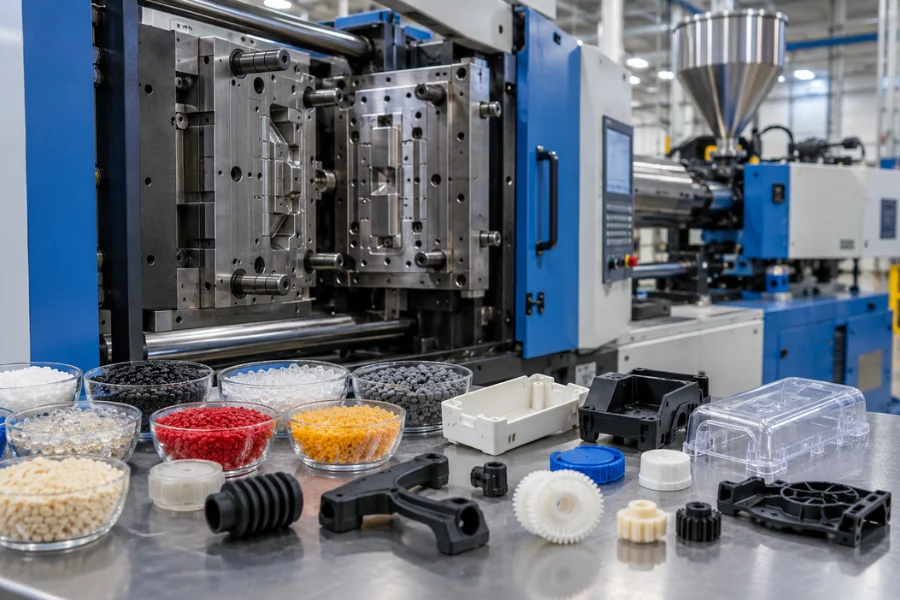
Injection molding can process a broad range of polymers, but choosing a resin involves more than matching strength, temperature resistance, or price. Material behavior also affects cavity filling, shrinkage during cooling, dimensional stability, cycle requirements, and what the mold and processing equipment must accommodate.
A practical injection molding material selection considers three areas together: part performance, molding behavior, and production requirements. A resin that performs well in service can still create manufacturing problems if its flow, shrinkage, moisture sensitivity, or processing requirements do not match the part geometry and mold design.
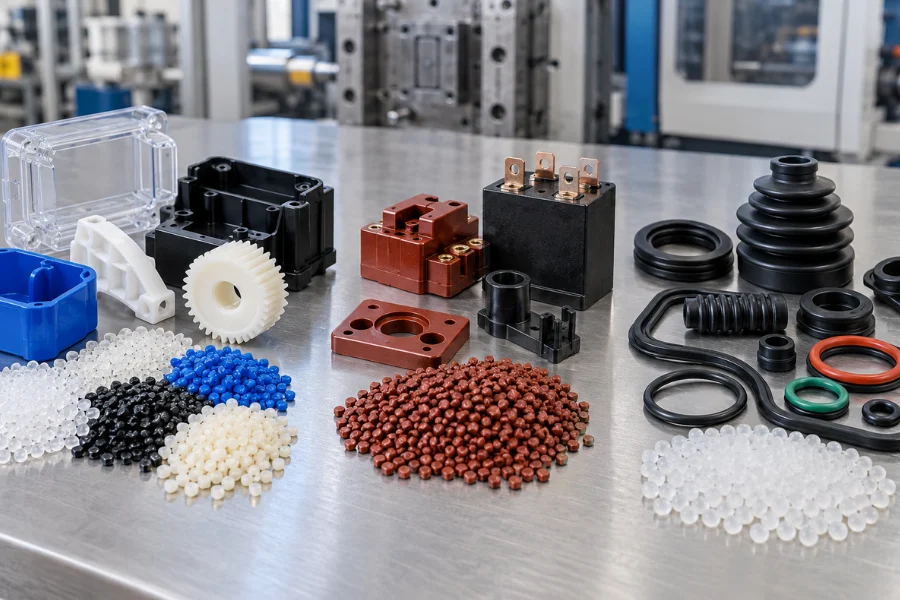
Injection molding can process three major polymer groups: thermoplastics, thermosets, and elastomers. Their response to heat determines how they are processed and whether the material can be reheated after molding.
Thermoplastics soften or melt when heated and solidify when cooled. Because this change is reversible, they can generally be reheated and reshaped.
They represent the most widely used thermoplastic materials for injection molding, including ABS, polypropylene (PP), polyethylene (PE), polycarbonate (PC), nylon (PA), and acetal (POM).
For molding decisions, another distinction matters: amorphous versus semi-crystalline thermoplastics.
| Structure | Common Materials | General Molding Implication |
|---|---|---|
| Amorphous | ABS, PC, PMMA, PVC | Generally lower and more predictable shrinkage |
| Semi-crystalline | PP, PE, PA, POM, PBT, PET | Often greater shrinkage and warpage sensitivity |
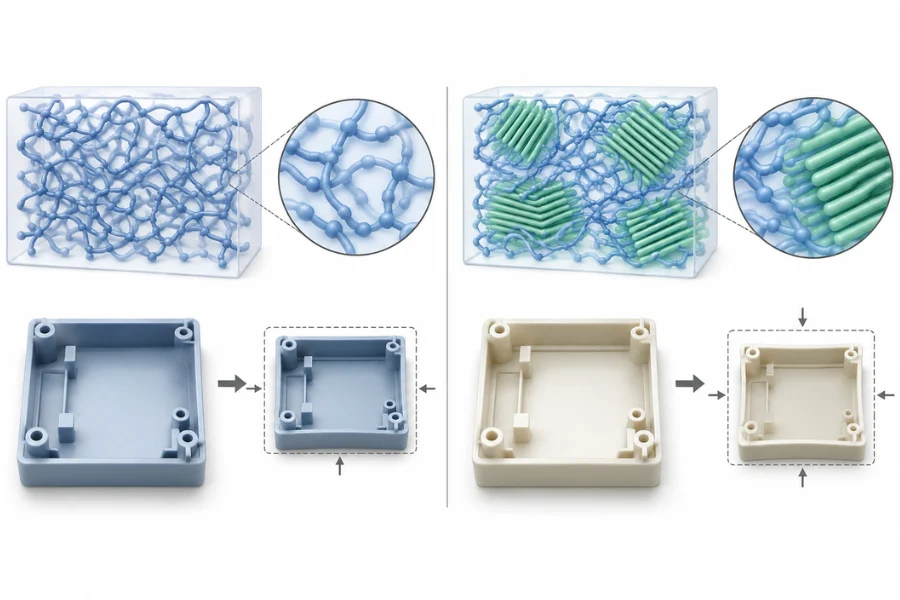
Amorphous polymers have randomly arranged molecular chains, while semi-crystalline polymers develop both ordered crystalline regions and amorphous regions as they cool.
Crystallization contributes additional volumetric change during cooling. As a result, semi-crystalline materials generally require more attention to shrinkage compensation, wall uniformity, packing, cooling, and warpage control.
Thermosetting plastics undergo an irreversible chemical reaction during curing. Once cross-linked, they cannot simply be reheated and remelted.
Phenolic resins, epoxy systems, and certain polyurethane and silicone materials fall within this category. Their cross-linked structures can provide heat resistance, dimensional stability, strength, and electrical insulation, but processing must accommodate curing rather than the melt-solidify cycle used for thermoplastics.
Elastomers deform under load and recover toward their original shape when the load is removed, making them useful for seals, cushioning, and flexible components.
Traditional rubber and silicone systems require processing appropriate to their chemistry. Thermoplastic elastomers (TPEs) and thermoplastic polyurethane (TPU) combine rubber-like flexibility with thermoplastic processing behavior and are commonly considered for seals, grips, gaskets, and soft-touch overmolding.
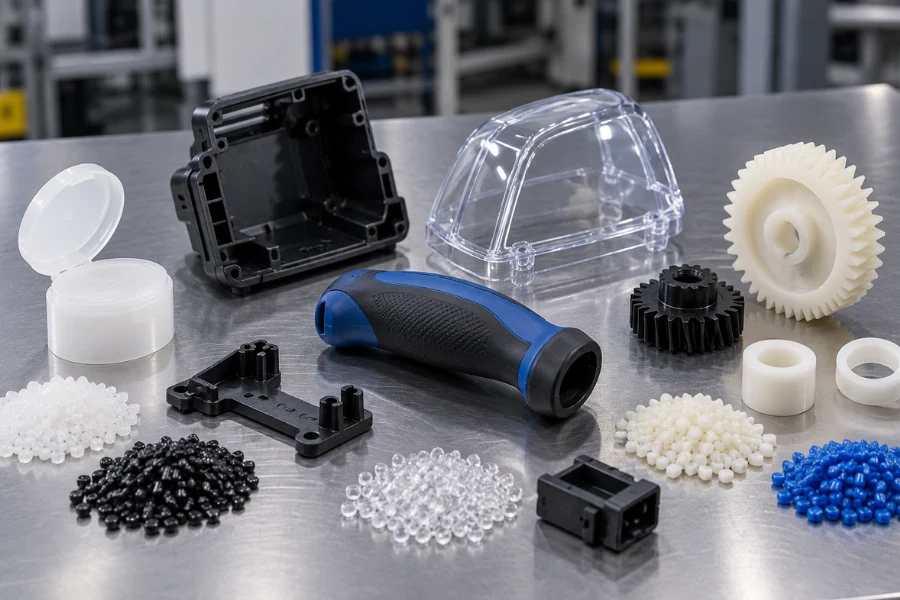
This table provides a starting point for plastic resin selection rather than a final material specification. Specific grades, fillers, additives, and supplier formulations can change both processing behavior and finished-part performance.
| Material | Why It Is Considered | Main Molding Concern | Typical Parts |
|---|---|---|---|
| PP | Chemical and fatigue resistance, low cost | Shrinkage and warpage | Living hinges, closures, containers |
| PE | Toughness and chemical resistance | Relatively high shrinkage | Containers, caps, industrial parts |
| PS | Rigidity, clarity, economical processing | Brittleness | Packaging, disposable parts, housings |
| ABS | Impact resistance and surface finish | Sink/void risk in thick sections | Cosmetic and electronic housings |
| PC | Impact strength, transparency, heat capability | Processing and stress sensitivity | Protective covers, lenses, housings |
| PA | Strength, wear resistance, low friction | Moisture and warpage | Gears, bearings, structural parts |
| POM | Stiffness, low friction, dimensional stability | Semi-crystalline shrinkage | Gears, bushings, mechanisms |
| TPE/TPU | Flexibility and impact absorption | Draft, shrinkage, bonding | Seals, grips, overmolded features |
| PEEK | Thermal and chemical performance | High processing and tooling demands | High-performance mechanical parts |
The useful question is not which resin has the highest property value. It is whether the required properties can be achieved consistently in the actual molded geometry, manufacturing process, and service environment.
PP, PE, and PS are widely used when production economics matter and the application does not require the performance of an engineering resin.
PP’s fatigue and chemical resistance make it useful for closures, containers, and repeated-flex features such as living hinges. Its semi-crystalline structure, however, also produces meaningful molding shrinkage.
Uneven walls and cooling can turn that shrinkage into dimensional variation or warpage. Thick regions can also increase sink and void risk, so geometry and cooling strategy remain important even when PP is selected primarily for cost and functional performance.
PE ranges from flexible LDPE grades to more rigid HDPE grades and is widely used where toughness, moisture resistance, and chemical resistance are required.
For injection molding, dimensional control can become the larger issue. Its semi-crystalline structure and relatively high shrinkage mean cavity sizing, wall uniformity, packing, and cooling need to match the tolerance requirements of the component.
PS provides rigidity, electrical insulation, and clarity in appropriate grades, but its brittleness limits applications requiring significant impact resistance.
High-impact polystyrene (HIPS) can provide greater toughness. The choice between PS, HIPS, and a tougher engineering resin should therefore be driven by the actual mechanical and environmental demands rather than cost alone.
Engineering plastics become relevant when the design requires a more demanding combination of impact resistance, stiffness, heat performance, wear resistance, surface quality, or dimensional control.
ABS combines toughness, impact resistance, good surface quality, and relatively manageable shrinkage. It is commonly used for snap-fit housings, handheld enclosures, appliance components, and other cosmetic parts.
Geometry still affects the result. Thick bosses, ribs, or wall transitions can develop sink or internal voids because their cores cool and contract later than surrounding sections. Uniform walls and appropriate rib and boss proportions therefore remain important even with a relatively mold-friendly resin.
Heat and UV performance depend on the specific ABS grade and additives and should be checked against the intended environment.
PC is considered when impact resistance, transparency, dimensional stability, or elevated-temperature performance drives the design. Typical parts include transparent protective covers, lighting components, and structural housings.
Processing is generally more demanding than with many commodity plastics. Restrictive flow paths can require careful control of material and mold conditions, while thick sections can increase sink, bubble, or void risk.
Chemical compatibility also matters. Residual molding or assembly stress combined with an incompatible chemical environment can increase susceptibility to environmental stress cracking.
Nylon is commonly considered for gears, bearings, brackets, pump components, and wear-loaded mechanical parts because of its strength, fatigue performance, wear resistance, and relatively low friction.
Moisture and dimensional behavior require attention. Nylon can absorb moisture after molding, affecting both dimensions and mechanical properties, while its semi-crystalline structure contributes to molding shrinkage and warpage.
Glass-filled grades add stiffness but also introduce directional shrinkage and increased tooling wear. These effects need to be considered when planning gate location, flow direction, and dimensional control.
POM combines stiffness, low friction, wear resistance, and good dimensional stability in service, making it suitable for gears, bushings, valves, and precision moving mechanisms.
Its semi-crystalline structure still produces significant molding shrinkage. Cavity dimensions must reflect the intended grade, while uniform walls and balanced cooling help reduce differential contraction.
Its low-friction surface can also complicate some painting, coating, and bonding operations.
TPE and TPU provide rubber-like flexibility with thermoplastic processing behavior. For seals, grips, gaskets, and overmolded features, hardness is only one consideration; shrinkage, draft, ejection, chemical exposure, and substrate adhesion can also determine whether the material works in production.
PEEK is used when demanding thermal, chemical, and mechanical requirements justify a high-performance resin. Its processing temperatures place greater demands on molding equipment, mold temperature control, tooling, and process stability than conventional commodity plastics.
This creates an important trade-off:
Required Performance → Processing Requirements → Tooling and Process Control → Production Cost
Other resins such as PBT, PET, PPS, PEI, and PPSU provide different combinations of thermal, electrical, dimensional, and chemical performance. They should be screened against application requirements rather than ranked by a single property.
A resin does not behave independently of the mold. Flow, cooling, geometry, gates, fillers, and processing conditions interact to determine the finished component.
Material viscosity interacts directly with wall thickness, flow length, gate location, injection pressure, and mold temperature.
A difficult-flowing resin combined with long, thin geometry may require greater pressure or different thermal conditions to fill the cavity. If the available processing window becomes too narrow, short shots or weak weld lines may result.
Changing the injection molding resin can therefore change whether the existing geometry and gate strategy remain practical.
All polymers contract during cooling, but the magnitude and direction of contraction depend on the material and process.
The basic relationship is:
Polymer Structure → Cooling/Crystallization → Shrinkage → Cavity Compensation → Finished Dimensions
Semi-crystalline materials generally undergo greater volumetric change during solidification. Uneven wall thickness, packing, cooling, or orientation can make that shrinkage nonuniform and distort the part.
A nominal material shrinkage value therefore cannot guarantee finished dimensions.
Hygroscopic engineering plastics require controlled material handling before molding. Inadequate drying can affect processing, appearance, and material performance.
Moisture can remain relevant after production. Nylon, for example, can absorb moisture from its service environment and undergo dimensional and mechanical changes.
Material qualification should therefore consider both pre-molding moisture control and in-service exposure.
Many high-temperature engineering polymers require more demanding thermal processing conditions.
Higher melt or mold temperatures may require appropriate temperature-control equipment, suitable mold construction, longer stabilization, and tighter process control. The effect can extend to machine selection, energy consumption, cycle economics, and tooling.
Glass fiber and other reinforcements can increase stiffness and structural performance while changing flow, shrinkage, surface appearance, and tool wear.
Fiber orientation follows the cavity flow pattern. A gate that creates strongly directional flow can therefore contribute to anisotropic shrinkage and warpage, particularly in geometries where different regions orient differently.
This type of distortion may not be solved by a single process adjustment. Gate location, part geometry, flow pattern, and cooling may all need to be evaluated together.
Abrasive fillers can also accelerate wear at gates, runners, screws, barrels, and mold surfaces. Resin formulation is therefore both a part-performance and tooling decision.
A useful selection process starts with the application and progressively eliminates unsuitable materials:
Service Conditions → Required Properties → Candidate Resin Family → Moldability → DFM → Production Economics
Define the actual operating environment before comparing resin data.
Consider mechanical loading and fatigue, impact, operating temperature, chemicals, moisture, UV exposure, wear, electrical requirements, and any relevant regulatory conditions.
Then translate those conditions into required material behavior. Tensile strength alone is rarely sufficient; stiffness, creep, fatigue, impact performance, and long-term loading may determine whether the molded component works in service.
Chemical exposure should also be considered together with stress. A material that tolerates a chemical as an unstressed specimen may behave differently when the molded part contains residual or assembly stress.
Once the requirements are defined, identify several resin families capable of meeting them.
ABS may be considered for cosmetic impact-resistant housings, PA or POM for wear-loaded mechanical components, PC for transparent impact-resistant parts, and PEEK or PPS where severe thermal or chemical conditions justify more demanding materials.
The goal at this stage is to narrow the field—not to specify the final grade.
Next, evaluate each candidate against the actual part and mold:
For example, switching to a glass-filled resin may improve stiffness but alter flow orientation and warpage. Selecting a semi-crystalline material for a part with large wall-thickness transitions may increase the burden on packing and cooling.
This step often identifies problems that cannot be seen by comparing data sheets alone.
Transparency, gloss, texture, color, painting, printing, coating, bonding, plating, and overmolding can further narrow the options.
Surface energy and chemical compatibility are particularly relevant when secondary operations are required. A resin that meets mechanical requirements may still add manufacturing complexity if it is difficult to bond, decorate, or overmold.
The relevant cost is not simply the price per kilogram of resin.
A more complete comparison is:
Resin Cost + Processing Cost + Cycle Time + Tooling Impact + Scrap Risk + Secondary Operations
Production volume changes the weight of these factors. Additional drying, longer cycles, elevated mold temperatures, or greater tool wear may have a modest effect on a low-volume program but become significant across hundreds of thousands of molded parts.
A lower-cost polymer is therefore not automatically the lowest-cost manufacturing choice. Conversely, specifying a high-performance resin where a conventional engineering plastic satisfies the real requirements adds cost without necessarily improving the product.
A technical data sheet describes resin behavior under defined test conditions. It does not fully predict the performance of the finished molded component.
The distinction is important:
Material Property ≠ Molded-Part Performance
Actual performance can change with the resin grade and additives, moisture, wall thickness, weld lines, fiber orientation, residual stress, processing history, service temperature, and duration of loading.
Tensile strength, modulus, impact strength, and heat deflection temperature should therefore be treated as screening data rather than universal design limits.
Melt flow rate also requires context. It is useful when comparing suitable grades under equivalent test conditions, but values from unrelated polymers or different test conditions should not be treated as a universal ranking of moldability.
Supplier technical data should support initial screening. Final decisions should be verified against the specific resin grade, part geometry, mold design, service environment, and validated production conditions.
There is no universal best injection molding material. The dominant design requirement can instead provide a starting point for selecting candidate resin families.
| Primary Requirement | Materials to Consider |
|---|---|
| Cost-sensitive high-volume production | PP, PE, PS |
| Cosmetic structural housings | ABS |
| Transparent impact-resistant components | PC |
| High optical clarity | PMMA |
| Wear-loaded mechanical components | PA, POM |
| Flexible or soft-touch components | TPE, TPU |
| Demanding thermal or chemical environments | PEEK, PPS, PEI |
These are screening options rather than final specifications. Grade, additives, geometry, tolerance, operating environment, regulatory requirements, production volume, and cost still need to be evaluated.
Material selection should ideally be resolved before production tooling is finalized. Changing resin families after the mold is built can alter shrinkage, flow, mold temperature, cooling, gate requirements, and finished dimensions—sometimes enough that processing adjustments alone cannot compensate.
Common injection molding materials include PP, PE, PS, ABS, PC, PA, POM, PBT, TPE, and TPU. Higher-performance applications may use PEEK, PPS, PEI, or PPSU.
The appropriate resin depends on both the service requirements of the component and how the material behaves during molding.
Thermoplastics soften or melt when heated and solidify when cooled, allowing them to be reheated and reshaped.
Thermosets undergo an irreversible curing reaction that creates a cross-linked structure and cannot be remelted after curing.
The choice depends on temperature, load, exposure duration, and operating environment. PC can serve some elevated-temperature applications, while materials such as PEEK, PPS, and PEI may be considered for more demanding thermal conditions.
The specific grade and supplier technical data should be verified before final selection.
Sometimes. A new material can have different shrinkage, flow behavior, mold-temperature requirements, cooling behavior, and filler content.
Small changes between compatible grades may be manageable through process adjustments. A major change between resin families can affect cavity dimensions, gates, cooling, tolerances, or tool wear enough to require mold modifications.
Material affects more than resin price. It can change drying and processing requirements, cycle time, mold temperature, machine requirements, tool wear, scrap risk, and secondary operations.
For high-volume production, relatively small differences in cycle time or scrap rate can become significant across the full production run. The lowest-cost resin is therefore not necessarily the lowest-cost material to manufacture.