Physical Address
304 North Cardinal St.
Dorchester Center, MA 02124
Physical Address
304 North Cardinal St.
Dorchester Center, MA 02124
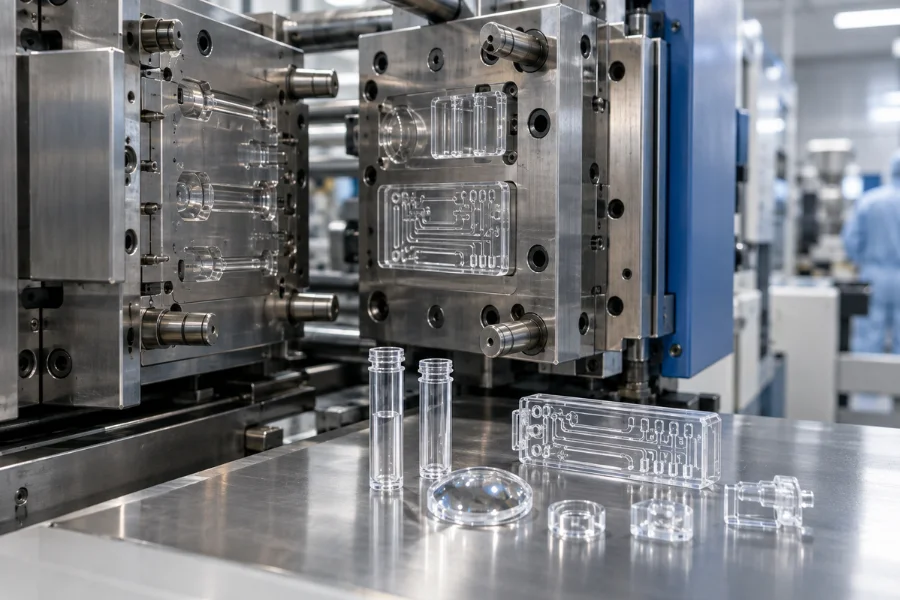
Cyclic olefin copolymer (COC) is a transparent, amorphous thermoplastic used when optical performance, low moisture absorption, dimensional stability, purity, or moisture barrier properties are critical. These characteristics have established COC in medical devices, pharmaceutical packaging, microfluidics, precision optics, and selected electronic applications.
For injection molded parts, resin properties are only part of the decision. COC grade, flow behavior, mold temperature, gate and vent design, cooling, and residual stress can determine whether a molded component achieves the optical or dimensional performance expected from the material.
This guide explains what COC plastic is, how its properties influence injection molding, and where it fits compared with PC, PMMA, and glass.
COC stands for cyclic olefin copolymer, a family of thermoplastics produced by copolymerizing cyclic olefins with linear olefins, commonly ethylene. Commercial COC materials include grades based on ethylene and norbornene chemistry.
Unlike semicrystalline polyolefins such as PE and PP, COC is amorphous. Without the crystalline regions typical of those materials, it can maintain high transparency while avoiding crystallization-related optical haze. Its thermal behavior is therefore associated primarily with glass transition temperature (Tg) rather than a distinct crystalline melting point.
COC is not a single resin with one fixed property set. Changes in comonomer content and polymer structure can alter Tg, stiffness, viscosity, heat resistance, and processing behavior. Commercial families include standard injection molding, high-flow, optical, medical, and film grades.
COC and COP, or cyclic olefin polymer, belong to the broader cyclic olefin material family but are produced through different polymerization routes. Their individual properties should be checked at the grade level rather than assuming the two materials are interchangeable.

COC plastic is valuable because several useful characteristics can occur within the same material family.
| Property | Engineering Significance |
|---|---|
| High optical clarity | Transparent medical, diagnostic, and optical components |
| Low birefringence | Reduced optical distortion in precision applications |
| Very low moisture absorption | Improved dimensional stability under changing humidity |
| High moisture barrier | Protection for moisture-sensitive packaged products |
| Grade-dependent heat resistance | Material selection across different thermal requirements |
| High purity | Medical, pharmaceutical, and analytical applications |
| Fine-detail replication | Microfluidic channels and precision molded features |
| Low dielectric loss | Selected high-frequency electronic applications |
Suitable COC grades can provide visible-light transmission around 91%, making the material relevant where transparent polymers or glass would otherwise be considered. Low birefringence further supports applications where light must pass through a molded component with limited optical distortion.
Resin transparency alone does not produce an optical-quality molded part. Flow-induced orientation, residual stress, weld lines, contamination, and mold-surface condition can reduce the optical performance of the finished component.
Optical COC parts therefore require both an appropriate resin grade and a molding process developed around the functional optical surface.
COC absorbs very little water, reducing moisture-driven dimensional changes compared with more moisture-sensitive transparent engineering plastics. This behavior is useful for microfluidic channels, diagnostic components, and precision optical geometries.
Low moisture uptake does not eliminate dimensional variation. Mold shrinkage, packing, cooling uniformity, thermal expansion, wall-thickness transitions, and residual stress still influence molded dimensions.
This matters during troubleshooting. If a COC part moves out of dimensional specification, moisture should not automatically be treated as the primary cause. Tooling, packing, cooling, and overall process stability may be more relevant.
The glass transition temperature of COC varies substantially by grade. High-heat formulations can reach Tg values around 180°C, while other grades prioritize flow, processing behavior, film production, or different thermal requirements.
A higher Tg is not automatically better. Higher thermal capability can change the molding window without adding functional value if the component does not require it.
Material selection should therefore begin with service temperature and manufacturing requirements, followed by selection of a COC grade that provides an appropriate balance.
COC provides useful resistance to many acids, bases, and alcohols. Its high purity and low extractables are particularly relevant to pharmaceutical, diagnostic, and analytical applications.
Chemical resistance is not universal. Certain non-polar solvents can attack COC or affect its surface, making compatibility testing important for parts exposed to chemicals. The actual medium, concentration, temperature, and exposure duration all matter.
COC also provides strong water-vapor barrier performance for a transparent polymer. Combined with low water uptake, this supports pharmaceutical and other moisture-sensitive packaging applications.
COC can be processed with conventional thermoplastic injection molding equipment, but the required process window depends on the resin grade and part requirements.
A transparent housing and a microfluidic cartridge may use the same polymer family while presenting very different molding challenges. In microfluidic or optical components, small variations in feature replication, surface condition, or residual stress can become functional defects.
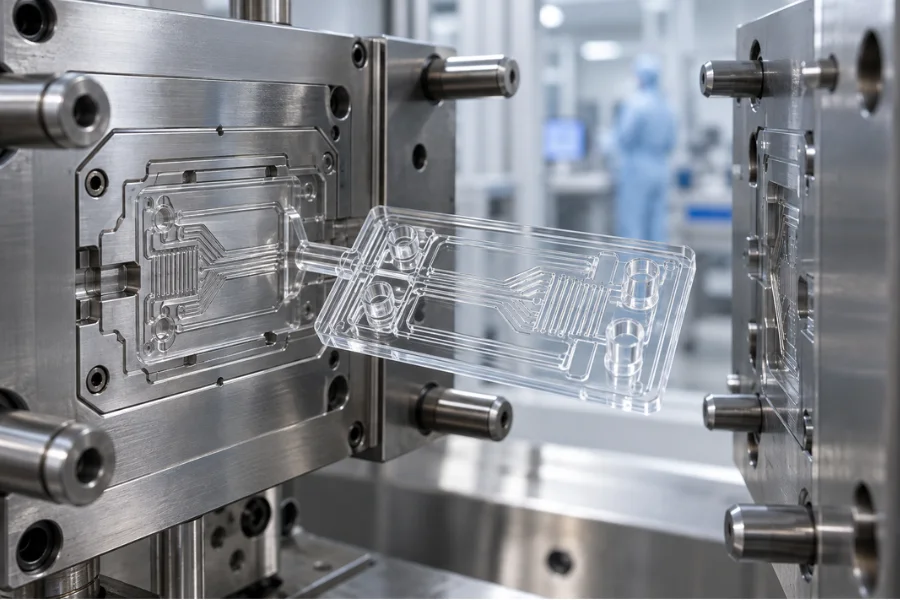
High-flow COC grades can reproduce fine mold details, supporting microchannels, diagnostic components, thin-wall features, and precision optical geometries.
Successful replication still depends on how the melt reaches and fills those features. Rapid cooling at the cavity surface can freeze the skin layer before a microfeature is fully formed, while inadequate venting can trap air at the end of narrow channels.
Gate position controls flow direction and where flow fronts converge. A weld line that would be acceptable on a conventional housing may interfere with optical transmission or cross a critical flow path in a microfluidic component.
COC does not have one universal molding-temperature window because commercial grades differ in Tg and viscosity.
Increasing mold temperature can delay solidification at the cavity surface, extending the time available for fine-feature and surface replication. This may support better optical or microstructured surfaces, but additional cooling demand can increase cycle time.
Injection speed and pressure interact with geometry in a similar way. Faster or more forceful filling may help the melt reach thin or distant features before freeze-off, while excessive or poorly controlled flow can increase visible defects or residual stress.
The process relationship can be summarized as:
Temperature and Filling Conditions → Melt Behavior → Feature Replication and Stress → Part Quality → Cycle Time
Final melt temperature, mold temperature, injection speed, packing conditions, and cooling time should follow the selected resin supplier’s processing guidance and then be validated with the production mold.
COC’s very low moisture absorption distinguishes it from strongly hygroscopic plastics such as nylon or PC. Material handling, however, still affects molded quality.
Dust, foreign resin, degraded polymer, and other contamination are especially visible in transparent components and may be unacceptable in optical, diagnostic, or medical products.
Predrying requirements and drying conditions should follow the recommendations for the specific COC grade rather than a universal drying schedule.
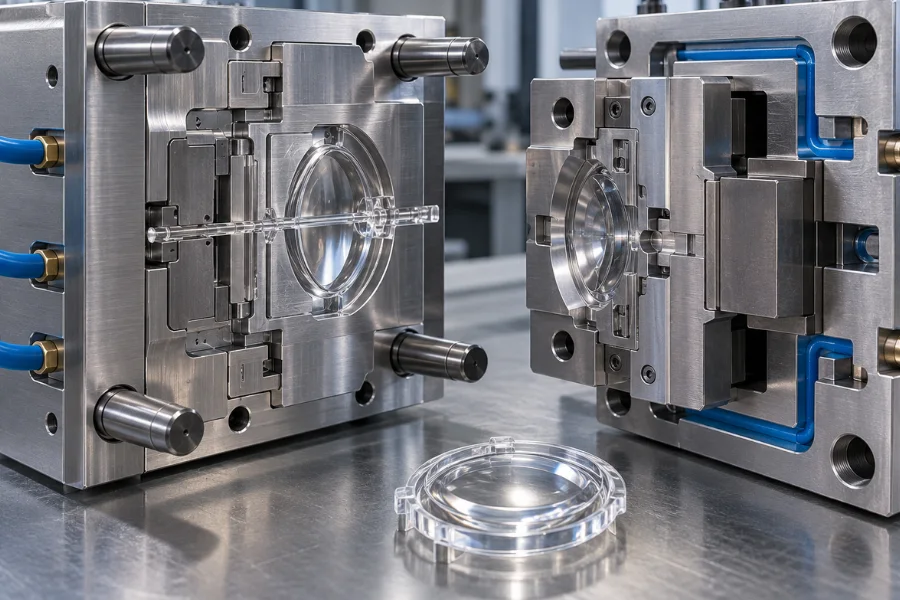
Gate location should support balanced filling while keeping weld lines and highly stressed flow regions away from critical optical or microfluidic surfaces. Fine features also require effective venting so displaced air does not restrict replication.
Uniform wall thickness and balanced cooling help control dimensional variation. Although COC is known for good dimensional stability, molded parts can still shrink unevenly or warp when wall thickness, packing, mold temperature, or cooling varies across the geometry.
This distinction is important: low moisture absorption reduces one source of dimensional change, but it does not eliminate molding-induced shrinkage or warpage.
Mold finish directly affects transparent and optical surfaces. Highly polished or delicate microstructured areas also require appropriate release geometry and ejection design because excessive ejection force can damage a functional surface.
For precision COC molding, the design relationship is:
Part Geometry → Melt Flow → Gate and Vent Design → Packing and Cooling → Ejection → Functional Part Quality
Many molding defects associated with COC can also occur in other transparent thermoplastics. Their significance changes when the molded surface or geometry performs an optical, diagnostic, or fluid-control function.
| Issue | COC-Specific Manufacturing Concern |
|---|---|
| Incomplete microfeatures | Can alter microchannel geometry or diagnostic function |
| Weld lines | May interfere with optical windows or functional flow paths |
| Residual stress | Can affect optical performance and dimensional stability |
| Flow marks | Highly visible on transparent functional surfaces |
| Contamination or streaks | Critical for optical, diagnostic, and medical components |
| Shrinkage or warpage | Can alter precision geometry despite low moisture uptake |
| Surface damage | Can compromise polished optical or microstructured surfaces |
For example, incomplete replication of a decorative feature may have little functional consequence. The same molding condition in a microfluidic channel can change its geometry and potentially affect fluid behavior.
Residual stress deserves similar attention in optical components. A molded part can appear dimensionally acceptable while still carrying stress that affects optical behavior. Defect limits should therefore be tied to component function rather than appearance alone.
COC is used in prefilled syringes, vials, cartridges, diagnostic consumables, microfluidic chips, cuvettes, microplates, and laboratory components.
Microfluidics demonstrate why this property combination matters. Optical clarity supports inspection and analysis, low moisture uptake supports dimensional stability, and injection molding can reproduce fine channel structures at production volumes.
COC can also replace glass in selected drug-delivery and packaging applications where lower weight and resistance to breakage provide practical advantages. Chemical compatibility, sterilization method, barrier requirements, and applicable regulatory requirements still require product-specific validation.
COC is used for lenses, sensor windows, light-guiding components, optical films, and other precision optical parts.
Here, resin clarity is only the starting point. Mold-surface quality, filling behavior, cooling uniformity, and residual stress determine how much of the material’s optical potential is retained in the finished component.
COC is used in pharmaceutical blister packaging, medical packaging, food packaging, and high-clarity barrier films. Its moisture barrier, transparency, and stiffness can be useful in film structures, including applications where COC is combined with PE or PP.
Selected electronic applications use COC for a different reason. Its low dielectric constant and low dielectric loss can support certain high-frequency antenna and communication components where electrical performance and dimensional stability matter more than transparency.
COC has several engineering limitations that should be considered before material selection.
Cost can make it difficult to justify when a component does not benefit from its specialized optical, purity, barrier, or dimensional properties. Commodity plastics and conventional transparent resins may be more economical for less demanding parts.
Impact performance can also shift the material decision. Where toughness and ductility dominate, PC may provide a more suitable balance.
Chemical exposure requires application-specific evaluation because certain non-polar media can affect COC even though the material performs well against many other chemicals.
Finally, specifying only “COC” is not sufficient for a production material decision. Thermal capability, flow, stiffness, and processing requirements can vary significantly between grades.
COC overlaps with several transparent materials, but the preferred option depends on the requirements controlling the design.
| Decision Factor | COC | PC | PMMA | Glass |
|---|---|---|---|---|
| Optical clarity | High | High | High | High |
| Moisture sensitivity | Very low | Higher than COC | Higher than COC | Very low |
| Impact resistance | Moderate, grade-dependent | High | Lower than PC | Brittle |
| Heat capability | Broad, grade-dependent | Good | Generally lower than high-Tg COC | High |
| Injection moldability | Good | Good | Good | Different manufacturing route |
| Fine-feature replication | Strong in suitable grades | Application-dependent | Application-dependent | Different manufacturing route |
| Purity/drug-contact potential | Strong in suitable medical grades | Grade-dependent | Grade-dependent | Established for many applications |
| Main trade-off | Cost and chemical limitations | Moisture/process requirements | Thermal and impact limitations | Weight, breakage, and processing constraints |
These comparisons are directional. Actual performance depends on the resin grade, part design, processing conditions, chemical environment, and application requirements.
PC is often attractive when impact toughness and ductility control the design, while PMMA remains useful where optical appearance is important under more moderate thermal requirements. Glass provides strong optical, chemical, and barrier properties but introduces different manufacturing constraints, additional weight, and breakage risk.
COC becomes more compelling when several requirements—such as clarity, low moisture uptake, purity, dimensional stability, and fine-detail molding—must be achieved in the same component.
The strongest case for COC is rarely transparency alone. It is more often a combination of requirements that conventional transparent plastics struggle to satisfy simultaneously.
COC is worth evaluating when a part needs optical performance together with low moisture absorption, dimensional stability, high purity, moisture barrier properties, or precise replication of small molded features. This combination explains its use in microfluidics, diagnostics, drug-delivery systems, pharmaceutical packaging, and precision optics.
Material selection should start with the critical function of the component—not with the assumption that COC is inherently the higher-performance choice. Once those requirements are defined, engineers can determine whether a specific COC grade or an alternative such as PC, PMMA, or glass provides the better manufacturing and performance balance.
COC combines high transparency, very low moisture absorption, dimensional stability, purity, moisture barrier performance, and fine-detail molding capability within an amorphous thermoplastic family.
Its advantages are most valuable when several of these properties are required at the same time. Successful production still depends on matching the COC grade to part geometry, thermal and chemical exposure, optical requirements, and molding conditions, followed by validation with the actual mold and application.