Physical Address
304 North Cardinal St.
Dorchester Center, MA 02124
Physical Address
304 North Cardinal St.
Dorchester Center, MA 02124
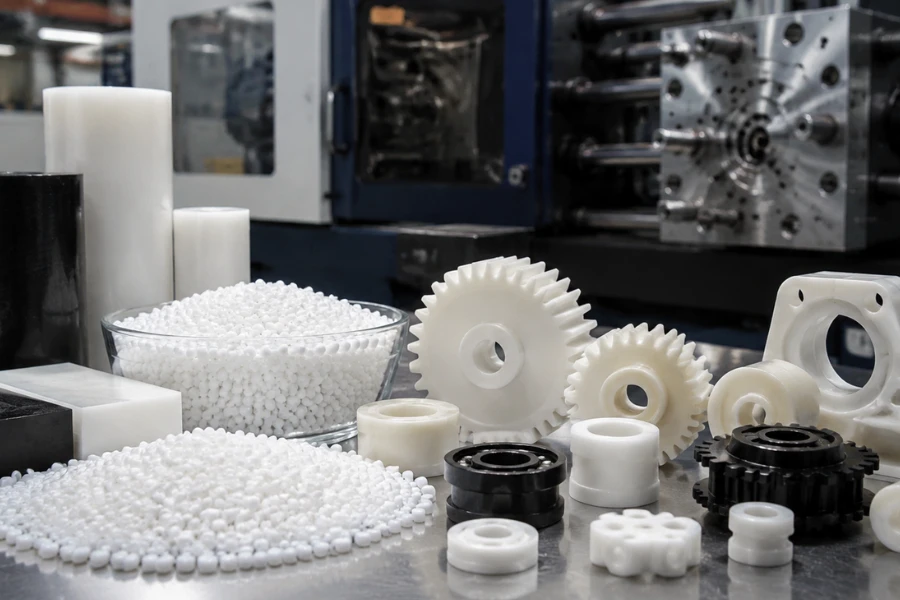
Choosing the right engineering plastic requires more than comparing strength values on a material datasheet. In real manufacturing projects, engineers must balance mechanical performance, friction behavior, dimensional stability, processing requirements, production cost, and long-term reliability. A material that performs well in testing may still create challenges during injection molding if shrinkage, cooling behavior, or tooling design are not properly considered.
So, what is Delrin? Delrin is a commercial name for polyoxymethylene (POM) homopolymer, a semi-crystalline engineering thermoplastic known for high stiffness, low friction, excellent wear resistance, and low moisture absorption. These properties make Delrin plastic widely used for precision mechanical components such as gears, bearings, bushings, rollers, and industrial mechanisms.
This article explains Delrin material properties, Delrin vs acetal and nylon comparisons, common applications, injection molding considerations, tooling requirements, and practical selection factors engineers should evaluate before moving a part into production.
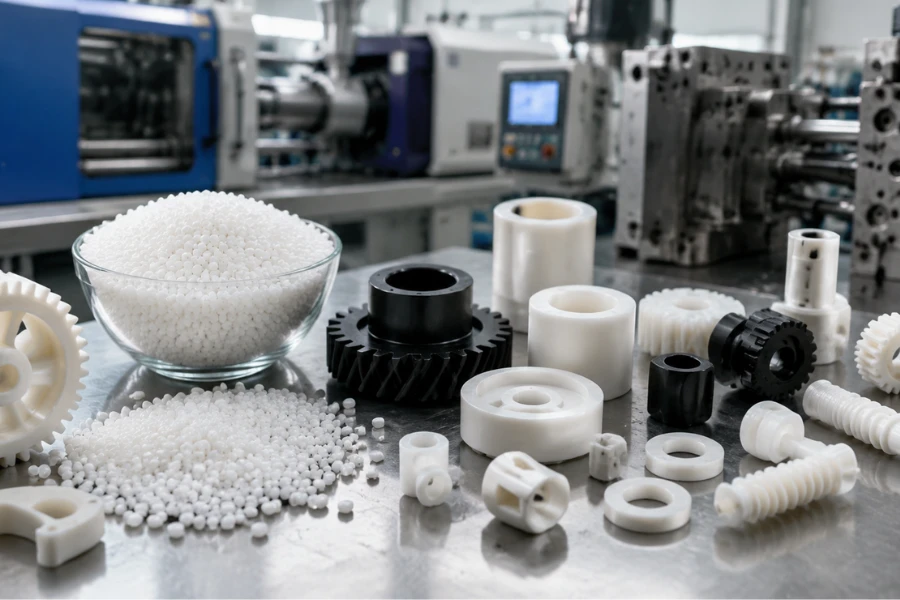
Delrin is a high-performance engineering thermoplastic based on polyoxymethylene (POM). It belongs to the acetal plastic family and is specifically classified as a homopolymer acetal (POM-H).
Compared with general-purpose plastics, Delrin plastic is designed for functional components that require mechanical performance, precision, and long-term stability. Its semi-crystalline structure provides excellent stiffness, hardness, fatigue resistance, and wear behavior.
Engineers typically consider Delrin when a component requires:
Unlike commodity plastics such as polyethylene or polypropylene, Delrin is commonly used in applications where the plastic component directly affects mechanical performance.
Typical Delrin applications include:
However, Delrin should not be selected only because it is a “strong plastic.” Material selection depends on the complete operating environment, including load conditions, temperature, chemical exposure, required tolerance, and manufacturing process capability.
A successful Delrin application requires alignment between:
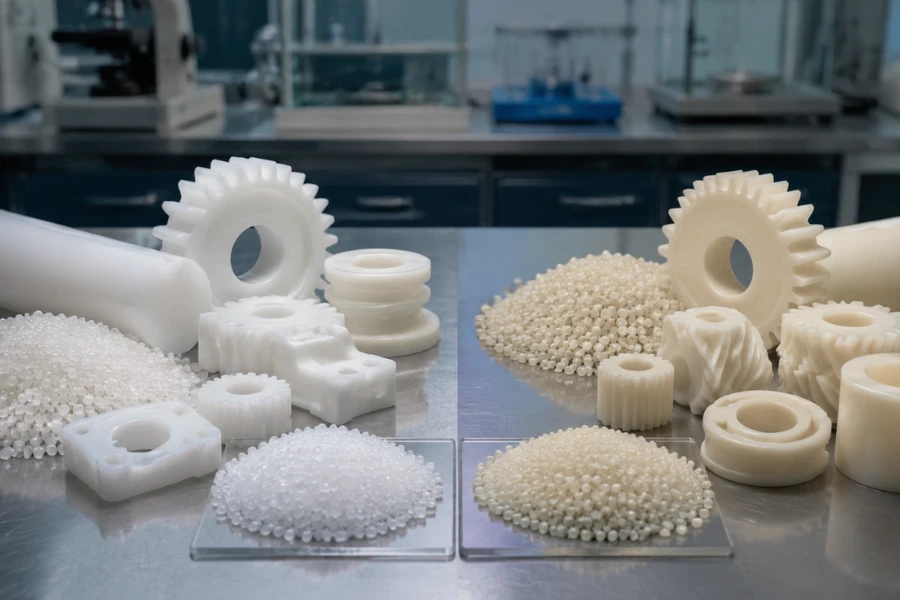
One of the most common questions engineers ask is whether Delrin and acetal are the same material.
The answer is related but not identical.
POM (polyoxymethylene) is the overall polymer family. Acetal materials are generally divided into:
Delrin is a well-known example of POM-H.
The difference comes from polymer structure. Delrin’s homopolymer structure provides higher mechanical strength and stiffness, while copolymer acetal improves certain properties such as chemical resistance and resistance to hot water exposure.
| Property | Delrin (POM-H) | POM-C |
|---|---|---|
| Strength | Higher | Slightly lower |
| Stiffness | Higher | Slightly lower |
| Fatigue resistance | Excellent | Excellent |
| Wear resistance | Excellent | Excellent |
| Toughness | Good | Generally higher |
| Chemical resistance | Good | Better in some environments |
| Hot water resistance | Moderate | Better |
| Dimensional stability | Excellent | Excellent |
From a design perspective:
Delrin is often selected when:
POM-C may be preferred when:
The best choice depends on the application environment rather than selecting the material with the highest individual property.
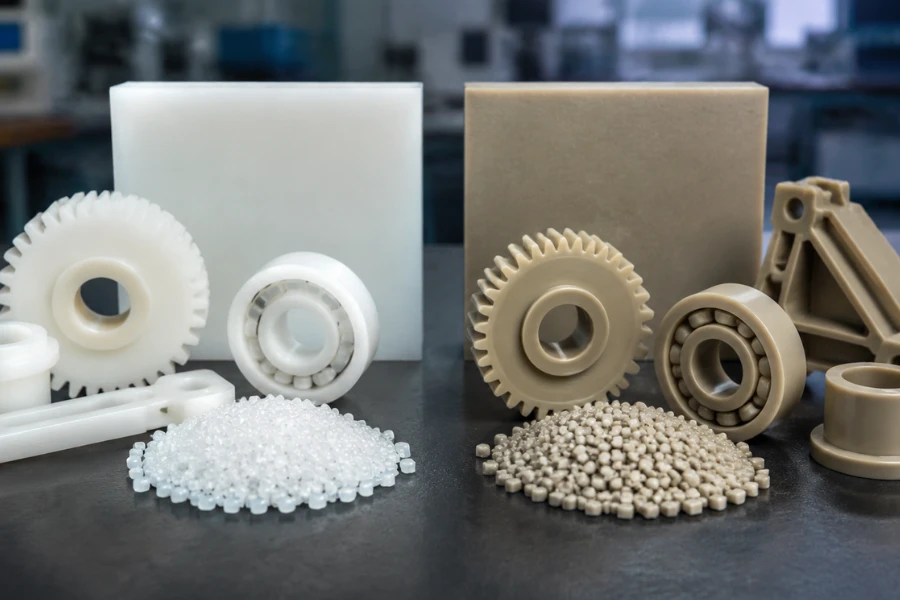
Delrin and nylon are often compared because both are widely used engineering plastics for mechanical components. However, their behavior during production and operation is different.
Nylon generally provides excellent toughness and impact resistance, while Delrin provides better dimensional stability because of its low moisture absorption.
| Selection Factor | Delrin (POM) | Nylon (PA) |
|---|---|---|
| Moisture absorption | Low | Higher |
| Dimensional stability | Excellent | More affected by humidity |
| Friction performance | Excellent | Good |
| Wear resistance | Excellent | Excellent |
| Impact resistance | Good | Usually higher |
| Precision applications | Excellent | Depends on grade |
| Humidity variation | More stable | Requires consideration |
For precision injection molded components, Delrin is often preferred when maintaining consistent dimensions is critical.
For example:
A gear operating in a humid environment may experience dimensional changes if moisture absorption affects the material. In this case, Delrin may provide more predictable performance.
However, nylon may be the better choice when:
The decision should always consider the complete application rather than comparing material strength alone.
Delrin is widely selected for engineering applications because it provides a balanced combination of mechanical strength, low friction, wear resistance, dimensional stability, and chemical resistance. However, the reason engineers choose Delrin is not because of one single outstanding property. Its value comes from how these characteristics work together in real operating conditions.
For production components, engineers need to consider not only material performance but also how the material behaves during molding, assembly, and long-term service.
One of the most important advantages of Delrin is its ability to withstand repeated mechanical loading.
Unlike many general-purpose plastics that are suitable mainly for housings or covers, Delrin is frequently used for functional mechanical parts because of its high tensile strength, compressive strength, stiffness, and fatigue resistance.
This makes Delrin suitable for components such as:
For these applications, fatigue performance is often more important than short-term strength.
A gear, for example, may experience millions of loading cycles during its service life. The material must maintain:
Delrin performs well in these situations because it combines rigidity with resistance to repeated stress.
However, engineers should avoid evaluating Delrin only by material strength values. Actual component life depends on:
A sharp internal corner or sudden wall thickness change can create stress concentration points that reduce fatigue life, even when the selected material has good mechanical properties.
From a design perspective, improving geometry is often as important as selecting a stronger material.
Recommended practices include:
Delrin is widely used in moving components because of its naturally low friction behavior and excellent wear resistance.
Its hard, smooth surface allows components to operate with reduced resistance compared with many engineering plastics. This makes it valuable in applications where repeated contact occurs.
Typical examples include:
The advantage of Delrin is not simply that it has low friction. It is that the material can maintain stable performance during repeated movement.
For example, in a sliding mechanism, excessive friction can cause:
Delrin can reduce these risks when the application conditions are appropriate.
However, wear performance depends on the complete mechanical system.
Engineers should evaluate:
| Factor | Impact on Delrin Performance |
|---|---|
| Contact pressure | Higher pressure increases wear rate |
| Sliding speed | Higher speed increases heat generation |
| Surface finish | Rough mating surfaces accelerate wear |
| Temperature | Excessive heat reduces performance |
| Lubrication | May improve service life |
A common mistake is assuming that using Delrin automatically eliminates wear problems. In reality, correct design of the mating components is equally important.
Dimensional stability is one of Delrin’s most important advantages compared with many other engineering plastics.
Delrin has low moisture absorption, which means its dimensions are less affected by changes in humidity compared with materials such as nylon.
This makes Delrin plastic particularly suitable for:
For example, in a precision gear system, even small dimensional changes can affect:
Using a material with better dimensional stability helps maintain consistent performance throughout the product lifecycle.
However, injection molded Delrin parts still experience dimensional changes due to:
Delrin has a relatively high molding shrinkage range:
1.2%–3.0%
This is an important tooling consideration.
Because Delrin is semi-crystalline, the polymer structure changes during cooling, creating greater volume reduction than many amorphous plastics.
During mold development, engineers must compensate for:
Poor shrinkage management can result in:
In production environments, dimensional consistency is achieved through the combination of:
Delrin provides good resistance to many industrial chemicals and fluids, which expands its use in demanding environments.
It generally performs well against:
This makes Delrin suitable for:
However, Delrin is not universally chemical-resistant.
Applications involving:
require additional validation.
Material selection should consider:
Temperature performance also requires careful consideration.
Delrin has a melting point range of approximately:
153–160°C
However, melting temperature should not be confused with service temperature capability.
During injection molding, Delrin requires strict thermal control because excessive heat exposure can cause degradation.
Potential results include:
This thermal sensitivity becomes especially important during high-volume manufacturing, where small process variations can affect thousands of parts.
Delrin is often considered as a metal replacement material because it can provide mechanical performance while reducing weight, friction, and manufacturing complexity.
However, successful metal replacement requires engineering evaluation rather than direct substitution.
A plastic component cannot simply copy a metal design. The geometry often needs optimization because polymers behave differently under load.
Delrin can provide advantages when applications require:
Compared with steel or aluminum components, Delrin parts are significantly lighter.
This benefits:
Metal components often require lubrication systems to reduce wear.
Delrin’s low-friction properties can simplify designs where continuous lubrication is difficult.
Injection molding allows complex Delrin components to be produced efficiently at scale.
Compared with machining individual metal parts, molded plastic components can reduce:
Plastic gears and moving components often operate more quietly than metal alternatives.
This is valuable in:
Delrin is not suitable for every metal replacement application.
Metal remains preferable when the component requires:
For example, replacing a small mechanism gear with Delrin may improve noise and reduce weight. However, replacing a heavily loaded industrial transmission gear may create unacceptable durability risks.
Engineers should evaluate:
| Requirement | Delrin Suitability |
|---|---|
| Low friction movement | Excellent |
| Precision mechanisms | Excellent |
| Humidity exposure | Excellent |
| Weight reduction | Excellent |
| High temperature | Limited |
| Extreme load | Application dependent |
| Structural components | Usually not preferred |
The best material choice balances performance, manufacturing feasibility, and total product cost.
Delrin is most valuable in applications where engineers need a combination of mechanical reliability, low friction, dimensional stability, and repeatable manufacturing performance.
Instead of selecting Delrin simply because it is a strong engineering plastic, successful applications usually share similar requirements:
Mechanical components remain one of the largest application areas for Delrin.
Common examples include:
For these components, Delrin provides advantages beyond basic strength.
For example, a Delrin gear is often selected because it can provide:
However, gear performance depends on more than material selection.
Engineers must also evaluate:
A poorly designed gear made from Delrin can still fail prematurely if tooth stress, heat generation, or load distribution are not properly controlled.
Delrin is widely used in automotive mechanisms where components require repeated movement and stable performance.
Typical applications include:
Automotive engineers often choose Delrin because components must operate reliably under:
Compared with metals, Delrin can reduce weight and noise. Compared with moisture-sensitive plastics, it provides more predictable dimensional behavior.
Industrial applications often require materials that can maintain performance over long operating periods.
Common Delrin industrial applications include:
In these environments, the combination of wear resistance and chemical resistance can improve equipment reliability.
However, industrial applications require careful validation because operating conditions vary significantly.
A pump component, for example, may require different material considerations depending on:
Delrin performs well as a finished engineering material, but producing consistent Delrin injection molded parts requires careful process control.
Compared with some common thermoplastics, Delrin has a narrower processing window because of:
For mass production, engineers must control not only molding parameters but also the interaction between:
A successful first-shot molding result does not always guarantee stable long-term production.
Typical Delrin injection molding parameters include:
| Parameter | Typical Range |
|---|---|
| Nozzle temperature | 170–180°C |
| Barrel temperature | 170–200°C |
| Mold temperature | 90–120°C |
| Injection pressure | 80–130 MPa |
| Holding pressure | 30–50 MPa |
| Cooling time | 20–60 seconds |
| Screw speed | 20–40 rpm |
Delrin has a melting point range of approximately 153–160°C.
During processing, the goal is to achieve sufficient melting and flow without exposing the material to excessive thermal stress.
Overheating or excessive residence time can cause:
For production molding, process stability is usually more important than achieving the fastest possible cycle time.
Delrin has relatively fast melting and solidification behavior around its processing temperature.
This means controlling the flow front during filling is important.
If the melt freezes too early, potential problems include:
A stable filling process requires balancing:
Increasing injection pressure alone is not always the correct solution.
For example, if a thin section freezes before filling is complete, improving gate design or increasing mold temperature may be more effective than simply increasing pressure.
Delrin can be molded using different gate systems, including:
The appropriate choice depends on:
From a tooling perspective, runner balance is important because uneven filling can create:
A balanced runner system helps maintain more consistent filling conditions across multiple cavities.
For precision components, the goal is not simply to fill the cavity. The goal is to create repeatable filling behavior from cycle to cycle.
Cooling design is one of the most important factors affecting Delrin part quality.
Because Delrin releases significant heat during crystallization, uneven cooling can create different shrinkage rates across the part.
Potential results include:
A well-designed cooling system should provide:
For high-volume production, cooling consistency directly affects:
Injection molding problems are rarely caused by one factor alone. Delrin part quality depends on the interaction between material characteristics, tooling design, and process control.
| Defect | Root Cause | Production Impact | Engineering Solution |
|---|---|---|---|
| Short shot | Premature freezing, insufficient filling capability | Incomplete parts and production rejection | Optimize injection speed, gate design, and mold temperature |
| Warpage | Uneven cooling or inconsistent shrinkage | Assembly failure and dimensional issues | Improve cooling balance and part geometry |
| Dimensional variation | Unstable process conditions or poor shrinkage compensation | Functional failure during assembly | Optimize tooling compensation and process control |
| Burn marks | Trapped gas or thermal degradation | Cosmetic defects and possible material damage | Improve venting and temperature control |
| Weld line weakness | Poor flow meeting conditions | Reduced mechanical strength | Adjust gate position and filling profile |
| Flash | Excessive pressure or insufficient clamping control | Increased trimming and dimensional issues | Optimize molding window |
For prototype molding, producing one acceptable part may be enough.
For production, repeatability is the real challenge.
A stable Delrin injection molding process requires monitoring:
Quality control should focus on preventing variation rather than only detecting defective parts after production.
For critical components, validation may include:
This approach reduces production risk when scaling from prototype quantities to high-volume manufacturing.
Selecting Delrin as the material is only one part of achieving a reliable production component. Because Delrin is a semi-crystalline thermoplastic with relatively high shrinkage, part design decisions directly affect dimensional accuracy, mechanical performance, tooling cost, and production stability.
From a manufacturing perspective, many Delrin part failures are not caused by the material itself. They are often the result of unsuitable geometry, excessive tolerance requirements, poor gate location, or insufficient consideration of molding behavior during the design stage.
A successful Delrin injection molded part should be designed with the relationship between:
in mind.
Maintaining consistent wall thickness is one of the most important design principles for Delrin injection molding.
Uneven wall sections create differences in cooling rate and crystallization behavior. Since Delrin experiences significant volume changes during cooling, inconsistent thickness can increase the risk of:
Instead of simply increasing wall thickness to improve strength, engineers should consider structural optimization methods such as:
For example, a Delrin gear does not necessarily require thicker walls to improve performance. Improving tooth geometry, reducing stress concentration, and optimizing load distribution may provide better results without increasing material usage.
Gate location has a direct influence on Delrin part quality.
Because Delrin solidifies relatively quickly, the filling process must be carefully controlled to ensure the melt reaches all critical features before freezing.
During mold design, engineers should evaluate:
A poorly positioned gate may create:
For precision components, gate placement should prioritize balanced flow behavior rather than only minimizing cosmetic marks.
The runner system also affects filling consistency, especially for multi-cavity molds.
A balanced runner layout helps ensure that each cavity receives similar melt conditions.
Important considerations include:
In high-volume production, runner imbalance can create cavity-to-cavity variation, resulting in inconsistent dimensions and increased inspection requirements.
For production molds, optimizing the runner system during tooling development is often more cost-effective than correcting variation after mass production begins.
Proper draft angle helps reduce ejection force and prevents damage during mold opening.
Delrin has a relatively low friction surface, but sufficient draft is still required for stable production.
Typical draft recommendations:
| Feature | Recommended Draft Angle |
|---|---|
| Mold cavity | 35′–1°30′ |
| Mold core | 30′–40′ |
Insufficient draft may cause:
Textured surfaces usually require additional draft compared with polished surfaces because the texture increases mechanical interference during ejection.
Delrin can achieve good dimensional accuracy, but injection molded tolerances depend on several factors:
According to plastic precision classifications, smaller Delrin parts can achieve tighter tolerances than larger components because dimensional variation increases as part size increases.
Engineers should avoid specifying unnecessarily tight tolerances across all dimensions.
A better approach is to identify:
Examples:
Examples:
Overly strict tolerance requirements can increase:
A successful design balances functional requirements with realistic manufacturing capability.
Material selection should begin with application requirements rather than material popularity.
A practical engineering evaluation process includes four questions:
If the part involves repeated movement, Delrin is often a strong candidate.
Suitable examples:
If the application requires extreme pressure or abrasive contact, additional evaluation is needed.
Delrin is often preferred when maintaining consistent dimensions is critical.
Examples:
If the environment involves large temperature changes or aggressive chemicals, alternative materials may need consideration.
Engineers should evaluate:
Delrin performs well in many industrial environments but is not suitable for every condition.
Delrin is particularly attractive when:
For very low-volume parts, machining may sometimes be more practical.
Before approving Delrin for production, engineers should evaluate:
This approach helps prevent material selection decisions based only on datasheet values.
Delrin is a type of POM material, specifically a polyoxymethylene homopolymer (POM-H). POM is the broader material family that includes both homopolymer and copolymer grades. Delrin is commonly selected when higher stiffness, strength, and wear resistance are required for precision mechanical components.
Delrin and nylon have different engineering advantages. Delrin generally provides better dimensional stability because it absorbs less moisture, making it suitable for precision parts. Nylon often provides higher toughness and impact resistance. The better choice depends on environmental conditions, load requirements, and dimensional control needs.
Yes. Delrin is widely used for injection molding, especially for high-volume precision components. However, manufacturers must carefully control processing temperature, cooling conditions, shrinkage compensation, and tooling design to achieve stable production quality.
Common issues include shrinkage variation, warpage, short shots, thermal degradation, and dimensional inconsistency. These problems usually result from the interaction between material properties, mold design, and process conditions rather than from the material alone.
Certain Delrin grades are used in medical and healthcare products, but suitability depends on grade selection, regulatory requirements, sterilization conditions, and application environment. Medical applications require additional validation beyond basic material performance.
Delrin is a versatile engineering thermoplastic that provides an effective combination of strength, low friction, wear resistance, and dimensional stability. These characteristics make Delrin plastic suitable for precision components such as gears, bearings, bushings, and industrial mechanisms where consistent performance is required.
However, successful Delrin applications depend on more than selecting the material. Engineers must evaluate operating conditions, part geometry, tooling design, injection molding parameters, and production capability before moving into mass production.
For Delrin injection molding, controlling shrinkage, cooling behavior, flow conditions, and thermal exposure is essential for achieving repeatable quality. When material selection, design optimization, and manufacturing processes are considered together, Delrin can provide a reliable alternative to metals and other engineering plastics while improving production efficiency and long-term component performance.