Physical Address
304 North Cardinal St.
Dorchester Center, MA 02124
Physical Address
304 North Cardinal St.
Dorchester Center, MA 02124
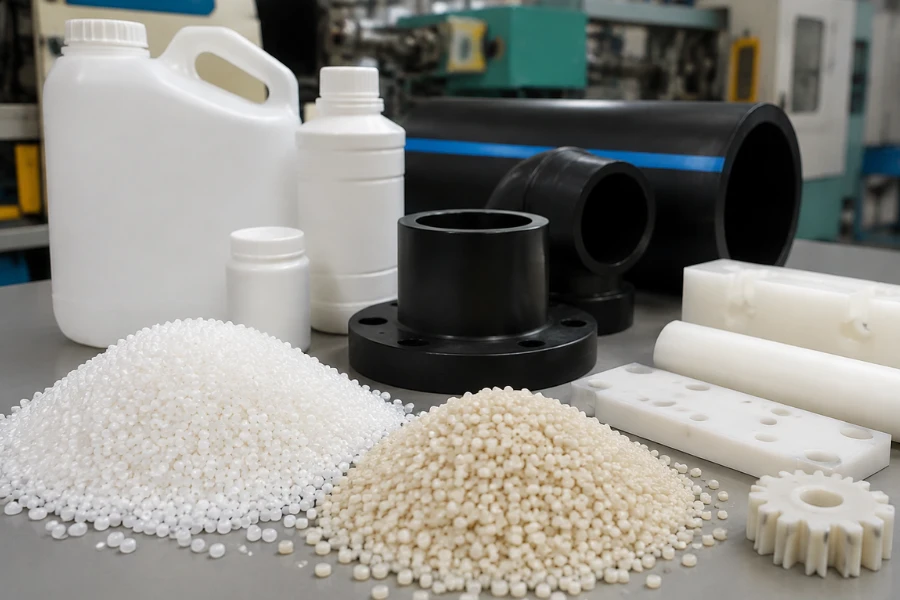
High-density polyethylene, or HDPE, is one of the most widely used thermoplastics in packaging, piping, industrial equipment, consumer products, and molded components. Engineers often select HDPE for its chemical resistance, impact toughness, low moisture absorption, processability, and relatively low material cost. However, these advantages do not make it suitable for every application.
The key to understanding HDPE is its highly crystalline, mostly linear molecular structure. The same structure that contributes to stiffness, strength, and chemical resistance also produces relatively high molding shrinkage and creates challenges when tight dimensional control is required.
This guide explains what HDPE is, its material properties, manufacturing methods, applications, processing behavior, and limitations, with practical guidance for material selection, DFM, tooling, production, and validation.
HDPE stands for high-density polyethylene, a thermoplastic polymer produced from ethylene. Its repeating chemical unit is represented as (C₂H₄)n, where “n” indicates the number of repeating ethylene units in the polymer chain.
Compared with more highly branched polyethylene materials, HDPE has mostly linear molecular chains with relatively limited branching. These chains can pack closely together during solidification, resulting in higher density and crystallinity.
Typical HDPE density is approximately 0.941–0.965 g/cm³, although the actual value depends on the resin grade and formulation.
This molecular arrangement explains much of HDPE’s engineering behavior. Greater crystallinity contributes to stiffness, tensile strength, chemical resistance, and low moisture absorption, while crystallization during cooling also contributes to significant molding shrinkage.
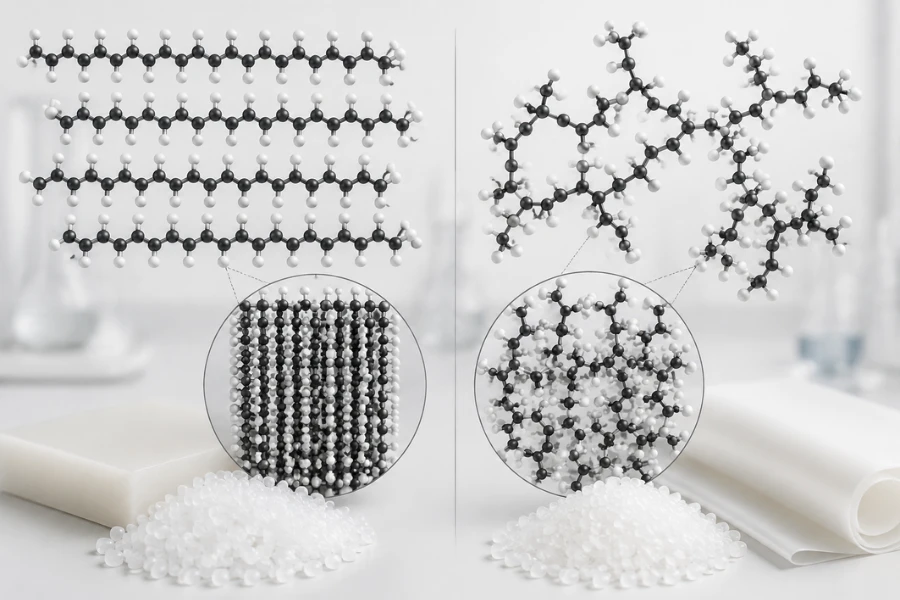
HDPE and low-density polyethylene (LDPE) are both polyethylene materials, but differences in molecular branching produce different mechanical and manufacturing behavior.
| Property | HDPE | LDPE |
|---|---|---|
| Molecular structure | Mostly linear, limited branching | More highly branched |
| Density | Higher | Lower |
| Crystallinity | Higher | Lower |
| Stiffness | Higher | Lower |
| Flexibility | Lower | Higher |
| Tensile strength | Generally higher | Generally lower |
| Typical behavior | Rigid and tough | Soft and flexible |
| Common design concern | Shrinkage and dimensional control | Lower stiffness |
Similar chemical composition therefore does not mean similar product performance. Polymer architecture affects mechanical properties, process behavior, and dimensional stability after molding.
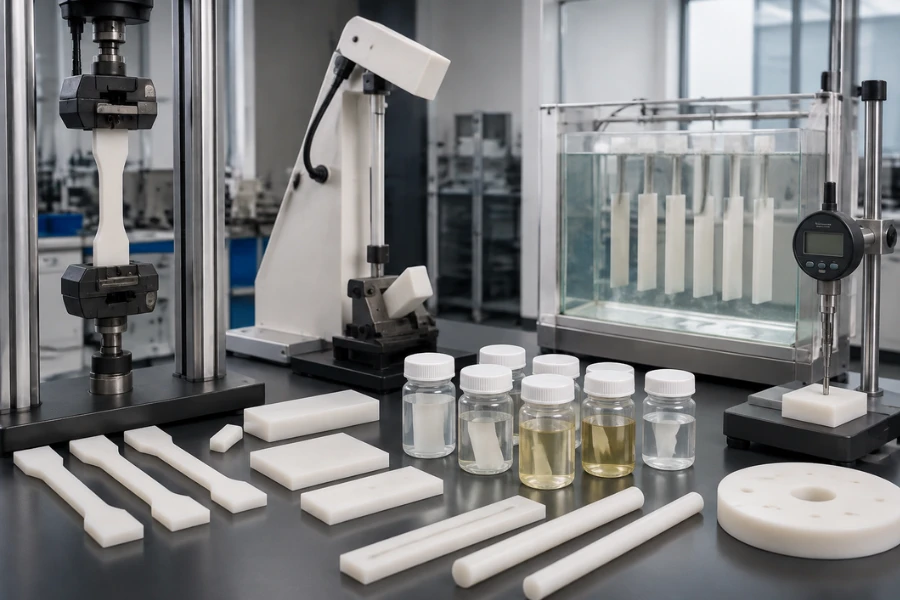
HDPE plastic provides a useful balance of mechanical performance, chemical resistance, moisture resistance, and manufacturing cost. Exact values vary with molecular weight, density, melt flow rate, additives, and resin grade, so grade-specific technical data should be used for final engineering calculations.
| Property | Typical Value or Behavior | Engineering Significance |
| Density | 0.941–0.965 g/cm³ | Low component weight with useful rigidity |
| Water absorption | Typically ≤0.01% | Pre-drying is usually unnecessary |
| Melting temperature | Typically around 130–135°C, grade dependent | Important for thermal material selection |
| Molding shrinkage | Relatively high and direction-dependent | Important for tooling and tolerance control |
| Impact resistance | High | Suitable for tough, handling-intensive products |
| Chemical resistance | Excellent against many chemicals | Useful for pipes, tanks, and containers |
| Electrical insulation | Excellent | Suitable for many electrical applications |
| Creep resistance | Better than LDPE | Important under sustained loading |
These values are material-selection references rather than guaranteed design values. Temperature, load duration, part geometry, processing history, and the selected HDPE grade can significantly change actual product performance.
HDPE is relatively rigid and tough within the polyethylene family. Compared with LDPE, it generally provides greater stiffness, tensile strength, hardness, and creep resistance while maintaining useful impact performance, including toughness at relatively low temperatures.
High tensile strength should not be confused with high structural rigidity. Components carrying continuous loads also need to be evaluated for modulus, creep, wall geometry, stress concentration, service temperature, and load duration.
HDPE resists many acids, alkalis, oils, detergents, and other chemicals. Its low moisture absorption and corrosion resistance make it attractive for chemical containers, tanks, piping, and fluid-handling products.
Chemical resistance measured without mechanical stress, however, does not always predict long-term part performance. Compatibility depends on the chemical, concentration, temperature, exposure duration, applied or residual stress, and resin grade.
This distinction is important because environmental stress cracking can occur when sustained stress acts together with certain chemicals or environmental agents. For long-life pipes, containers, and chemically exposed components, environmental stress cracking resistance (ESCR) should be considered during grade selection and validation rather than assuming that general chemical resistance is sufficient.
HDPE has extremely low water absorption, typically no more than about 0.01% under general processing guidance. Unlike hygroscopic polymers such as nylon, properly stored HDPE normally does not require extensive drying before molding.
HDPE is also an effective electrical insulator with high dielectric resistance, supporting its use in cable-related products and other components exposed to moisture or requiring electrical insulation.
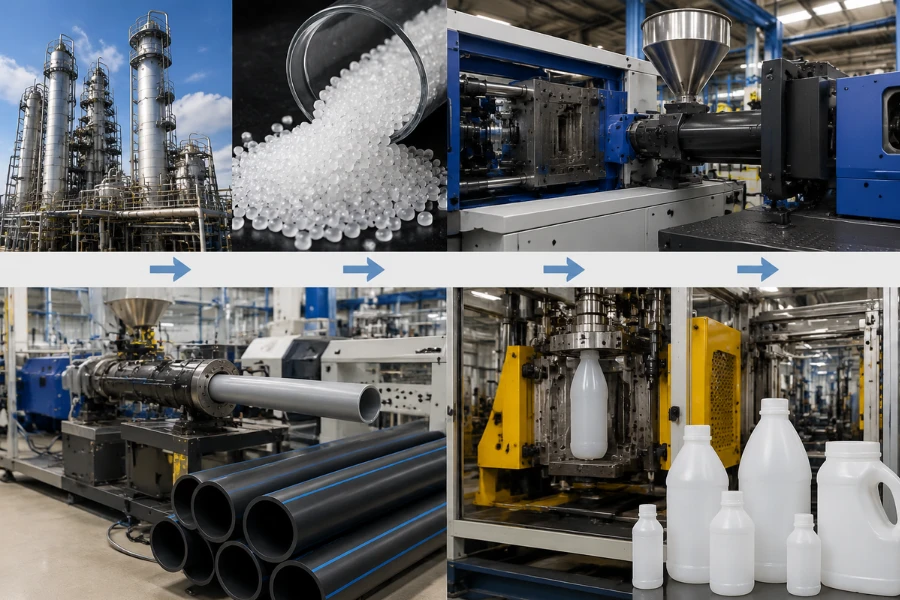
HDPE is produced by polymerizing ethylene under controlled conditions to form long polyethylene chains with limited branching. Industrial production may use catalyst systems such as Ziegler-Natta or chromium-based catalysts, with slurry, gas-phase, and solution polymerization among the common production routes.
A simplified production flow is:
Ethylene → Polymerization → HDPE Resin → Additives/Compounding → Pellets → Product Manufacturing
The resulting resin can then be processed by injection molding, blow molding, extrusion, rotational molding, or other conversion methods.
For product engineers, the important point is that HDPE is a family of resin grades rather than one universal material. Molecular weight, density, molecular weight distribution, comonomers, additives, and production conditions can be adjusted to create grades with different processing and performance characteristics.
A blow-molding grade designed for containers should therefore not automatically replace an injection-molding, extrusion, or pipe grade simply because all are identified as HDPE.
HDPE can be injection molded, blow molded, extruded, and rotationally molded. The appropriate process depends on product geometry, production volume, wall thickness, required performance, and resin grade.
| Process | Typical HDPE Products | Main Engineering Concern |
| Injection molding | Caps, housings, bins, molded components | Shrinkage and warpage |
| Blow molding | Bottles, containers, hollow products | Wall thickness distribution and ESCR |
| Extrusion | Pipe, sheet, profiles, film | Melt stability and dimensional control |
| Rotational molding | Tanks and large hollow parts | Cycle time and wall consistency |
HDPE has low moisture absorption and good melt flow, making it relatively straightforward to injection mold. General HDPE injection molding references include:
| Processing Parameter | General Processing Reference |
| Feed zone temperature | 30–50°C |
| Barrel zones | 160–250°C |
| Melt temperature | 220–280°C |
| Mold temperature | 20–95°C |
| Injection pressure | 80–140 MPa |
These ranges are starting references rather than universal machine settings. Resin grades vary in molecular weight, melt flow, additives, and intended processing method, so supplier processing data should be checked before mold qualification.
The HDPE melting point should not be confused with its injection molding processing temperature. Although crystalline melting typically occurs around 130–135°C, the polymer is heated further during injection molding to obtain the melt flow required for stable cavity filling.
Because HDPE already flows well, excessive injection pressure can create flash, residual stress, or unstable processing without correcting the actual cause of a filling problem.
HDPE is semicrystalline, so cooling conditions affect crystallization, shrinkage, cycle time, and final dimensions. Mold temperature cannot be selected from wall thickness alone; resin grade, geometry, cooling-channel design, surface requirements, dimensional targets, and cycle time all matter.
Gate position also influences filling and packing. Uneven packing between different regions can contribute to sink marks, residual stress, differential shrinkage, and warpage. During DFM, gate location, flow direction, wall thickness, packing, cooling, and critical dimensions should therefore be evaluated together.
Relatively high molding shrinkage is one of the most important limitations of HDPE for precision injection-molded parts.
As HDPE cools, molecular chains pack more closely while crystalline regions develop. This reduction in volume explains why the same crystallinity that contributes to useful stiffness and chemical resistance also creates dimensional-control challenges.
There is no single HDPE shrinkage rate that should be applied to every mold. Actual shrinkage depends strongly on resin grade, flow direction, wall thickness, gate position, packing conditions, mold temperature, cooling rate, and part geometry. Supplier shrinkage data should be the starting point for tooling compensation, followed by measurements from actual mold trials.
Shrinkage can also be directional. Different cooling and molecular-orientation conditions along and across the melt-flow direction can produce unequal dimensional changes and warpage even when average linear shrinkage appears acceptable.
Uniform wall thickness is one of the most effective starting points for HDPE part design. Abrupt transitions between thick and thin regions create different cooling and crystallization conditions, increasing the risk of sink marks and distortion.
Ribs, bosses, and reinforcing features should add stiffness without creating excessive local material accumulation. Critical assembly, sealing, or alignment dimensions should also be identified during DFM so that gating, cooling, and tooling compensation can be designed around the dimensions that matter most.
For precision HDPE components, dimensional capability should ultimately be established through mold trials, controlled processing, dimensional inspection, and production validation, not from a generic shrinkage value alone.
HDPE offers strong overall value, but engineering selection should account for both performance and limitations.
| Advantages of HDPE | Limitations of HDPE |
| Excellent resistance to many chemicals | Relatively high molding shrinkage |
| Very low moisture absorption | Relatively high thermal expansion |
| Good impact toughness | Limited high-temperature performance |
| Lightweight | Lower stiffness than many engineering polymers |
| Good processability | Tight dimensional tolerances can be challenging |
| Relatively low material cost | UV stabilization may be needed outdoors |
| Good electrical insulation | Creep and ESCR require application-specific evaluation |
HDPE is most competitive when chemical resistance, toughness, moisture resistance, manufacturability, and cost matter more than extreme temperature capability or very tight dimensional stability.
The wide range of HDPE uses comes from the way its properties match common product requirements rather than from one exceptional characteristic.
| Application | Why HDPE Is Used | Main Engineering Concern |
| Bottles and containers | Chemical resistance, impact toughness, blow moldability | Wall distribution and ESCR |
| Pipes | Corrosion resistance, toughness, low water absorption | Pressure, joining, creep, service temperature |
| Chemical tanks | Chemical and moisture resistance | Long-term compatibility and creep |
| Molded housings and bins | Impact resistance, cost, processability | Shrinkage and warpage |
| Outdoor products | Moisture resistance and toughness | UV exposure and thermal expansion |
| Food or medical packaging | Processability and suitable grade availability | Grade-specific regulatory compliance |
HDPE is also supplied as sheet, rod, and other stock shapes for machined and fabricated components such as liners, cutting surfaces, guides, tanks, and industrial parts. Machining HDPE avoids molding-tool investment for low-volume components, although thermal expansion and material flexibility can make very tight machining tolerances difficult to maintain.
For food-contact or healthcare applications, specifying only “HDPE” is insufficient. The resin grade, additives, colorants, applicable regulations, traceability, chemical exposure, and sterilization requirements must be verified for the intended product.
Outdoor applications may similarly require UV-stabilized HDPE grades or appropriate additive systems when prolonged sunlight exposure is expected.
Choosing an HDPE grade requires more than checking density and tensile strength. The resin must match the finished-product requirements, manufacturing process, regulatory needs, and long-term production plan.
| Selection Factor | Why It Matters |
| Melt flow behavior | Influences filling, processability, and suitable geometry |
| Density and crystallinity | Affect stiffness, shrinkage, and mechanical behavior |
| Molecular weight | Influences toughness and processing behavior |
| ESCR | Important for stressed parts exposed to chemicals |
| UV stabilization | Important for long-term outdoor applications |
| Regulatory compliance | Required for certain food and healthcare applications |
| Additives and colorants | Can change processing and final performance |
| Recycled content | May affect consistency, appearance, and process capability |
| Supply and lot consistency | Affect repeatability, validation, and long-term production |
Higher melt flow is not automatically better. A grade that fills a thin-wall cavity easily may not provide the same toughness or long-term performance as a resin optimized for a different application.
Supply stability also becomes increasingly important as production scales. A grade change caused by availability or sourcing problems can alter melt flow, shrinkage, appearance, and mechanical behavior, potentially requiring process requalification or dimensional revalidation.
For high-volume molded products, the resin grade should ideally be frozen before final tooling compensation. Changing grades after mold construction can alter shrinkage enough to affect dimensions, warpage, and process capability.
HDPE should be compared with alternative materials according to the actual engineering requirement rather than by asking which plastic is generally better.
| Material | Main Strength | Main Limitation | Consider It When |
| HDPE | Chemical resistance, toughness, cost | Shrinkage and temperature capability | Durable general-purpose components |
| LDPE | Flexibility | Lower stiffness | Flexible films and products |
| PP | Heat and fatigue performance | Impact performance varies by grade and temperature | Hinges, containers, molded parts |
| UHMWPE | Excellent wear and impact resistance | More difficult processing | Wear-intensive components |
| Nylon | Higher stiffness and structural strength | Moisture absorption | Load-bearing molded parts |
HDPE is a strong candidate when chemical resistance, impact toughness, low moisture absorption, lightweight construction, and cost efficiency dominate the design requirements. If high service temperature, very tight dimensional tolerances, structural stiffness, low thermal expansion, or severe wear resistance are the priorities, another polymer may provide a better engineering balance.
Yes. HDPE is a thermoplastic polyethylene that softens or melts when sufficiently heated and solidifies again during cooling. This allows HDPE plastic to be processed through injection molding, extrusion, blow molding, and rotational molding. Because HDPE is semicrystalline, crystallization during cooling significantly influences shrinkage, stiffness, cycle time, and the final dimensions of manufactured products.
The melting point of HDPE is typically around 130–135°C, although the exact temperature depends on resin grade, molecular structure, and crystallinity. This should not be confused with processing temperature or continuous service temperature. Injection molding typically uses substantially higher melt temperatures to achieve sufficient flow, while finished HDPE components can lose stiffness and dimensional stability well below the polymer’s melting point.
HDPE generally has relatively high molding shrinkage because crystallization causes polymer chains to pack more closely during cooling. There is no single shrinkage percentage suitable for every HDPE grade or molded geometry. Flow direction, wall thickness, packing, mold temperature, cooling rate, and resin formulation all influence the result. Supplier shrinkage data should be used for initial tooling calculations and verified through mold trials for critical dimensions.
Certain HDPE grades are suitable for food-contact applications, which is why the material is widely used in bottles, containers, cutting boards, and food-handling products. However, not every HDPE formulation should automatically be considered compliant. The specific resin grade, additives, colorants, manufacturing requirements, and applicable food-contact regulations should be verified for the intended market and application.
HDPE can be used outdoors, but long-term UV resistance depends on the formulation. Extended ultraviolet exposure can degrade unstabilized polyethylene and reduce appearance or mechanical performance. Products intended for prolonged outdoor service should use an appropriate UV-stabilized HDPE grade or additive system and be evaluated according to expected sunlight exposure, temperature, mechanical load, and required service life.
Yes. HDPE is widely used in injection molding because of its good melt flow and very low moisture absorption. The main manufacturing challenge is often not cavity filling but controlling shrinkage, cooling, warpage, and dimensional repeatability. Gate design, wall thickness, packing, mold temperature, cooling layout, resin grade, and critical tolerances should be evaluated together during DFM and process validation.
HDPE should be high on the material-selection list when a product needs chemical resistance, impact toughness, low moisture absorption, low weight, scalable processing, and controlled material cost. These requirements align well with the strengths of high-density polyethylene across molded products, containers, piping, and industrial components.
The decision becomes less straightforward when tight tolerances, high structural stiffness, elevated service temperatures, low thermal expansion, or severe wear are dominant requirements. In those cases, comparing HDPE with PP, nylon, UHMWPE, or other engineering plastics before committing to tooling can prevent expensive redesigns.
For production parts, select the HDPE grade before finalizing shrinkage compensation, then verify the design through DFM, supplier material data, mold trials, dimensional inspection, and process validation. Material choice and manufacturing strategy should be treated as one engineering decision rather than two separate steps.