Physical Address
304 North Cardinal St.
Dorchester Center, MA 02124
Physical Address
304 North Cardinal St.
Dorchester Center, MA 02124
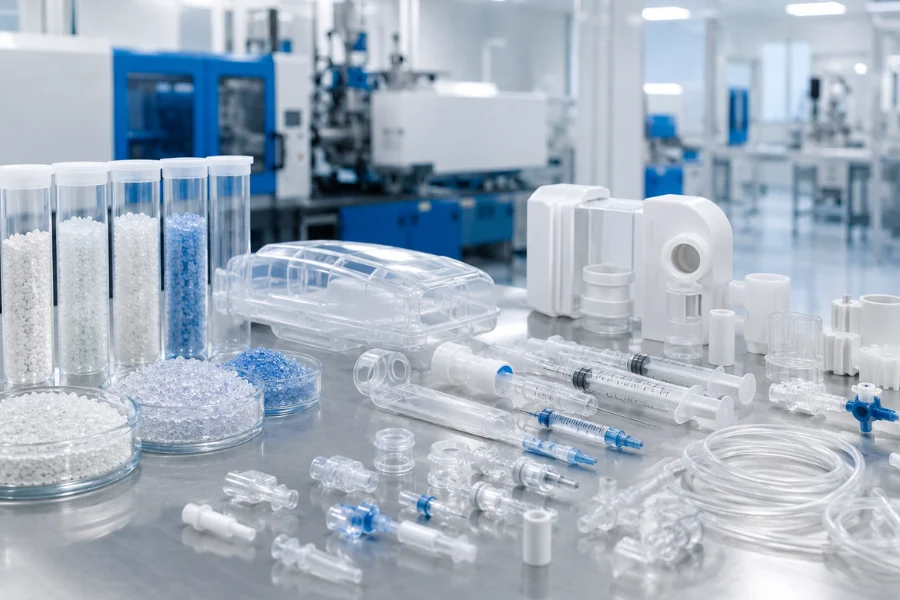
One of the most common mistakes in medical device material selection is treating “medical grade” as an inherent property of a polymer. A designer may specify PP, PC, PEEK, or another material widely used in healthcare, but the polymer name alone does not establish whether a specific resin is suitable for a particular medical device.
A medical grade plastic must be considered in the context of intended patient contact, biological risk, sterilization, chemical exposure, mechanical requirements, manufacturing conditions, and device lifetime. The formulation also matters: additives, colorants, fillers, and processing aids can distinguish one grade from another.
For product designers, R&D teams, medical device startups, and manufacturing engineers, the practical task is therefore not simply finding a “medical plastic.” It is selecting a controlled resin formulation that can maintain biological, functional, dimensional, and manufacturing performance throughout the device lifecycle.
Medical grade plastic generally refers to a polymer material or resin formulation selected for medical or healthcare applications where biological safety, material consistency, and reliable performance are important.
The term should not be interpreted as a universal regulatory classification that automatically makes a polymer acceptable for every medical device.
It helps to separate four levels:
Polymer Family → Specific Resin Formulation → Manufactured Component → Finished Medical Device
Polycarbonate, for example, is a polymer family. Suppliers may offer multiple PC grades with different stabilizers, pigments, mold-release agents, molecular characteristics, or other additives. Those differences can affect processing, sterilization response, chemical resistance, and the relevance of available biological data.
Manufacturing introduces additional variables. Molding, machining, bonding, cleaning, sterilization, packaging, and aging can alter the condition of the material before clinical use.
The useful question is therefore not simply, “Is polycarbonate medical grade?” It is, “Is this specific polycarbonate formulation appropriate for this device, manufacturing process, sterilization method, patient contact, and expected service life?”
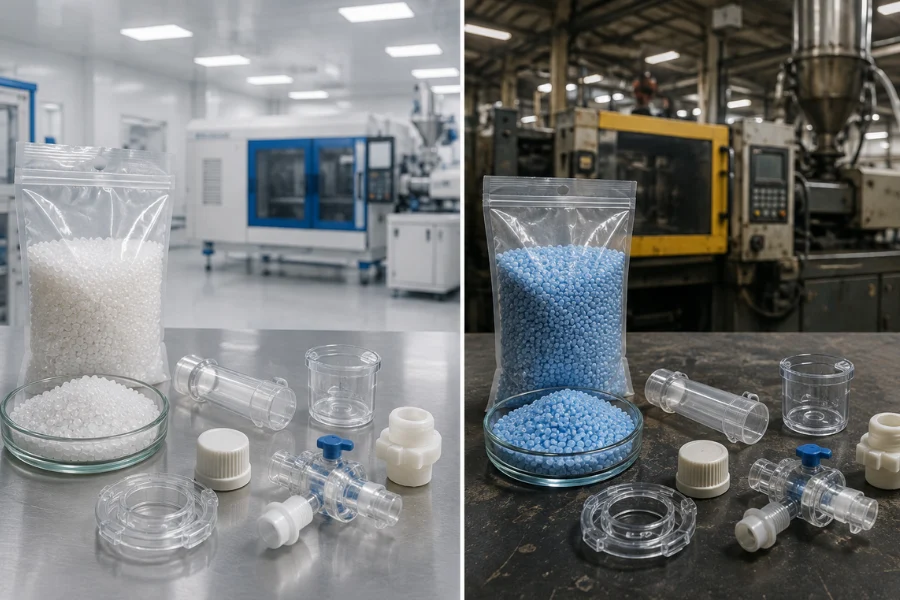
The base polymer chemistry may be similar between a medical-use formulation and a general-purpose resin. The difference often lies in how the specific grade is formulated, documented, controlled, and supported for its intended market.
| Factor | Medical-Use Resin | General-Purpose Resin |
|---|---|---|
| Intended Market | Medical and healthcare applications | Broad industrial or consumer applications |
| Formulation Control | Typically important for validated applications | Depends on grade and supplier |
| Traceability | Often required by medical supply chains | Varies by application |
| Change Notification | Important when a validated formulation must remain stable | May be more limited |
| Biological Data | May be available for specific grades | Usually not developed for medical evaluation |
| Sterilization Data | May be available | Often limited |
| Cost | Often higher due to controls and supporting documentation | Generally lower |
These are practical differences rather than universal rules. A medical-use resin is not automatically “purer” or mechanically superior to an industrial resin.
Its value is often the combination of a suitable formulation, supporting data, consistency, traceability, and supplier controls that allow an OEM to manage risk throughout development and production.
Medical suitability is application-specific. A resin that works in a diagnostic housing may not be appropriate for a blood-contacting component, reusable surgical device, or implant.
| Qualification Factor | Engineering Question | Why It Matters |
|---|---|---|
| Biocompatibility | How and how long will the device contact the patient? | Determines biological evaluation needs |
| Sterilization | What sterilization method and how many cycles? | Can alter polymer structure and properties |
| Chemical Resistance | Will it contact drugs, cleaners, blood, or body fluids? | Poor compatibility may cause swelling or cracking |
| Mechanical Performance | What loads, impact, creep, or fatigue occur? | Determines functional reliability |
| Dimensional Stability | Are tight fits, seals, or assemblies involved? | Dimensional drift can cause failure |
| Manufacturing Compatibility | Can the material be processed consistently? | Affects quality, tolerance, and cost |
| Material Consistency | Is the formulation controlled over time? | Supports repeatable validation |
| Traceability | Can material lots and changes be tracked? | Supports quality and risk control |
Consider a transparent PC component. A grade may perform well in a diagnostic enclosure but fail in another application when molding stress and repeated disinfectant exposure interact to produce environmental stress cracking.
Likewise, changing from a natural resin to a pigmented, lubricated, reinforced, or radiopaque formulation changes more than appearance. The base polymer may remain the same while processing behavior and other relevant material characteristics change.

Several standards and regulatory terms appear frequently in medical plastic discussions, but they address different questions.
| Term or Claim | Practical Meaning |
|---|---|
| Medical-grade resin | Supplier- or application-specific designation; device suitability still requires evaluation |
| USP Class VI tested | The tested material has passed specified biological reactivity tests |
| ISO 10993 test data | Biological test data may support a broader device-specific evaluation |
| ISO 13485 | Quality management system standard for medical-device organizations |
| Device clearance or approval | Regulatory status relates to the device and intended use, not automatically to every material used in it |
ISO 10993 provides a framework for biological evaluation of medical devices. The evaluation depends on factors such as the type and duration of patient contact and the biological risks associated with the device.
Relevant considerations can include cytotoxicity, sensitization, irritation, hemocompatibility, material constituents, process residues, leachables, and degradation products.
Engineers should therefore be cautious with broad statements such as “ISO 10993 compliant plastic.” More useful questions are: Which evaluations or tests were performed? On which formulation? Under what conditions? Are those data relevant to the finished device and its intended contact?
USP Class VI testing is frequently referenced in medical polymer supply chains and can provide useful biological reactivity information for material screening.
It should not, however, be treated as a universal substitute for the biological evaluation appropriate to every finished medical device.
ISO 13485 addresses the quality management system used by medical-device organizations. It is not a biocompatibility certification for a plastic resin.
Separating these concepts helps engineering and procurement teams evaluate supplier claims without treating one certificate or test report as universal evidence of device suitability.
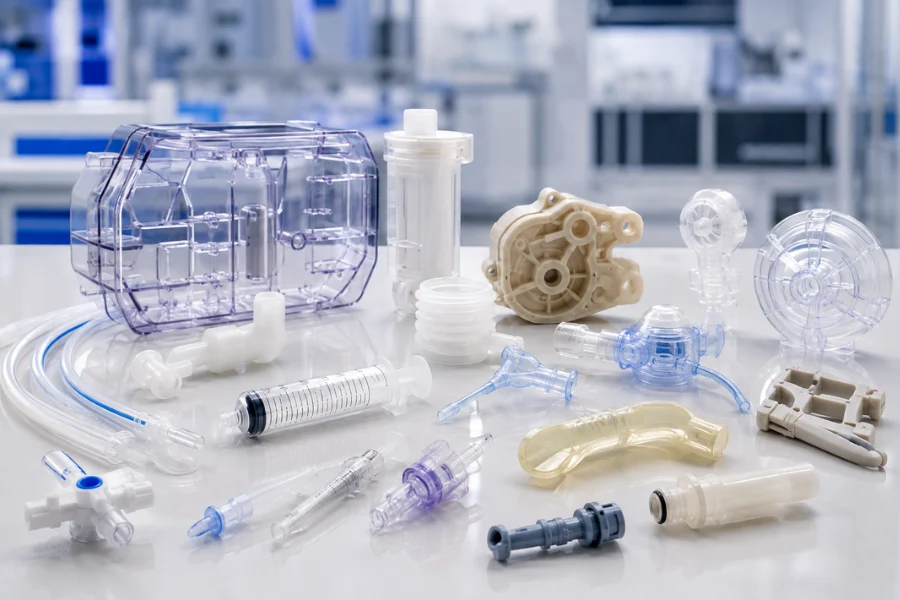
Several polymer families are widely used in healthcare, but not every commercial grade within those families is intended or suitable for medical applications.
| Plastic | Common Medical Fit | Key Engineering Strength | Important Trade-Off |
|---|---|---|---|
| PE | Fluid handling and flexible components | Toughness, chemical resistance, low cost | Limited high-temperature capability |
| PP | Disposable molded parts, containers, labware | Low density, fatigue and chemical resistance | Sterilization response depends on grade |
| PVC | Tubing, fluid bags, masks | Flexible formulations, clarity, economical processing | Plasticizer and leachable considerations |
| PC | Transparent housings and precision components | Impact resistance, clarity, dimensional stability | Chemical and stress-cracking risk |
| PMMA | Optical and viewing components | Excellent transparency | Lower impact resistance than PC |
| ABS | Housings, handles, structural parts | Rigidity, processability, cost | Limited under some sterilization conditions |
| Nylon | Mechanical and wear components | Strength, toughness, abrasion resistance | Moisture absorption can affect dimensions |
| PEEK | Selected implantable and high-performance applications | Thermal, chemical, and mechanical performance | High resin and processing cost |
The highest-performance polymer is not automatically the best choice.
PP may be preferable to a high-performance engineering polymer for a high-volume disposable product when it meets the functional and sterilization requirements at substantially lower cost. A more expensive material becomes justified when its performance reduces meaningful device or manufacturing risk.
Material selection should therefore balance biological requirements, functional performance, processing capability, sterilization, production volume, and validation burden rather than ranking polymers by datasheet properties alone.

Sterilization compatibility is a major material-selection constraint because each method exposes polymers to different stresses.
| Sterilization Method | Main Material Risk | What to Validate |
|---|---|---|
| Steam/Autoclave | Heat distortion, hydrolysis, property loss | Dimensions and repeated-cycle performance |
| Gamma | Chain changes, oxidation, discoloration | Mechanical retention, appearance, aging |
| E-beam | Radiation-induced degradation | Dose-dependent property retention |
| EtO | Sterilant absorption and residuals | Aeration, residuals, compatibility |
| Chemical | Swelling, cracking, chemical attack | Repeated exposure and functional integrity |
A polymer surviving one sterilization cycle does not demonstrate suitability for the entire device lifecycle.
For reusable products, validation may need to examine dimensional accuracy, mechanical performance, transparency, sealing function, surface condition, and appearance after the expected number of cycles.
Material degradation rarely occurs under one isolated condition.
For example, residual stress introduced during injection molding can make a PC component more vulnerable to certain chemicals. Repeated cleaning, sterilization, and aging may then amplify the effect.
A supplier sterilization chart is useful for screening candidate materials. It does not reproduce the combined effects of molding stress, chemical exposure, sterilization, and time in the finished device.
A structured selection process reduces the risk of changing materials after tooling or validation.
Identify where the component contacts the patient and the expected duration. Skin contact, blood contact, tissue contact, and long-term implantation create different biological considerations.
Determine the sterilization method, expected number of cycles, cleaning agents, disinfectants, pharmaceuticals, and other chemicals the component may encounter.
Translate the device function into measurable requirements for strength, stiffness, impact resistance, flexibility, creep, fatigue, transparency, wear, temperature, and dimensional stability.
Eliminate materials that cannot meet the biological, thermal, chemical, mechanical, or optical requirements.
The remaining candidates can then be compared on processing capability, cost, and production scalability.
Review the actual production grade rather than relying on polymer-family properties. Consider additives, pigments, fillers, melt behavior, sterilization data, biological information, and supplier documentation.
Confirm that the material can be processed consistently into the intended geometry.
For molded parts, DFM should consider flow behavior, shrinkage, residual stress, warpage, critical tolerances, contamination control, and process capability before validation.
Procurement and engineering should confirm material traceability, formulation consistency, documentation, supply continuity, and change-notification practices.
Two PP grades with similar mechanical datasheets are not automatically interchangeable. Differences in additives, melt flow, shrinkage, sterilization response, or supporting biological data can affect a validated device.
A practical development sequence is:
Patient Contact → Sterilization and Exposure → Functional Requirements → Polymer Family → Production Resin → Manufacturing/DFM → Supplier Control → Sterilization and Aging → Device Validation
This sequence keeps the material decision tied to actual device requirements instead of starting with a preferred polymer and attempting to justify it afterward.
A suitable medical resin still requires a capable manufacturing process.
Injection molding can introduce residual stress, thermal degradation, contamination, shrinkage, warpage, and dimensional variation. These effects matter particularly around sealing surfaces, fluid paths, snap features, optical areas, and precision assemblies.
Material changes late in development create another risk. A prototype made from a convenient general-purpose resin may behave differently when the intended production formulation is introduced.
Differences in melt flow, shrinkage, stiffness, appearance, or mold filling can turn a successful prototype into tooling adjustments or additional validation work.
Whenever practical, use the intended production material before critical dimensional and functional validation. Prototype substitutes are useful for early learning, but they should not be treated as proof of production performance.
A cheaper resin can become an expensive production choice if it requires extensive drying, produces high scrap, has a narrow processing window, fails sterilization testing, or creates dimensional instability.
Medical device teams should evaluate material price together with processing requirements, molding yield, cycle time, inspection burden, sterilization compatibility, supplier continuity, and qualification effort.
Material substitutions can be particularly costly after validation. A seemingly simple purchasing change may require new molding trials, dimensional studies, sterilization testing, risk assessment, or additional biological evaluation.
For medical production, the lowest resin price and the lowest validated manufacturing cost are not necessarily the same.
| Mistake | Engineering Risk |
|---|---|
| Selecting by polymer name alone | Specific grade may not meet device requirements |
| Treating supplier claims as device approval | Device-specific evaluation remains incomplete |
| Ignoring sterilization during design | Cracking, warpage, discoloration, or property loss |
| Ignoring additives and colorants | Formulation and performance may change |
| Switching production resin late | Dimensional, tooling, and validation rework |
| Allowing uncontrolled supplier substitution | Validated material state may change |
| Evaluating resin but not the manufactured device | Processing and sterilization effects remain unverified |
| Choosing primarily by resin price | Higher scrap, qualification, or lifecycle cost |
Material substitution deserves particular attention. Natural, colored, reinforced, lubricated, and other modified versions of the same polymer can behave differently during manufacturing and use.
Treat resin substitutions as controlled engineering changes, not routine purchasing replacements.
Food-contact compliance and medical-device suitability address different exposure conditions.
Food-grade materials are evaluated for intended food-contact applications. Medical devices may involve skin, tissue, blood, fluid pathways, sterilization, or prolonged patient contact.
Food-contact compliance can provide useful information about a material, but it does not by itself establish suitability for a medical device. Material evaluation must follow the actual clinical use, patient contact, manufacturing process, and applicable device requirements.
Before releasing a material specification, confirm that:
These questions are less expensive to resolve before tooling and validation than after production development.
There is no single property that makes an entire polymer family medical grade. In practice, engineers evaluate a specific resin formulation according to its intended medical application, patient contact, biological data, sterilization compatibility, chemical resistance, mechanical performance, manufacturing consistency, traceability, and supplier controls. The finished component and device still need to meet the requirements applicable to their intended use.
“Medical grade” should not be interpreted as universal FDA approval of a polymer. Medical-device regulatory status applies in the context of the finished device and its intended use. Material documentation may support device evaluation, but the specific formulation, additives, manufacturing process, sterilization, patient contact, aging, and final device performance still need to be considered.
USP Class VI provides specified biological reactivity testing commonly referenced for polymer materials. ISO 10993 provides a broader framework for biological evaluation of medical devices based on factors such as patient contact and biological risk. USP Class VI data can support material screening, but it should not automatically be treated as equivalent to the biological evaluation appropriate for a finished medical device.
Potentially. Changing color can introduce a different pigment or additive package, so the material formulation is no longer identical even when the base polymer remains unchanged. The significance depends on the device, patient contact, manufacturing process, and existing validation strategy. Color and additive changes should therefore go through documented engineering and quality change control.
Not automatically. Two grades from the same polymer family can differ in additives, melt flow, shrinkage, sterilization response, mechanical behavior, and supporting biological data. A substitution may therefore affect molding conditions, dimensions, device performance, or validation. Engineering and quality teams should perform an appropriate equivalency and risk assessment before approving a replacement.
Selecting medical grade plastic starts with understanding the device, not choosing a familiar polymer or relying on a supplier label. Patient contact, sterilization, chemical exposure, mechanical loading, expected lifetime, dimensional requirements, and manufacturing conditions should define the material specification.
Engineers can then narrow the options from polymer family to production resin, review the formulation and supplier controls, evaluate manufacturing feasibility, and verify performance after representative sterilization and aging.
The best choice is not necessarily the strongest, most expensive, or most heavily documented plastic. It is the material grade that can maintain biological suitability, functional performance, dimensional consistency, and manufacturability throughout the validated device lifecycle while keeping production and qualification risk under control.