Physical Address
304 North Cardinal St.
Dorchester Center, MA 02124
Physical Address
304 North Cardinal St.
Dorchester Center, MA 02124
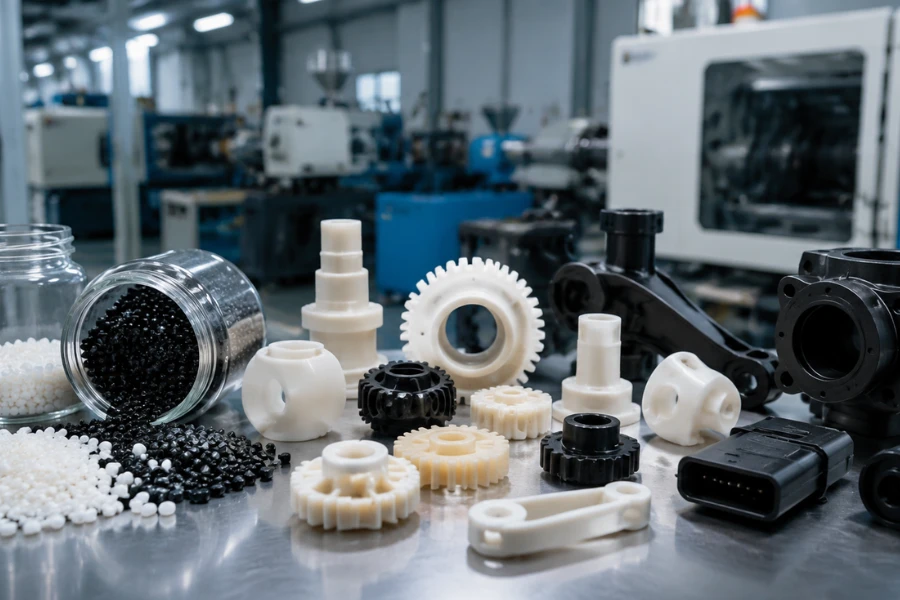
Nylon plastic is one of the most widely used engineering thermoplastics in modern manufacturing, but selecting the right nylon material for a production part requires more than comparing basic strength values. Engineers choose nylon because it provides a strong balance of mechanical performance, wear resistance, fatigue resistance, and lightweight design advantages. However, factors such as moisture absorption, dimensional stability, shrinkage behavior, and processing conditions can significantly influence the final performance of injection molded components.
Unlike commodity plastics, nylon is a family of polyamide (PA) materials with different grades designed for specific engineering requirements. PA6, PA66, PA11, PA12, and glass-filled nylon each provide different combinations of stiffness, toughness, heat resistance, and manufacturing characteristics.
This guide explains what nylon plastic is, how its molecular structure affects performance, how engineers select between different nylon grades, and what design and injection molding considerations are required to produce reliable nylon parts.
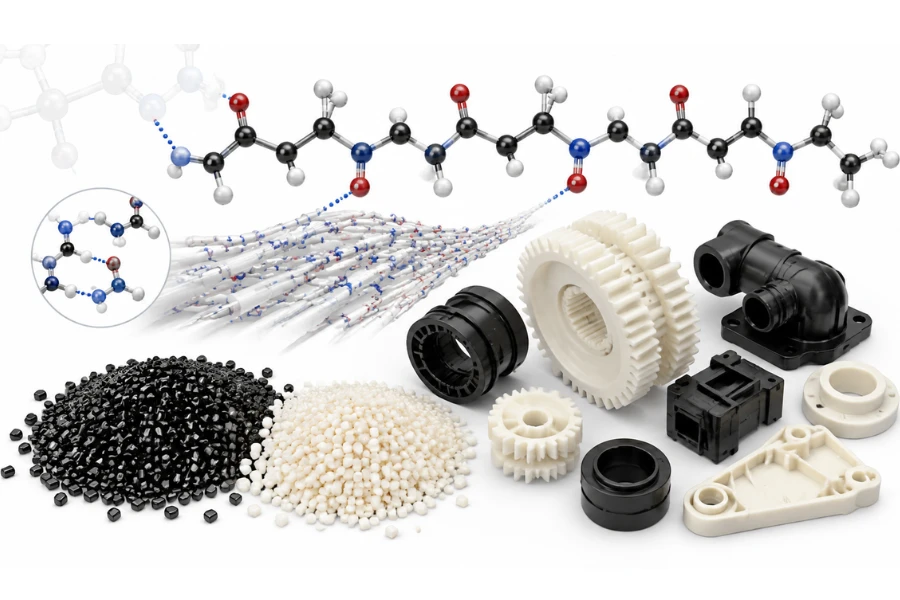
Nylon plastic is a synthetic engineering thermoplastic belonging to the polyamide (PA) family. Its chemical structure contains repeating amide groups (-CONH-) within the polymer backbone, which create strong intermolecular interactions between molecular chains.
These molecular interactions give nylon several important engineering characteristics, including:
Unlike general-purpose plastics such as polyethylene (PE) and polypropylene (PP), nylon is classified as an engineering plastic because it can withstand higher mechanical loads and more demanding operating conditions.
Nylon is commonly used for:
However, nylon plastic is not a single material. It represents a group of polyamide materials with different molecular structures and performance characteristics.
The choice between PA6, PA66, PA11, PA12, and reinforced nylon affects:
For this reason, engineers should select nylon based on the actual application environment rather than simply choosing the strongest available grade.
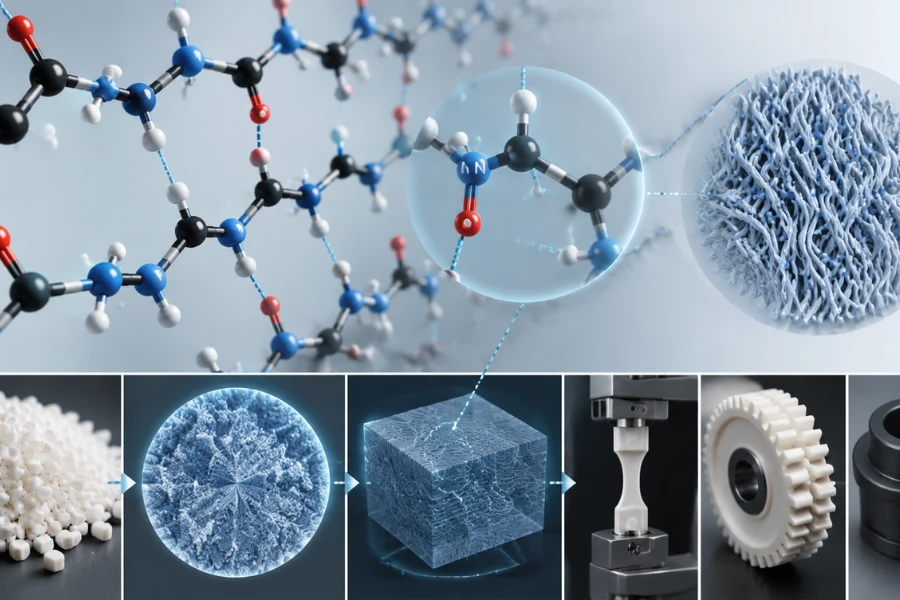
The performance of nylon plastic is closely related to its molecular structure.
The amide groups in nylon molecules can form hydrogen bonds between polymer chains. These interactions create stronger bonding compared with many other thermoplastic materials.
The relationship can be summarized as:
Amide groups → Hydrogen bonding → Stronger molecular interaction → Improved mechanical performance
This structure creates both advantages and limitations.
The same molecular characteristics that provide nylon with strength and wear resistance also contribute to moisture sensitivity and processing considerations.
The strong intermolecular bonding inside nylon improves its ability to withstand mechanical stress.
Compared with many common thermoplastics, nylon provides:
These properties make nylon suitable for components that experience repeated movement or mechanical loading.
For example, nylon gears and bushings are often used instead of metal parts because they can provide:
However, replacing metal with nylon requires careful engineering evaluation.
Nylon may not be suitable when applications require:
The correct material decision depends on balancing performance requirements, manufacturing cost, and operating conditions.
One of the most important characteristics of nylon plastic is its ability to absorb moisture.
Because nylon contains polar amide groups, water molecules can interact with the polymer structure. This moisture absorption changes the behavior of the material.
The effects include:
| Moisture Effect | Engineering Impact |
|---|---|
| Increased toughness | Improved impact resistance |
| Reduced stiffness | Lower rigidity |
| Dimensional expansion | Potential tolerance changes |
| Material property variation | Different dry and conditioned performance |
For many applications, moisture absorption is not necessarily a disadvantage.
A small amount of moisture can improve toughness and reduce brittleness.
However, for precision components, moisture-related dimensional changes must be considered during design.
Examples include:
Engineers should evaluate:
When dimensional stability is critical, lower moisture absorption grades such as PA12 may provide advantages compared with higher moisture absorption grades.
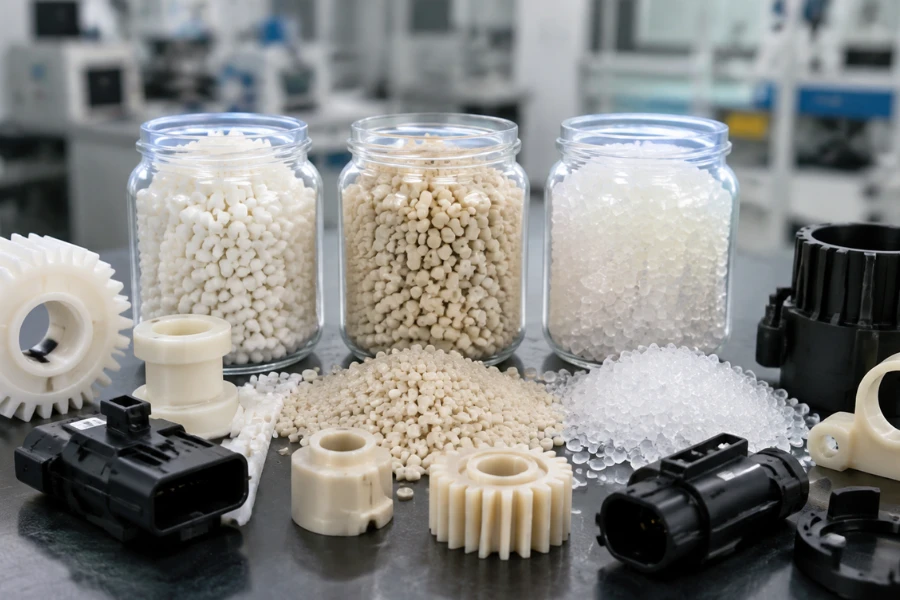
Nylon is available in many formulations, but several grades are commonly used for engineering applications.
The most widely used types include PA6, PA66, PA11, PA12, PA610, and glass-filled nylon.
| Nylon Grade | Main Characteristics | Typical Applications |
|---|---|---|
| PA6 | Good toughness, impact resistance, and processing flexibility | General mechanical parts, housings |
| PA66 | Higher strength, stiffness, and heat resistance | Automotive parts, gears, structural components |
| PA11 | Good chemical resistance and low-temperature toughness | Tubes, specialty industrial components |
| PA12 | Low moisture absorption and improved dimensional stability | Precision components, fluid systems |
| PA610 | Balanced properties with lower moisture absorption than PA66 | Mechanical components |
| Glass-Filled Nylon | Higher stiffness, strength, and heat resistance | Structural and load-bearing parts |
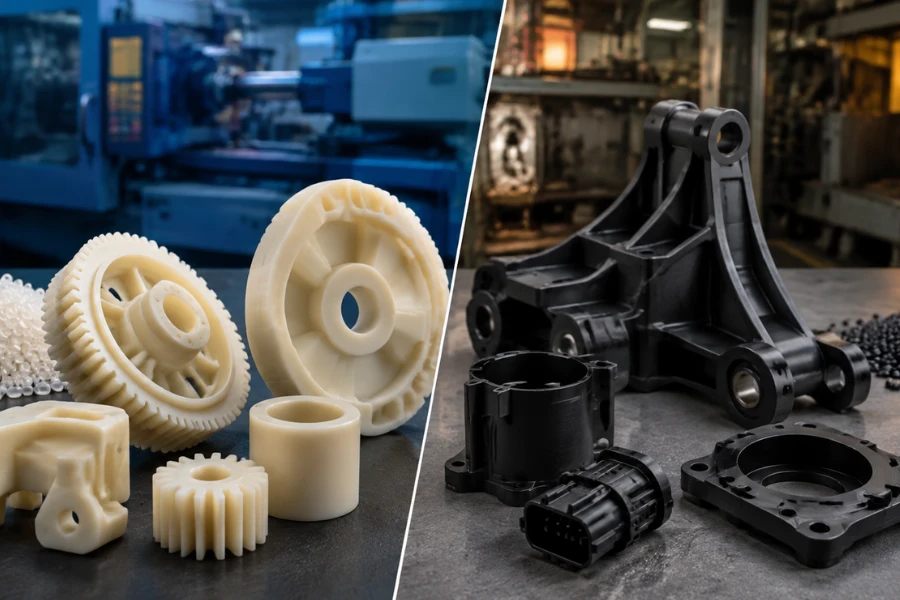
PA6 and PA66 are the two most commonly used nylon grades in injection molding.
Although they belong to the same polyamide family, their differences affect mechanical performance, processing requirements, and production decisions.
PA6 provides a balanced combination of toughness, impact resistance, and processing flexibility.
Main advantages:
PA6 is often selected when engineers need durable components that can withstand impact loads.
Typical applications include:
However, PA6 absorbs more moisture compared with some other nylon grades, which can affect dimensional stability in humid environments.
PA66 provides higher stiffness, strength, and temperature resistance compared with PA6.
Main advantages:
PA66 is commonly selected for components exposed to continuous mechanical stress.
Typical applications include:
The trade-off is that PA66 requires more demanding processing conditions because of its higher melting temperature and narrower processing window.
| Property | PA6 | PA66 |
|---|---|---|
| Impact resistance | Higher | Good |
| Stiffness | Good | Higher |
| Heat resistance | Moderate | Higher |
| Wear resistance | Good | Better |
| Processing difficulty | Easier | More demanding |
| Moisture absorption | Higher | Lower |
| Typical applications | Tough components | Structural components |
The choice between PA6 and PA66 should depend on the actual application requirements.
PA6 is often the better choice when impact resistance, processing flexibility, and cost efficiency are important.
PA66 is usually preferred when higher stiffness, temperature resistance, and long-term mechanical loading are required.
PA12 is widely selected when dimensional stability and lower moisture absorption are important.
Compared with PA6 and PA66, PA12 absorbs less moisture, which helps reduce environmental dimensional changes.
Common applications include:
However, PA12 generally provides lower stiffness compared with PA66, making it less suitable for applications requiring maximum structural rigidity.
PA11 provides good chemical resistance and maintains toughness at low temperatures.
It is commonly used for:
Its main advantage is maintaining performance under challenging environmental conditions.
Glass-filled nylon is created by adding glass fibers into the nylon polymer matrix to improve structural performance.
Compared with unfilled nylon, glass-filled grades provide:
However, reinforcement also introduces additional engineering considerations.
Glass fibers can cause:
Therefore, glass-filled nylon requires careful mold design and process optimization.
For structural applications, glass-filled nylon can provide a practical balance between plastic manufacturing advantages and metal-like mechanical performance.
Nylon plastic is widely used as an engineering material because it provides a balanced combination of strength, toughness, wear resistance, and manufacturing flexibility. However, engineers should evaluate both its advantages and limitations before selecting nylon for production parts.
The most important consideration is that nylon performance is highly dependent on application conditions. A nylon grade that performs well in a dry mechanical environment may not be the best choice for a precision component exposed to humidity, temperature changes, or chemical exposure.
Nylon is often selected when a plastic component must withstand repeated mechanical loading.
Compared with commodity plastics, nylon provides:
These properties make nylon suitable for moving components such as gears, bearings, bushings, and sliding elements.
In applications where metal replacement is considered, engineers typically evaluate nylon because it can provide:
However, nylon is not always a direct replacement for metals.
For example, a nylon gear may work effectively in a moderate-load transmission system, but a metal gear may still be preferred when the application requires extremely high torque capacity, elevated temperatures, or maximum dimensional stability.
The engineering decision should consider:
Nylon provides better thermal performance than many general-purpose plastics, but its temperature capability varies significantly between grades.
PA66 generally offers higher thermal resistance than PA6 because of its higher melting temperature and molecular structure.
Typical melting temperatures include:
| Material | Approximate Melting Temperature |
|---|---|
| PA6 | 220–225℃ |
| PA66 | 260–270℃ |
| PA12 | Around 178℃ |
However, melting temperature should not be confused with continuous service temperature.
A material may melt at a certain temperature, but long-term exposure to elevated temperatures can gradually reduce:
For applications involving continuous heat exposure, engineers may consider:
Nylon generally performs well against:
However, it has limitations when exposed to:
Chemical compatibility testing is recommended when nylon components operate in demanding environments.
Nylon is widely used for injection molded components because it combines mechanical performance with efficient manufacturing capability.
However, nylon injection molding requires careful process control because the material is affected by:
A successful production process requires alignment between material selection, part design, mold design, and molding parameters.
Proper drying is one of the most important requirements when processing nylon.
Because nylon is hygroscopic, it absorbs moisture from the surrounding environment. Excess moisture during molding can cause polymer degradation and reduce final part performance.
Common moisture-related defects include:
Typical moisture control requirements:
| Parameter | Recommendation |
|---|---|
| Moisture content before molding | ≤0.3% |
| PA6 drying | Hot air drying around 80℃ or vacuum drying |
| Vacuum drying option | Around 105℃ for several hours |
| Material storage | Protect from humidity after drying |
In production environments, drying should be combined with proper material handling.
Common mistakes include:
For high-volume production, moisture control should be treated as part of process capability management rather than only a material preparation step.
Nylon requires higher processing temperatures than many commodity plastics.
Typical processing ranges:
| Parameter | PA6 | PA66 |
|---|---|---|
| Nozzle temperature | 200–210℃ | 250–260℃ |
| Barrel temperature | 220–240℃ | 260–280℃ |
| Mold temperature | 60–100℃ | 60–120℃ |
| Injection pressure | 80–110 MPa | 80–130 MPa |
| Holding pressure | 30–50 MPa | 40–50 MPa |
These values should be adjusted according to:
For example, PA66 typically requires higher mold temperatures because proper crystallization helps achieve stable mechanical properties.
However, higher temperatures can also:
The objective is to maintain a stable processing window rather than simply increasing temperature or pressure.
For nylon parts, mold design directly affects dimensional accuracy, surface quality, and production consistency.
Because nylon is a semi-crystalline material, cooling and crystallization behavior must be carefully controlled.
Gate design is especially important for nylon because improper filling conditions can create:
Good gate design should consider:
For glass-filled nylon, gate location is even more important because fiber orientation can influence:
A poorly positioned gate may create inconsistent performance between different areas of the same component.
Cooling has a major impact on nylon dimensional stability.
Because nylon crystallizes during cooling, uneven cooling rates can create internal stress and warpage.
Potential problems include:
Effective cooling design should focus on:
For precision nylon components, dimensional validation should be performed after the part reaches its expected service condition because moisture absorption and temperature changes can affect final dimensions.
Good part design can reduce molding risks before production begins.
| Design Factor | Engineering Recommendation |
|---|---|
| Wall thickness | Maintain uniform thickness to reduce shrinkage variation |
| Thickness transitions | Avoid sudden changes that create stress and sink marks |
| Ribs | Use ribs carefully to improve stiffness without excessive thickness |
| Corners | Add radii to reduce stress concentration |
| Draft angle | Provide sufficient draft for easier ejection |
| Tolerance design | Consider moisture absorption and molding variation |
Uneven wall thickness can create:
Maintaining consistent wall thickness improves both appearance and dimensional repeatability.
Nylon components often require ribs and bosses to increase stiffness.
However, excessive rib thickness can create:
Design features should support structural requirements while maintaining consistent material distribution.
Nylon tolerance design requires more attention than materials with lower moisture sensitivity.
Engineers should consider:
A dimension measured immediately after molding may not represent the final service dimension after moisture absorption.
Nylon generally has higher shrinkage compared with many amorphous plastics because of its semi-crystalline structure.
Typical shrinkage ranges:
| Nylon Grade | Typical Shrinkage |
|---|---|
| PA6 | Approximately 0.5–2.5% |
| PA66 | Approximately 0.8–2.2% |
| General nylon range | Around 1–2% |
Actual shrinkage depends on:
Glass-filled nylon reduces overall shrinkage but introduces directional variation because fibers align with melt flow.
This creates an important engineering trade-off:
Glass reinforcement improves stiffness and dimensional stability, but it requires more careful mold design because shrinkage becomes anisotropic.
| Defect | Root Cause | Solution |
|---|---|---|
| Short shot | Low pressure, insufficient temperature, poor venting | Optimize pressure, temperature, and vent design |
| Flash | Excessive pressure or insufficient clamp force | Adjust molding parameters |
| Silver streaks | Moisture contamination | Improve drying process |
| Bubbles | Moisture or trapped gas | Improve drying and ventilation |
| Sink marks | Insufficient packing or cooling | Optimize holding pressure and cooling |
| Weld lines | Poor flow conditions | Improve gate design and temperature control |
| Warpage | Uneven shrinkage or cooling | Improve cooling balance and part design |
| Glass fiber exposure | Excessive shear or improper processing | Adjust speed and temperature |
Material selection often requires comparing nylon with other injection molding materials.
| Material | Main Advantages | Common Selection Reason |
|---|---|---|
| Nylon | Strength, wear resistance, fatigue performance | Mechanical moving parts |
| ABS | Appearance, cost efficiency, easy processing | Housings and consumer products |
| PC | High impact resistance, transparency | Protective covers and optical parts |
| PP | Chemical resistance, low cost, lightweight | Chemical containers and general components |
| POM | Low friction, dimensional stability | Precision gears and mechanisms |
Nylon is usually selected when mechanical performance and wear resistance are more important than appearance or absolute dimensional stability.
For highly precise components with strict tolerance requirements, POM may be more suitable.
For extreme temperature environments, materials such as PEEK may provide advantages.
A practical selection approach:
Need impact resistance and easier processing?
→ Choose PA6
Need higher stiffness and temperature resistance?
→ Choose PA66
Need lower moisture sensitivity and better dimensional stability?
→ Choose PA12
Need improved structural performance?
→ Choose glass-filled nylon
Need chemical resistance and low-temperature toughness?
→ Choose PA11
Before finalizing the material, engineers should evaluate:
Yes, but designers must consider moisture absorption, shrinkage behavior, and environmental conditions. Nylon can achieve reliable dimensional accuracy when the correct grade, mold design, processing parameters, and validation methods are applied. For precision applications, dimensions should be evaluated after conditioning rather than only immediately after molding.
PA66 is commonly selected for gears because it provides high stiffness, wear resistance, and creep resistance. However, PA6 may be preferred when higher impact toughness is more important. The final choice depends on load conditions, operating speed, temperature, and lubrication requirements.
In many applications, nylon can replace metal when weight reduction, corrosion resistance, and lower friction are priorities. However, metals remain superior for extreme loads, high temperatures, and applications requiring maximum structural rigidity.
Yes. Nylon is widely used for injection molded components, but successful production requires moisture control, proper mold design, optimized processing parameters, and dimensional validation.
Warpage can be reduced through uniform wall thickness, balanced cooling, optimized gate placement, proper holding pressure, and suitable material selection. Glass-filled nylon may improve stability but requires consideration of fiber orientation and directional shrinkage.
Nylon plastic remains one of the most important engineering thermoplastics because it provides an excellent balance of strength, wear resistance, toughness, and manufacturing flexibility. However, selecting nylon for a production component requires understanding more than material properties alone.
Engineers should evaluate grade selection, moisture behavior, dimensional requirements, mold design, processing conditions, and long-term operating environments before moving into production.
For injection molded nylon parts, successful results come from combining the right polyamide material with DFM-focused design, controlled manufacturing processes, and proper validation. Whether choosing PA6, PA66, PA12, or reinforced nylon, the best material decision is the one that balances performance, manufacturability, reliability, and total production cost.