Physical Address
304 North Cardinal St.
Dorchester Center, MA 02124
Physical Address
304 North Cardinal St.
Dorchester Center, MA 02124
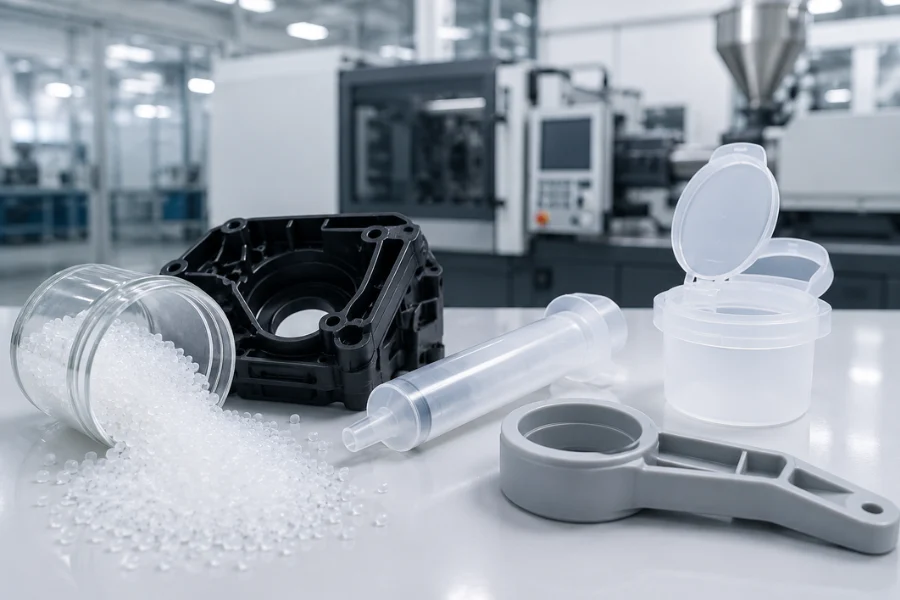
Polypropylene (PP) is one of the most widely used thermoplastics in manufacturing. Its low density, chemical resistance, fatigue resistance, useful heat performance, and relatively low cost make it suitable for products ranging from automotive components and packaging to laboratory equipment and medical devices.
Selecting PP, however, involves more than specifying a polymer name. Homopolymer, random copolymer, impact copolymer, filled, and reinforced grades can behave differently in stiffness, toughness, shrinkage, surface quality, and dimensional stability. Melt flow rate (MFR), crystallinity, additives, part geometry, and processing conditions further influence production results.
For engineers, the practical question is not simply what polypropylene is, but which PP grade can meet the mechanical, dimensional, manufacturing, cost, and validation requirements of the part.
Polypropylene is a lightweight, semi-crystalline thermoplastic made by polymerizing propylene. It belongs to the polyolefin family and is widely used because it combines low density, chemical resistance, fatigue resistance, electrical insulation, and efficient melt processing.
| Property | Typical PP Characteristic |
|---|---|
| Density | Approximately 0.89–0.92 g/cm³ |
| Melting behavior | Many commercial isotactic grades melt around 160–170°C |
| Moisture absorption | Very low |
| Chemical resistance | Good against many acids, alkalis, salts, and chemical solutions |
| Electrical properties | Good electrical insulation |
| Fatigue resistance | Excellent |
| Resin identification code | #5 |
These values are general references, not specifications for every grade. Molecular structure, comonomer content, additives, fillers, reinforcement, and processing history can all change final performance.
Melting temperature should also not be confused with continuous-use temperature. A PP resin may melt above 160°C while its allowable long-term service temperature is considerably lower. Mechanical load, exposure time, grade formulation, and dimensional requirements determine the practical temperature limit.
Most commercial molded PP is predominantly isotactic and semi-crystalline. The material contains ordered crystalline regions together with less ordered regions, and this structure affects stiffness, thermal behavior, optical appearance, and molding shrinkage.
The manufacturing implication is important. Crystallization continues as the molten polymer cools, so differences in section thickness and cooling rate can create different shrinkage behavior across a part. This is one reason semi-crystalline PP components can be more sensitive to warpage than their simple geometry might suggest.
Other tacticities, including syndiotactic and atactic structures, exist, but designers rarely select a commercial molding resin on tacticity alone. PP family, grade formulation, MFR, reinforcement, and supplier data are usually more useful production-level variables.
The three major PP families serve different engineering priorities.
| PP Type | Stiffness | Impact Behavior | Clarity | Typical Selection Reason |
|---|---|---|---|---|
| Homopolymer PP | Higher | Moderate | Moderate | Rigidity and heat performance |
| Random Copolymer PP | Lower | Improved | Better | Clarity and flexibility |
| Impact Copolymer PP | Moderate | Higher | Lower | Toughness and impact resistance |
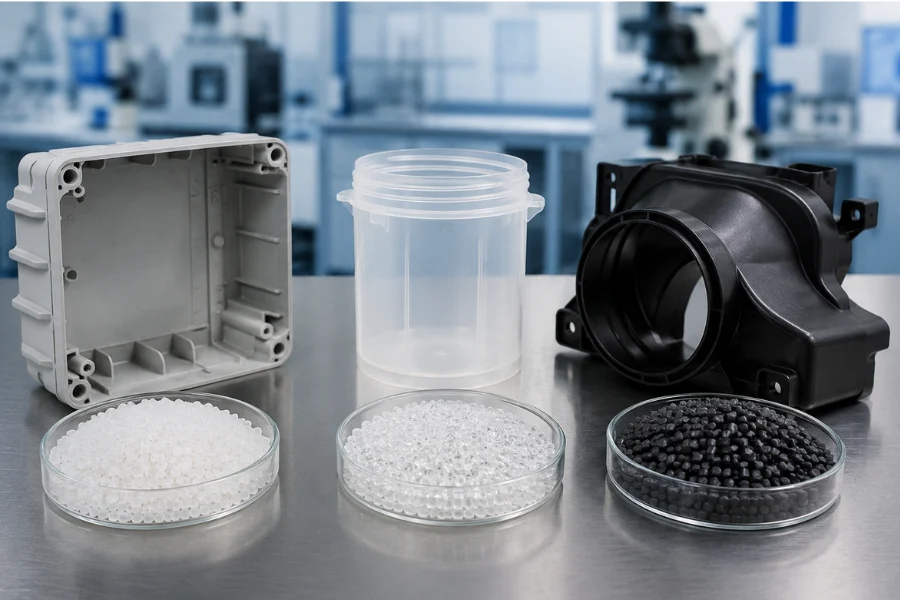
Homopolymer polypropylene generally offers higher stiffness, strength, and heat performance than comparable unfilled copolymer grades. It is commonly used for rigid containers, housings, household products, and industrial components where rigidity takes priority over maximum low-temperature toughness.
Random copolymer PP usually contains a small amount of ethylene distributed through the polymer chain. The resulting disruption of crystalline order can improve clarity and flexibility while reducing stiffness and melting temperature.
This balance is useful in clear or translucent packaging, laboratory products, containers, and selected medical applications.
Impact copolymer PP contains a dispersed impact-modifying phase designed to improve toughness and is sometimes referred to commercially as block copolymer PP.
It is frequently considered for automotive parts, housings, and components exposed to impact or lower temperatures. Greater toughness generally comes at the expense of some rigidity or optical clarity.
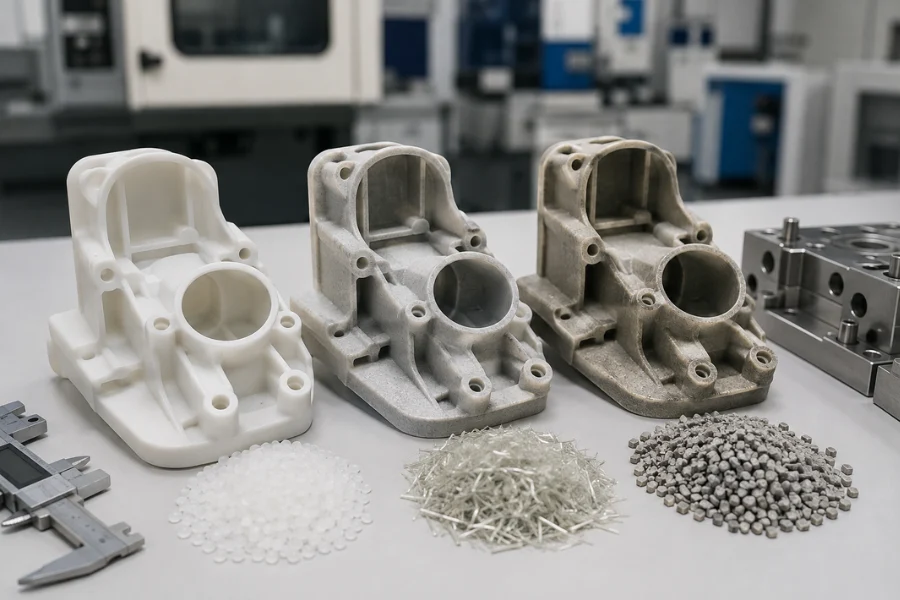
PP grades may contain glass fiber, talc, minerals, impact modifiers, or other additives to move performance beyond that of the base polymer.
Glass fiber can substantially increase stiffness and strength, but flow-induced fiber orientation may increase anisotropic shrinkage and warpage. It can also increase tooling wear and make cosmetic surface requirements more difficult to achieve.
Talc and mineral fillers can improve rigidity and dimensional stability, but they add density and can change impact behavior and surface appearance.
For precision components, specifying only “PP” or “glass-filled PP” leaves too much undefined. The actual resin grade should be part of the engineering specification.
PP’s engineering value comes from the combination of several properties rather than one exceptional characteristic.
At roughly 0.9 g/cm³, it is one of the lightest widely used thermoplastics. Low density reduces part weight and also means less resin mass is required for a component of a given volume. Across high production volumes, that difference can influence material consumption and total part cost.
PP absorbs very little moisture. Its dimensions and properties are therefore less sensitive to humidity than those of many hygroscopic engineering plastics, including numerous nylon grades.
The polymer also resists many acids, alkalis, salts, and chemical solutions. Compatibility still depends on the specific chemical, concentration, temperature, mechanical stress, and exposure duration.
Fatigue resistance is another important strength. PP is widely used for molded living hinges, but resin selection alone does not determine hinge life. Hinge thickness, gate position, flow orientation, mold design, and processing conditions all matter.
The limitations are equally relevant. Unmodified grades may lose toughness at low temperatures, unstabilized PP can degrade under prolonged UV exposure, and low surface energy makes adhesive bonding, painting, and some printing operations difficult without suitable surface preparation.
Melt flow rate is one of the most useful processing indicators on a polypropylene datasheet.
Higher-MFR grades generally flow more readily through thin sections, long flow paths, and small features. That can reduce filling difficulty in complex injection-molded parts.
Higher MFR does not automatically mean better performance. Flow behavior is related to molecular characteristics, and selecting a resin primarily for easy filling can introduce trade-offs in toughness or other mechanical properties.
MFR should therefore be reviewed with wall thickness, flow length, gate and runner design, required injection pressure, mechanical loads, impact requirements, and surface expectations.
In production, MFR is best treated as part of the complete material-part-tooling system, not as an isolated resin property.
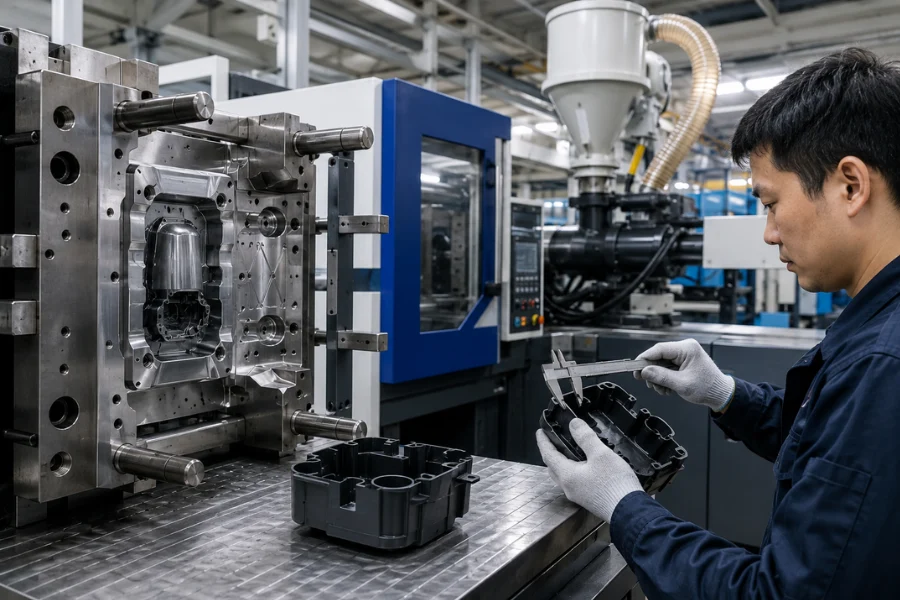
PP processes efficiently by injection molding, but its semi-crystalline behavior makes shrinkage and dimensional control important DFM considerations.
As molten PP cools, both thermal contraction and crystallization contribute to dimensional change. Actual molding shrinkage varies with resin grade, part thickness, mold temperature, packing conditions, cooling rate, flow orientation, and reinforcement.
Toolmakers normally use grade-specific supplier data as an initial basis for cavity sizing, then verify actual dimensions during mold trials.
A generic shrinkage value should not be treated as a guaranteed tooling compensation factor, especially for precision parts.
Many PP warpage problems originate from nonuniform shrinkage:
Uneven wall thickness → uneven cooling and crystallization → differential shrinkage → internal stress → warpage
Maintaining reasonably uniform sections reduces this risk. Where additional stiffness is needed, ribs can often provide structural efficiency without creating unnecessarily thick solid areas.
Reinforced PP adds another variable. Fibers tend to orient with melt flow, so shrinkage can differ along and across the flow direction. Even a geometrically symmetrical part may distort when flow or fiber orientation is unbalanced.
Gate position influences flow-front development, pressure loss, weld-line location, packing, orientation, and dimensional consistency.
For living hinges, flow orientation relative to the hinge can affect fatigue performance. Long or thin parts may also require careful gate and runner design to avoid excessive pressure drop or incomplete filling.
These decisions should be reviewed together during DFM rather than after the mold has been built.
| Engineering Factor | Advantage | Limitation or Risk |
|---|---|---|
| Weight | Very low density | Lower rigidity than some engineering plastics |
| Chemical exposure | Resistant to many chemicals | Compatibility depends on temperature, chemical, and stress |
| Heat | Useful thermal capability for a commodity plastic | Continuous-use temperature is below melting temperature |
| Low temperature | Impact-modified grades improve toughness | Homopolymer PP may become brittle |
| Fatigue | Excellent repeated-flex performance | Geometry and flow orientation affect hinge life |
| Processing | Good moldability | Shrinkage and warpage require control |
| Moisture | Very low absorption | Does not prevent UV or oxidative aging |
| Surface finishing | — | Bonding and painting may require surface treatment |
| Outdoor use | Stabilized grades are available | Unstabilized PP has limited UV durability |
| Cost | Economical base resin | Fillers, reinforcement, rejects, and secondary operations affect final cost |
Resin price tells only part of the cost story. Density, cycle time, scrap, dimensional rejects, secondary finishing, tooling corrections, and process stability can have a greater effect on the cost of the molded component.
The table below provides a general comparison of common unfilled grades. Actual properties can change significantly with grade, additives, reinforcement, and conditioning.
| Selection Requirement | PP | HDPE | ABS | Nylon |
|---|---|---|---|---|
| Low density | Strong choice | Strong choice | Moderate | Moderate |
| Living hinges | Excellent | Possible in suitable designs | Not typical | Not typical |
| Moisture stability | Excellent | Excellent | Good | Requires more attention |
| Structural stiffness | Moderate | Lower to moderate | Generally higher | Generally higher |
| Low-temperature toughness | Grade-dependent | Generally favorable | Generally good | Grade-dependent |
| Painting/bonding | Difficult without preparation | Difficult without preparation | Easier | Application-dependent |
| Chemical resistance | Strong in many environments | Strong in many environments | More limited for some chemicals | Application-dependent |
| High-volume molding economics | Competitive | Competitive | Moderate | Generally higher |
PP makes particular sense when low weight, chemical resistance, moisture stability, repeated flexing, high-volume moldability, and cost must be balanced.
ABS may be more attractive where surface finishing and rigidity matter. Nylon may suit applications requiring greater structural or wear performance, while HDPE can offer advantages where toughness and chemical resistance dominate.
Material selection should ultimately be based on the expected failure modes of the part rather than a generic ranking of plastics.
PP appears across many industries because different grades can be matched to different functional requirements.
| Application | Why PP Is Used | Main Engineering Risk |
|---|---|---|
| Living hinges and caps | Fatigue resistance | Hinge geometry and flow orientation |
| Automotive trim | Low density, moldability, cost | Impact, UV exposure, warpage |
| Chemical containers | Chemical and moisture resistance | Temperature-dependent compatibility |
| Consumer housings | Cost and processability | Rigidity and surface finishing |
| Electrical parts | Insulation and low moisture absorption | Heat and flame requirements |
| Medical disposables | Grade-specific processability | Regulatory and sterilization validation |
PP is also processed into films, fibers, pipes, sheets, and blow-molded products. A grade developed for one process should not automatically be assumed suitable for another.
Medical-grade PP requires more specific material control than ordinary polypropylene used in general consumer products.
Depending on the application, engineers may need to evaluate biocompatibility, additives, extractables and leachables, traceability, sterilization compatibility, lot consistency, and supplier documentation. ISO 10993 testing, USP Class VI classification, or other regulatory documentation may be relevant, but these are not inherent certifications of all PP.
Sterilization must also be validated for the actual grade. Steam, gamma radiation, and other methods expose polymers to different stresses, and radiation can change PP properties depending on formulation, dose, stabilizers, and aging.
For critical products, validation should cover the actual resin, molded component, sterilization process, and intended service conditions.
A practical PP selection process starts with the application rather than the resin datasheet.
1. Define the service conditions
Identify mechanical load, temperature, chemical exposure, impact, expected life, UV exposure, regulatory requirements, and critical dimensions.
2. Choose the PP family
Higher rigidity and heat performance
→ Consider homopolymer or reinforced PP.
Clarity or additional flexibility
→ Evaluate random copolymer PP.
Greater impact toughness
→ Evaluate impact copolymer PP.
3. Match material flow to the geometry
Thin walls or long flow paths
→ Review MFR, gate location, runner design, and filling requirements.
Tight dimensional requirements
→ Review grade-specific shrinkage, reinforcement, flow orientation, warpage risk, and tooling strategy.
4. Check secondary requirements
Painting, bonding, UV resistance, flame performance, sterilization, or regulatory documentation can eliminate an otherwise suitable resin.
5. Validate production capability
A successful T0 or initial mold trial does not prove that the process is ready for production. Critical dimensions and functional performance should remain stable across an established molding window and repeated production runs.
| Validation Item | What It Confirms |
|---|---|
| Dimensional inspection | Shrinkage, warpage, and tolerance stability |
| Visual inspection | Flow marks, sink, weld lines, and surface defects |
| Mechanical testing | Strength, stiffness, impact, or functional performance |
| Process-window study | Repeatability under realistic molding variation |
| Environmental testing | Heat, chemical, or UV performance |
| Application-specific testing | Sterilization, regulatory, or functional requirements |
The development sequence is:
Material Selection → DFM → Tooling → Mold Trial → Validation → Production
Low resin price does not always mean low molded-part cost. A material that produces unstable dimensions, excessive rejects, difficult secondary finishing, or repeated tooling changes can be more expensive over the production life of the part.
PP has very low moisture absorption and is not typically treated as a strongly hygroscopic resin like nylon. Under normal storage conditions, extensive pre-drying may therefore be unnecessary. Surface moisture, poor storage, contamination, additives, or compound-specific requirements can still affect processing, so the resin supplier’s drying and handling recommendations should take priority.
There is no universal answer because both polymer families contain many grades. PP generally offers greater stiffness and better heat performance than many polyethylene grades, while polyethylene can provide better low-temperature toughness in some applications. Actual grade datasheets and service conditions are more useful than comparing the polymer names alone.
Yes. PP combines good melt flow, low density, broad grade availability, and economical high-volume processing. Its main engineering challenges include shrinkage, warpage, dimensional control, and grade-dependent low-temperature performance. MFR, wall thickness, gate location, cooling, packing, and tooling compensation should be considered during DFM.
PP has excellent resistance to repeated flexing, making it particularly suitable for molded living hinges. Durable hinges still depend on appropriate thickness, resin grade, gate location, melt-flow orientation, mold design, and processing conditions. A poorly designed PP hinge can fail prematurely even when the base material has good fatigue resistance.
Certain medical-grade PP resins are widely used for syringes, laboratory products, trays, packaging, and other healthcare components. Suitability is application-specific. Engineers should review biocompatibility, additives, extractables and leachables, sterilization compatibility, regulatory documentation, and patient-contact requirements before approving a grade.
Polypropylene is a strong candidate when low weight, chemical resistance, moisture stability, fatigue resistance, efficient processing, and competitive manufacturing cost must be balanced. Its homopolymer, random copolymer, impact-modified, filled, and reinforced grades give designers considerable flexibility.
That flexibility also means “PP” alone is often an incomplete production specification. The selected grade must be evaluated for MFR, stiffness, impact behavior, temperature limits, shrinkage, dimensional requirements, surface finishing, environmental exposure, and any regulatory constraints.
For production parts, material selection should be connected to DFM, tooling, process development, inspection, and validation from the beginning. A polypropylene grade is successful not simply when the first molded samples look acceptable, but when the process repeatedly produces parts that meet functional and dimensional requirements at the intended manufacturing scale.