Physical Address
304 North Cardinal St.
Dorchester Center, MA 02124
Physical Address
304 North Cardinal St.
Dorchester Center, MA 02124
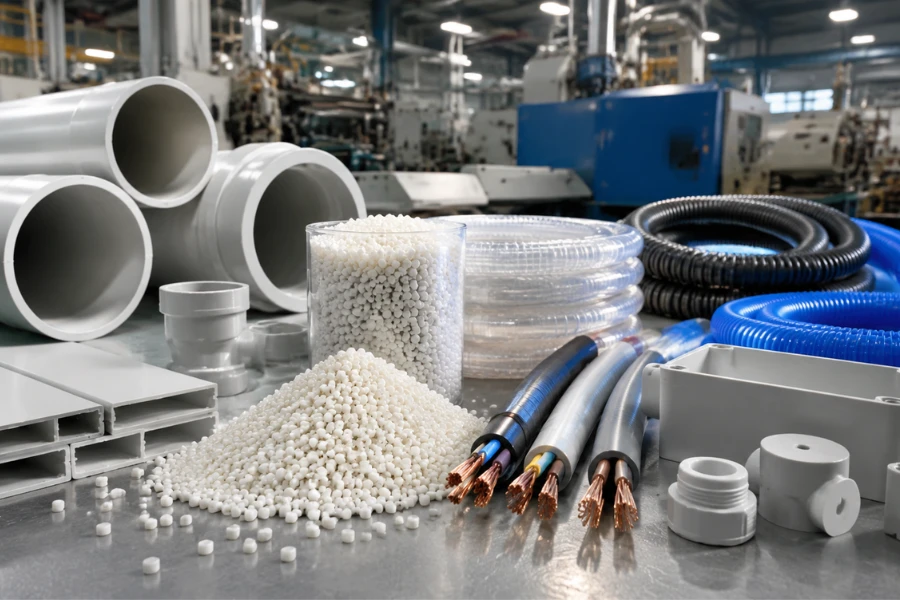
Polyvinyl chloride (PVC) is one of the most widely used thermoplastic materials in global manufacturing, but selecting PVC for a product requires more than understanding its basic definition. Unlike many plastics with relatively fixed performance characteristics, PVC can be engineered into rigid structural components, flexible tubing, electrical insulation, and chemical-resistant parts by adjusting its formulation and additive system.
For product designers, manufacturing engineers, and OEM buyers, the important question is not only “what is PVC?” but whether PVC can provide the required balance between mechanical performance, dimensional stability, processing reliability, and manufacturing cost.
This guide explains PVC material properties, rigid PVC and flexible PVC differences, injection molding considerations, mold design requirements, common production problems, and engineering selection factors to help manufacturers make better material decisions.
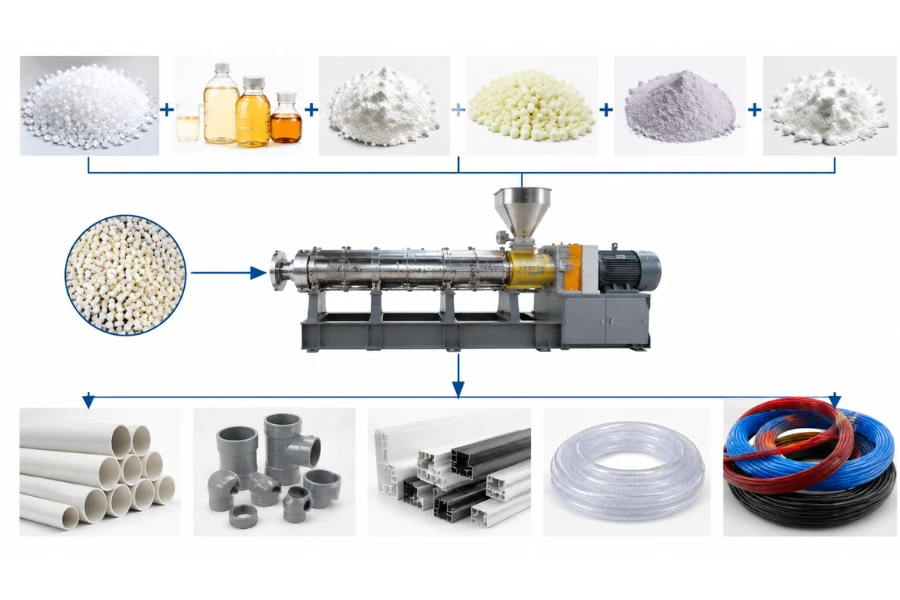
PVC, or polyvinyl chloride, is a thermoplastic polymer produced through the polymerization of vinyl chloride monomer. The polymer consists of long molecular chains containing chlorine atoms, which contribute to its chemical stability, electrical insulation properties, and unique ability to be modified through additives.
PVC resin is typically supplied as a white or light-yellow powder. Pure PVC has a density of approximately 1.4 g/cm³, while finished PVC compounds may have different densities depending on the amount of plasticizers, fillers, stabilizers, and modifiers used. In practical applications, PVC product density commonly ranges from approximately 1.15 to 2.00 g/cm³.
Unlike materials such as polypropylene or polyethylene, where the base polymer largely determines final performance, PVC behavior depends heavily on formulation design. A PVC compound is not simply “PVC”; it is a combination of PVC resin and carefully selected additives designed for a specific application.
For example:
This formulation flexibility allows PVC to serve very different industries, including construction, electrical, medical, chemical processing, and consumer products.
However, the same chemical structure that provides PVC with good performance also creates manufacturing challenges. PVC has relatively poor thermal stability compared with many common thermoplastics. When exposed to excessive processing temperature or excessive residence time, PVC can undergo thermal degradation and release hydrogen chloride (HCl).
This degradation can result in:
Therefore, successful PVC manufacturing requires controlling both material selection and processing conditions.
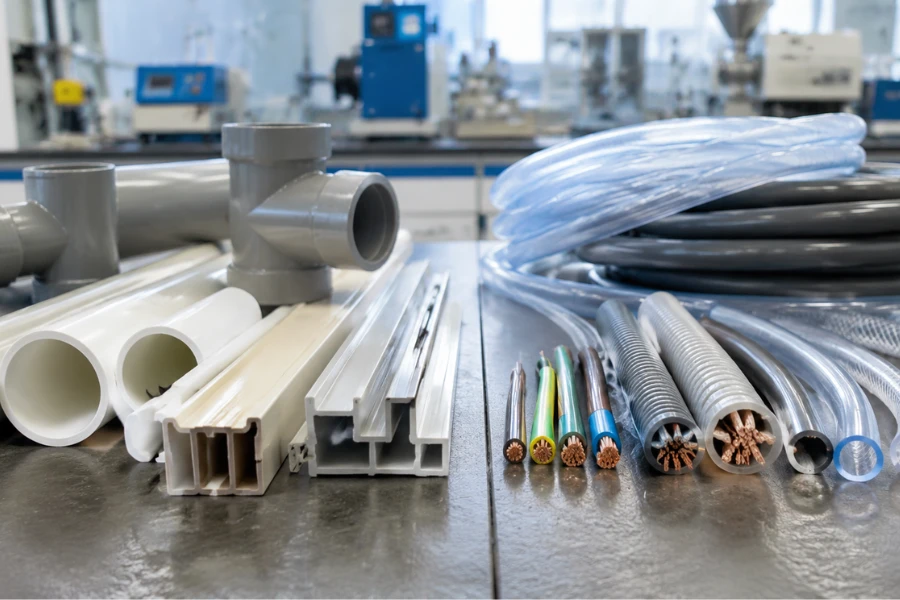
The most important classification of PVC materials is the difference between rigid PVC and flexible PVC.
The primary difference comes from plasticizer content.
Rigid PVC, also known as PVC-U or RPVC, contains little or no plasticizer. It maintains high stiffness, strength, and dimensional stability, making it suitable for structural applications.
Flexible PVC, also known as PVC-P or SPVC, contains a higher amount of plasticizer. Plasticizers reduce intermolecular forces between polymer chains, allowing the material to bend and stretch more easily.
However, this improvement in flexibility comes with trade-offs in strength, hardness, and dimensional stability.
| Property | Rigid PVC (PVC-U) | Flexible PVC (PVC-P) |
|---|---|---|
| Plasticizer content | None or very low | Higher content |
| Stiffness | High | Lower |
| Flexibility | Limited | Excellent |
| Tensile strength | Higher | Lower |
| Elongation | Lower | Higher |
| Dimensional stability | Better | More sensitive |
| Typical applications | Pipes, profiles, structural parts | Tubing, films, cable insulation |
Commercial PVC products are rarely made from pure PVC resin. Manufacturers use additive systems to adjust performance according to application requirements.
Common PVC additives include:
| Additive | Purpose |
|---|---|
| Plasticizers | Increase flexibility and elongation |
| Heat stabilizers | Improve resistance to thermal degradation |
| Lubricants | Improve processing behavior and reduce friction |
| Fillers | Adjust cost, stiffness, and dimensional performance |
| Impact modifiers | Improve toughness |
| Pigments | Control color and appearance |
For engineers, this means material selection should focus on the complete PVC compound rather than only the polymer family.
A rigid PVC pipe and a flexible medical tube may both be called PVC products, but their:
can be completely different.
The correct question is not:
“Is PVC suitable?”
It is:
“Which PVC formulation is suitable for this application?”
PVC remains popular because it provides a strong combination of chemical resistance, electrical insulation, cost efficiency, and formulation flexibility. However, engineers must understand where PVC performs well and where its limitations create risks.
Rigid PVC provides higher stiffness and mechanical strength compared with flexible PVC.
Typical rigid PVC grades can achieve:
Flexible PVC achieves greater elongation because plasticizers increase molecular mobility, but this reduces rigidity and load-bearing capability.
The engineering trade-off is straightforward:
Higher plasticizer content:
Lower plasticizer content:
For a rigid housing, pipe fitting, or structural profile, PVC-U is often preferred. For applications requiring repeated bending, soft touch, or elastic deformation, PVC-P is generally more suitable.
Chemical resistance is one of PVC’s strongest advantages.
PVC performs well against many common industrial chemicals, including:
This makes PVC suitable for:
However, engineers should evaluate chemical compatibility together with temperature and stress conditions.
A flexible PVC component exposed to oils or solvents may behave differently from a rigid PVC component because plasticizers can influence chemical resistance.
PVC has excellent electrical insulation characteristics, making it widely used in electrical applications.
Typical applications include:
The material’s combination of insulation performance, weather resistance, and extrusion capability makes PVC one of the most common materials for cable manufacturing.
The biggest engineering limitation of PVC is thermal sensitivity.
Typical PVC applications operate within approximately -15°C to 55°C depending on formulation and service conditions.
During processing, excessive heat can cause PVC degradation.
The main causes include:
The result is not only a material issue. PVC degradation can directly affect production efficiency by causing:
For manufacturers, thermal control is one of the most important factors affecting PVC production stability.
When engineers evaluate PVC for a new product, the decision should not be based only on material cost. The correct selection depends on the relationship between performance requirements, manufacturing conditions, and long-term reliability.
PVC can be an excellent choice when chemical resistance, electrical insulation, flexibility adjustment, and cost efficiency are priorities. However, its thermal sensitivity and processing limitations must be considered before committing to tooling and mass production.
PVC provides strong resistance against many corrosive environments, which is one of the main reasons it is widely used in industrial applications.
Compared with many metals, PVC does not suffer from conventional corrosion when exposed to acids, alkalis, or salt solutions.
Typical applications include:
However, chemical resistance should always be evaluated under actual operating conditions. Temperature, mechanical stress, and additive composition can influence long-term performance.
For example, a rigid PVC pipe used for chemical transportation may have excellent durability, while a flexible PVC component containing plasticizers may require additional compatibility testing when exposed to solvents or oils.
One of PVC’s biggest advantages is its ability to achieve different performance levels through formulation adjustment.
Manufacturers can modify PVC compounds to achieve:
This allows engineers to use PVC across different industries without changing to completely different polymer systems.
PVC provides a strong balance between material cost and functional performance.
For applications where extreme temperature resistance or high mechanical strength is not required, PVC can often provide sufficient performance at a lower cost compared with many engineering plastics.
This is why PVC remains widely used in:
However, low material cost should not be evaluated separately from manufacturing cost. Poor process control during PVC production can increase scrap rates, maintenance requirements, and quality issues.
The most important limitation of PVC is its sensitivity to heat.
During injection molding or extrusion, excessive thermal exposure can cause PVC degradation and release hydrogen chloride (HCl).
The result may include:
In production environments, these issues are not always caused by one incorrect temperature setting. A process may run successfully during initial trials but develop defects later because degraded material accumulates inside the screw, nozzle, or stagnant areas of the processing equipment.
A proper solution requires evaluating:
PVC is not typically selected for applications requiring continuous high-temperature exposure.
Engineers should carefully review alternatives when the product experiences:
Materials such as PP, PPS, or PEEK may be more suitable depending on performance requirements.
Compared with materials such as PP and PE, PVC has a narrower processing window.
Small variations in:
can influence product quality.
This makes process capability and production monitoring particularly important for PVC mass production.
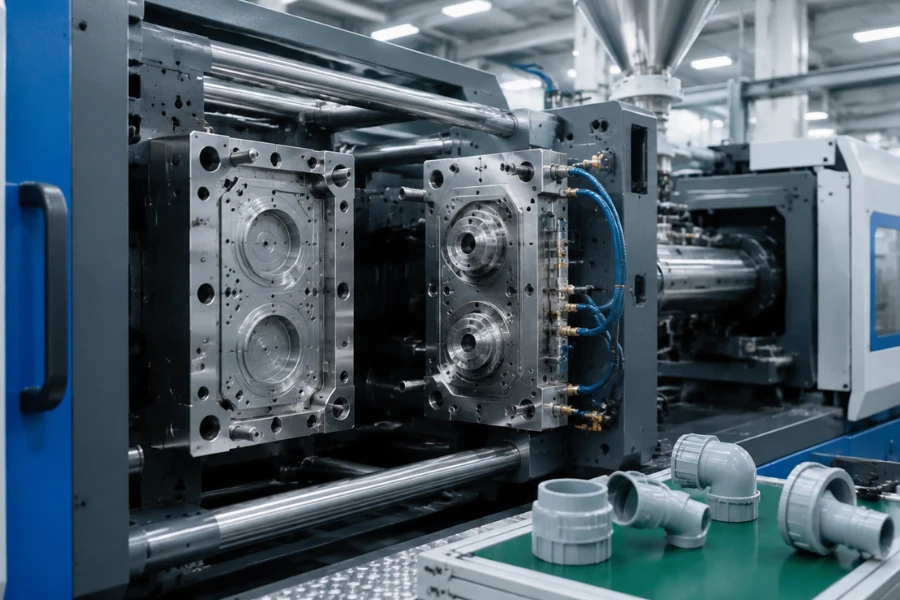
Although PVC is widely processed through extrusion, PVC injection molding is used for specific components requiring complex geometries, integrated features, or high production volumes.
However, PVC injection molding requires stricter process control compared with many common thermoplastics because the material can degrade when exposed to excessive heat.
PVC processing requires a balance between achieving sufficient melt flow and avoiding thermal damage.
Typical PVC injection molding parameters are:
| Parameter | Soft PVC | Rigid PVC |
|---|---|---|
| Nozzle temperature | 140–150°C | 150–170°C |
| Barrel temperature | 140–190°C | 160–180°C |
| Mold temperature | 30–40°C | 30–60°C |
| Injection pressure | 40–80 MPa | 80–130 MPa |
| Holding pressure | 20–30 MPa | 40–60 MPa |
| Cooling time | 15–30 s | 15–40 s |
These values are general processing ranges. Actual conditions depend on:
The objective is to maintain stable filling while minimizing unnecessary heat history.
Rigid PVC has poorer flow behavior compared with many commodity plastics.
This creates several manufacturing implications:
Reference processing data shows that rigid PVC generally requires higher injection pressure compared with flexible PVC because its flow capability is more limited.
Typical injection pressure ranges:
For engineers, this means rigid PVC parts require more careful evaluation during DFM review.
A design that fills easily with PP or PE may require significant mold adjustments when produced with rigid PVC.
Successful PVC injection molding starts before tooling begins.
Material behavior should influence part design decisions.
Sudden wall thickness changes should be avoided because they create uneven cooling and inconsistent shrinkage.
Thicker sections may retain heat longer, increasing the risk of:
Recommended practices:
Because rigid PVC has limited flow capability, long flow paths can increase filling difficulty.
During design review, engineers should evaluate:
A shorter and more balanced filling path generally improves production stability.
Cooling design affects both dimensional accuracy and cycle consistency.
Uneven cooling may cause:
For PVC components requiring tight dimensional control, cooling balance should be evaluated during mold design rather than corrected after production problems appear.
Mold design directly affects PVC quality because the material is sensitive to shear, temperature, and residence time.
Rigid PVC requires a mold filling system that minimizes unnecessary resistance.
Recommended practices include:
Typical PVC runner diameter:
3.1–9.5 mm
A restrictive runner can increase shear heating, which is especially risky for PVC because thermal degradation can occur quickly.
Gate selection should also consider processing stability.
Suitable gate types include:
Small restrictive gates may increase shear stress and create:
This creates an engineering trade-off:
A larger gate improves molding reliability but may increase finishing requirements after molding.
Proper venting is essential because trapped gas can create surface defects.
Common problems caused by poor venting include:
For rigid PVC, typical vent depth is approximately:
0.01–0.03 mm
The exact value depends on:
A well-designed venting system improves filling stability and reduces defect risk.
PVC manufacturing problems are often related to thermal degradation, unstable material flow, mold design limitations, or inconsistent process conditions. In production environments, solving defects requires identifying the root cause rather than only adjusting machine settings.
A temporary parameter adjustment may hide a problem during trial production, but long-term production stability requires understanding why the defect occurs.
| Defect | Possible Root Cause | Practical Solution |
|---|---|---|
| Black spots | PVC degradation, excessive melt temperature, long residence time, material trapped inside equipment | Reduce thermal exposure, clean screw and nozzle system, verify stabilizer performance |
| Discoloration | Overheating, poor temperature control, insufficient thermal stabilization | Optimize temperature profile and shorten material residence time |
| Poor surface finish | Incorrect mold temperature, unstable filling, poor venting | Adjust molding conditions and improve mold design |
| Short shot | Poor flow behavior, insufficient injection pressure, restrictive gate design | Increase filling capability and optimize gate/runner system |
| Dimensional variation | Uneven cooling, inconsistent material properties, excessive shrinkage variation | Improve cooling design and process control |
| Mold corrosion | HCl release caused by PVC degradation | Use corrosion-resistant mold materials and improve processing stability |
One common PVC production issue is black contamination appearing after continuous molding.
A common assumption is that the raw material is contaminated. However, in many cases, the actual cause is thermal degradation during processing.
Possible causes include:
A systematic troubleshooting process should include:
This approach improves production repeatability instead of only correcting individual defective parts.
Dimensional stability is an important factor when selecting PVC for precision components.
PVC shrinkage depends on several variables:
Typical PVC shrinkage ranges are:
| PVC Type | Typical Shrinkage Range |
|---|---|
| Rigid PVC (PVC-U) | 0.6–1.5% |
| Semi-rigid PVC | 0.6–2.5% |
| Flexible PVC (PVC-P) | 1.5–3.0% |
The difference between rigid and flexible PVC is mainly caused by molecular mobility.
Flexible PVC contains more plasticizer, allowing polymer chains to move more easily during cooling. This improves flexibility but increases shrinkage variation and dimensional instability.
For precision molded parts, engineers should consider:
Rigid PVC generally provides better dimensional control than flexible PVC.
According to plastic precision classification, unplasticized PVC (PVC-U) can achieve higher accuracy levels, while flexible PVC requires larger tolerance allowances because elastic recovery and deformation can influence final dimensions.
PVC is only one option among common thermoplastics. The correct material choice depends on the application requirements and manufacturing conditions.
A material that performs well in laboratory testing may not always provide the best production result.
| Selection Factor | PVC | PP | PE |
|---|---|---|---|
| Chemical resistance | Excellent | Excellent | Excellent |
| Thermal stability | Lower | Higher | Medium |
| Processing window | Narrower | Wider | Wider |
| Injection molding difficulty | Higher | Lower | Lower |
| Electrical insulation | Excellent | Good | Good |
| Flexibility adjustment | Excellent through additives | Moderate | High |
| Dimensional stability | Good in rigid grades | Good | Moderate |
| Material cost | Low | Low | Low |
Engineers often choose PVC when the application requires:
For example, chemical piping and electrical cable applications benefit from PVC’s unique combination of corrosion resistance and insulation performance.
PVC may not be the best option when manufacturing conditions or operating environments are more demanding.
PP may be preferred when:
PE may be preferred when:
The decision should consider not only material properties but also tooling investment, production repeatability, and quality requirements.
For OEM production, material selection is only the first step. Stable PVC manufacturing requires validation of the entire production process.
A reliable quality control system should evaluate:
| Validation Item | Purpose |
|---|---|
| Dimensional inspection | Confirm shrinkage stability and assembly requirements |
| Visual inspection | Detect discoloration, black spots, and surface defects |
| Mechanical testing | Verify strength and flexibility requirements |
| Material verification | Confirm correct PVC compound and additive system |
| Mold inspection | Identify corrosion or surface damage |
| Process monitoring | Ensure repeatability during mass production |
PVC components should be inspected after production stabilization because early parts may not represent steady-state conditions.
Important factors include:
For high-volume production, manufacturers should monitor:
A stable PVC process is not defined only by producing acceptable samples. It requires consistent performance over thousands or millions of production cycles.
PVC remains one of the most useful thermoplastics because it can be customized for very different applications. However, successful product development requires evaluating both benefits and limitations.
PVC is usually a good choice when the application requires:
However, engineers should consider alternatives when the application requires:
For product designers and OEM buyers, the best material decision should consider the complete manufacturing system:
PVC can provide excellent performance when these factors are aligned. The biggest manufacturing risks usually occur when PVC is selected only based on cost without considering processing limitations.
PVC, or polyvinyl chloride, is a thermoplastic polymer produced from vinyl chloride monomer. Commercial PVC products usually contain additives such as plasticizers, stabilizers, lubricants, fillers, and modifiers to achieve specific mechanical and processing characteristics.
Rigid PVC contains little or no plasticizer, providing higher stiffness, strength, and dimensional stability. Flexible PVC contains more plasticizer, which improves flexibility and elongation but reduces hardness and dimensional accuracy.
Yes, PVC can be injection molded, but it requires careful process control because excessive heat exposure can cause degradation and release hydrogen chloride. Proper temperature control, suitable mold design, and stable processing conditions are necessary for reliable production.
PVC has lower thermal stability than many common thermoplastics. Excessive temperature or long residence time can cause discoloration, black spots, reduced performance, and mold corrosion. Stabilizers and controlled processing conditions are required.
PVC is not universally better than PP or PE. PVC offers excellent chemical resistance, electrical insulation, and formulation flexibility, while PP and PE may provide advantages in temperature resistance, impact performance, or processing stability depending on the application.
Rigid PVC can achieve relatively good dimensional accuracy because of its lower shrinkage and higher stiffness. Flexible PVC generally requires larger tolerance allowances due to higher shrinkage, elastic recovery, and deformation after molding.
PVC remains an important engineering thermoplastic because it combines chemical resistance, electrical insulation, formulation flexibility, and cost efficiency. However, successful PVC product development depends on understanding the relationship between material selection, part design, tooling, and processing conditions.
For engineers, PVC should not be selected only because it is inexpensive. The more important question is whether the material can maintain stable performance throughout production and service life.
Rigid PVC is often a strong choice for applications requiring stiffness, corrosion resistance, and dimensional stability, while flexible PVC provides advantages where elasticity and deformation capability are required. However, applications involving high temperatures, extreme precision, or demanding mechanical conditions should be evaluated carefully against alternative materials.
A successful PVC manufacturing process combines the right compound, appropriate DFM decisions, controlled processing parameters, and consistent quality validation. When these factors are properly managed, PVC can provide reliable performance across industrial, electrical, medical, and construction applications.