Physical Address
304 North Cardinal St.
Dorchester Center, MA 02124
Physical Address
304 North Cardinal St.
Dorchester Center, MA 02124
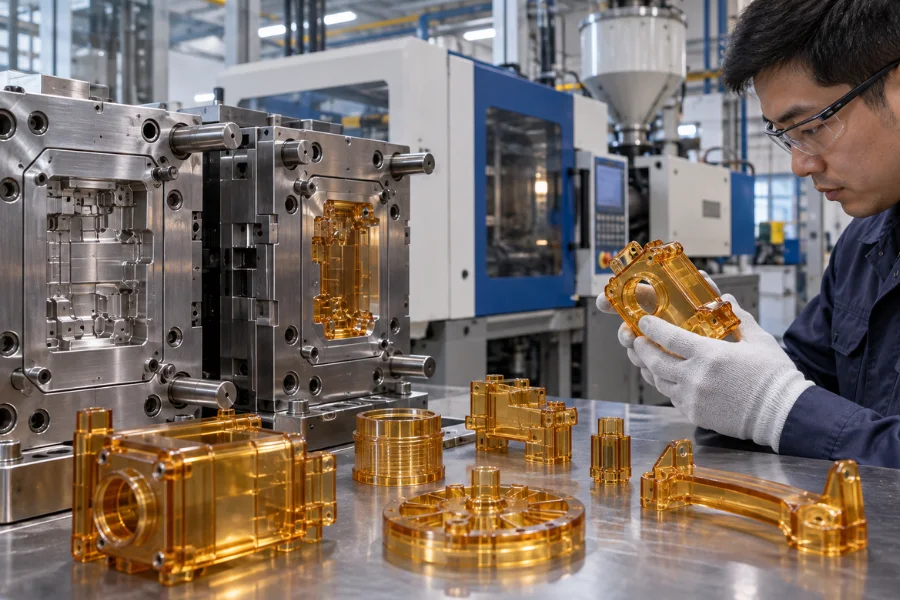
Ultem is a high-performance thermoplastic used when conventional engineering plastics cannot provide enough heat resistance, dimensional stability, stiffness, flame resistance, or electrical insulation. It is a commercial family of polyetherimide (PEI), an amorphous polymer commonly recognized by its natural translucent amber appearance.
For injection molded parts, these properties come with manufacturing trade-offs. PEI requires high processing temperatures, controlled drying, and careful consideration of material flow, part geometry, and dimensional requirements. Understanding both material performance and processing behavior helps determine when Ultem is justified over lower-cost engineering plastics.
Ultem is a family of high-performance polyetherimide (PEI) thermoplastics produced by SABIC. PEI is the polymer type, while ULTEM™ is a commercial material family based on PEI chemistry.
Unlike semi-crystalline thermoplastics such as PEEK, PEI is amorphous and does not develop the ordered crystalline regions associated with semi-crystalline polymers. This affects how the material softens, shrinks, and maintains dimensions during molding and service.
Standard unfilled Ultem is commonly translucent amber, although black, reinforced, and application-specific grades are also available.
PEI’s amorphous structure contributes to its predictable dimensional behavior. Because crystallization is not occurring during cooling, PEI avoids the additional crystallization-driven shrinkage found in semi-crystalline materials.
That does not mean an Ultem part automatically holds tight tolerances. Packing, cooling, wall thickness, gate location, mold temperature, and geometry still influence final dimensions.
Reinforced grades introduce additional considerations. Fiber orientation during mold filling can affect directional stiffness and shrinkage behavior, so gate position and flow direction become more important when dimensional control is critical.
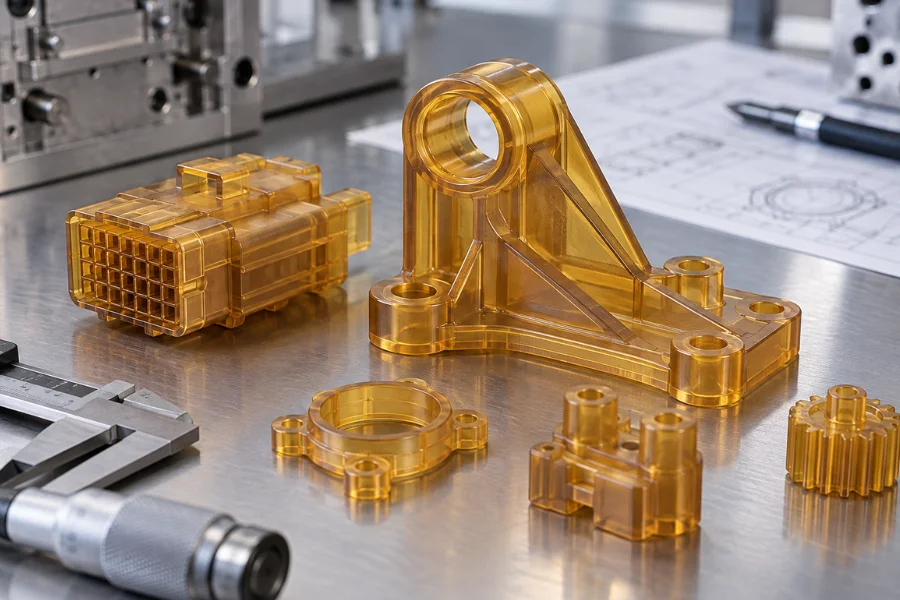
Ultem is usually selected because several demanding properties are required at the same time rather than because of one isolated performance value.
| Property | Engineering Relevance |
|---|---|
| High heat resistance | Retains useful properties at elevated temperatures |
| Dimensional stability | Supports precision components and assemblies |
| High strength and stiffness | Suitable for structural functions |
| Inherent flame resistance | Supports applications with fire-safety requirements |
| Electrical insulation | Useful for connectors and electrical components |
| Chemical and hydrolytic resistance | Supports many demanding service environments |
| Lower density than metals | Creates opportunities for selective weight reduction |
Actual performance depends on grade, reinforcement, test method, environment, and operating conditions.
Heat resistance is one of the defining characteristics of Ultem. Typical reference values place its glass transition temperature around 215–217°C. Depending on grade and test conditions, reference data also indicates continuous-use temperatures around 170°C and heat-deflection temperatures approaching or exceeding 200°C.
A high glass transition temperature allows suitable PEI grades to retain useful stiffness and dimensional stability at temperatures where many conventional engineering plastics soften significantly.
This thermal capability also affects processing. PEI requires substantially higher processing temperatures than commodity plastics, increasing the importance of stable barrel heating, controlled residence time, and appropriate mold temperature management.
Unfilled Ultem combines high tensile strength with substantial stiffness. Typical reference values for some grades place tensile strength around 115 MPa, although reinforced and specialized grades can differ considerably.
Its shrinkage behavior and thermal stability can support good dimensional control over changing service conditions. This is useful for precision housings, connectors, insulating parts, and structural components where dimensional change could affect assembly or function.
Ultem also has relatively low moisture absorption compared with some engineering plastics, but this should not be confused with the drying requirements of resin before molding.
Ultem has inherent flame resistance, and suitable grades can meet demanding flame classifications while producing relatively low smoke.
PEI also provides strong electrical insulation and stable dielectric behavior. A single molded component can therefore provide structural support, electrical isolation, and elevated-temperature performance.
These characteristics are particularly useful in connectors, sockets, electrical housings, and transportation components.
Ultem can resist many service fluids, including certain alcohols, acids, aliphatic hydrocarbons, automotive or aircraft fluids, and aqueous environments. Its hydrolytic stability also supports applications involving hot water and steam.
Compatibility still depends on the chemical, concentration, temperature, applied stress, and exposure duration. Components exposed continuously to cleaning agents, fuels, process chemicals, or sterilization environments should be evaluated using grade-specific compatibility information and representative service conditions.
Ultem can be injection molded into complex production parts, but its processing requirements are more demanding than those of common materials such as ABS, PP, or many PC grades.
High-temperature processing, moisture control, and dimensional consistency deserve particular attention because each can directly affect molded-part quality.
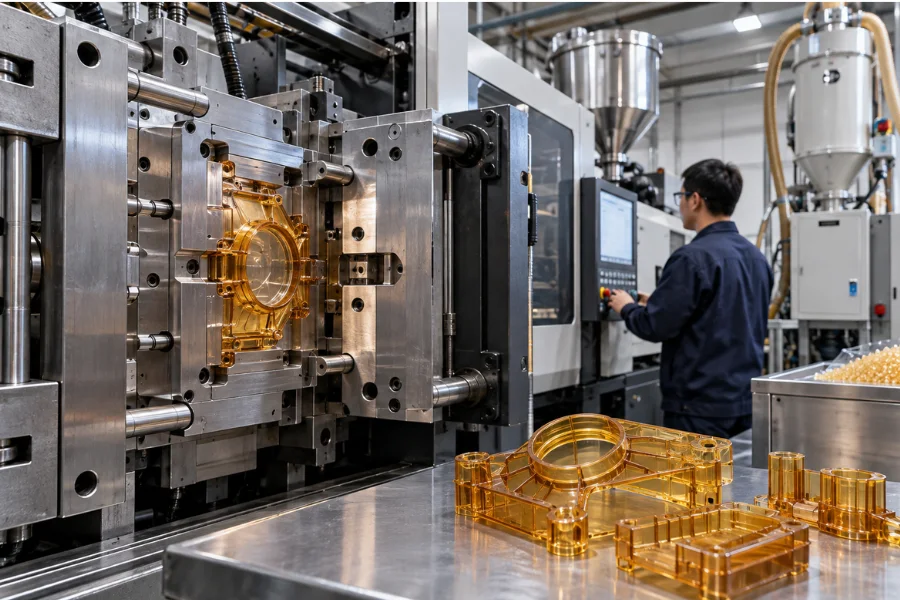
PEI requires high melt-processing temperatures. The molding machine must provide sufficient heating capacity and stable control without keeping the material at elevated temperatures longer than necessary.
Higher temperature can support flow, but excessive thermal exposure or residence time can increase degradation risk. Depending on the severity and molding conditions, degradation may appear as discoloration, surface deterioration, or loss of material performance.
Machine capacity, shot size, residence conditions, part geometry, and the resin supplier’s recommended processing window should therefore be evaluated together.
Relatively low moisture absorption in service does not mean PEI should be molded without drying.
Residual moisture becomes more significant at the high temperatures used to process PEI. If moisture control is inadequate, material degradation can contribute to visible surface defects or reduced molded-part performance.
Resin storage and drying are therefore part of process control. Drying temperature and time should follow the requirements of the selected grade and resin supplier rather than a generic PEI setting.
Ultem’s dimensional stability is attractive for precision molding, but tolerance capability depends on more than the resin.
A long, thin flow path increases filling resistance. If the available flow and pressure window cannot fill the geometry reliably, short shots or poorly formed flow-front intersections can result. Changing wall thickness or gate location may improve filling but can also alter packing, cooling, and final dimensions.
Reinforced PEI introduces another variable because fiber orientation can create directional behavior. The resulting stiffness may improve dimensional stability under load while an unfavorable flow pattern can increase warpage risk.
DFM for PEI should focus on how geometry interacts with flow, high-temperature processing, and dimensional requirements.
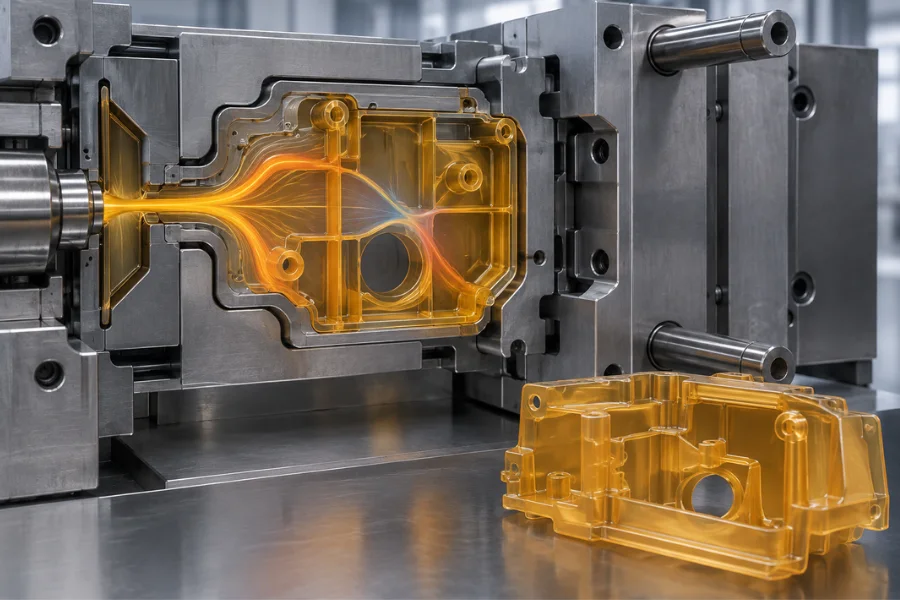
Relatively consistent wall sections help produce more predictable filling and cooling. Abrupt transitions between thick and thin regions can cause local differences in packing and cooling, contributing to dimensional variation or internal stress.
Thin sections combined with long flow lengths are particularly important to review. Filling resistance increases as the flow path becomes more demanding, so the selected PEI grade, gate arrangement, wall geometry, and machine capability need to work within a stable molding window.
Gate location controls the primary flow pattern and influences where separate melt fronts meet around holes, ribs, bosses, and other features.
If a weld line forms across a highly loaded feature, it may become more significant than one located in a low-stress area. Gate location should therefore consider structural requirements as well as filling balance and appearance.
For glass-filled PEI, flow direction can also influence fiber orientation and directional dimensional behavior. Gate placement is therefore part of both the filling strategy and dimensional-control strategy.
Deep walls, ribs, bosses, and textured surfaces require adequate draft for reliable release. Excessive ejection resistance can damage parts or introduce unnecessary stress during demolding.
Sharp internal corners and abrupt section changes can also concentrate service loads. Appropriate radii and smoother transitions help reduce these localized stresses without relying on material strength alone to compensate for poor geometry.
For precision or highly loaded PEI components, these issues are better addressed during DFM than through process adjustments after tooling is complete.
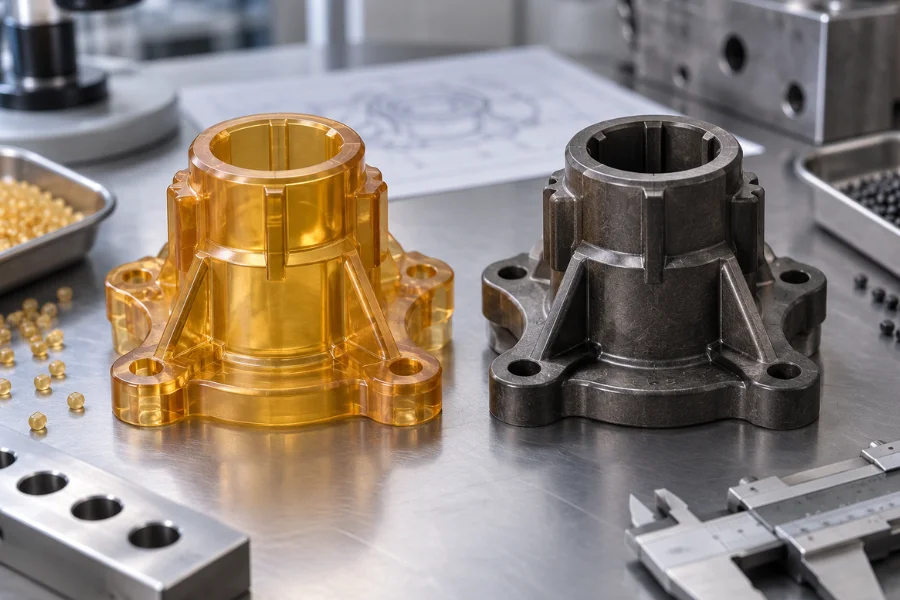
Ultem is a material family rather than a single formulation. Engineers will generally encounter unfilled, reinforced, and application-specific grades.
Unfilled Ultem, including grades such as Ultem 1000, provides the characteristic balance of thermal, mechanical, electrical, and dimensional properties associated with PEI.
Glass-filled Ultem, represented by grades such as Ultem 2300, is considered when greater stiffness or dimensional stability under load is required. Reinforcement also changes flow and directional behavior, so it should not be treated as a simple performance upgrade.
Specialized grades may be formulated or qualified around particular regulatory, flame, processing, or application requirements.
Grade selection should therefore be based on the supplier’s technical data, processing recommendations, and applicable compliance documentation rather than the Ultem name alone.
Ultem provides an unusual combination of elevated-temperature capability, dimensional stability, stiffness, electrical insulation, and flame performance. It can therefore solve applications where a conventional engineering plastic would require compromises in several areas at once.
The trade-off is higher resin cost and more demanding processing than materials such as ABS, POM, nylon, or PC. PEI is also not automatically the preferred choice when extreme impact toughness, sliding wear, aggressive chemical exposure, or minimum material cost dominates the design.
Using Ultem where its thermal, electrical, or dimensional capabilities are unnecessary can result in higher material and manufacturing costs without a corresponding engineering benefit.
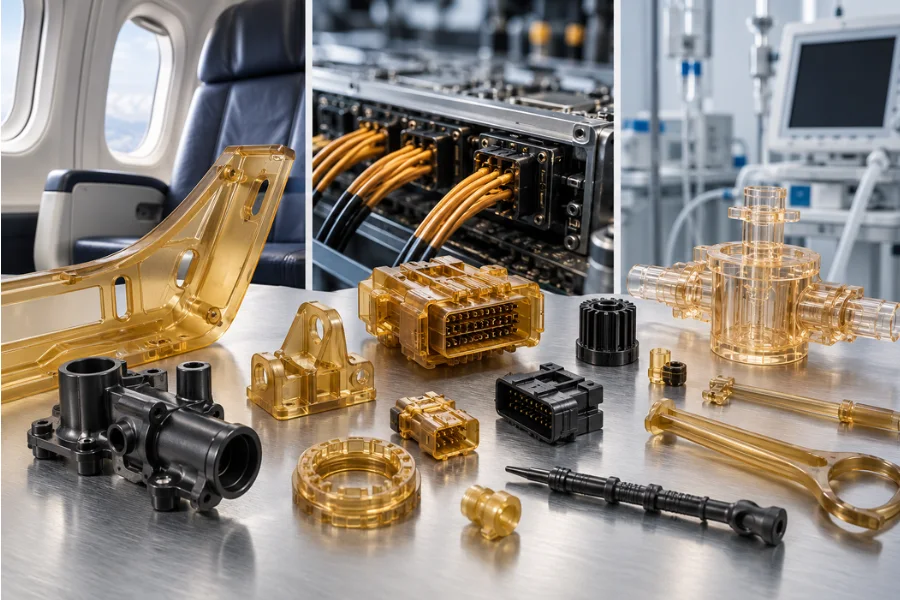
Ultem is used in aircraft and transportation components where heat resistance, flame performance, low smoke generation, and weight reduction are important. Applications include interior components, electrical parts, and structural or functional components.
Connectors, sockets, insulating components, and electronic housings can benefit from PEI’s dielectric properties, stiffness, and dimensional stability at elevated temperatures.
Suitable Ultem grades are used in surgical devices, instrument components, respiratory equipment, and other parts that may encounter heat, cleaning, or sterilization.
Medical suitability is grade-specific. USP Class VI, ISO 10993, sterilization compatibility, and other applicable requirements should be confirmed for the selected resin and final application.
PEI is also used in industrial components and certain food-handling or cooking equipment exposed to heat, water, or service fluids.
Food-contact status depends on the specific grade and applicable regulatory requirements rather than the Ultem material family as a whole.
Material selection should start with the operating requirements rather than a simple ranking of material performance.
| Material | Often Considered When… |
|---|---|
| Ultem / PEI | Heat resistance, dimensional stability, electrical insulation, and flame performance must be balanced |
| PEEK | More extreme thermal, chemical, or wear performance is required |
| PPSU | Toughness and repeated sterilization are major priorities |
| PC | Impact performance and lower material cost matter more than extreme heat resistance |
PEEK may be more appropriate in environments involving aggressive chemicals, wear, or more extreme temperatures, but usually at a higher material cost. PPSU is often considered where repeated sterilization and toughness dominate, while PC can provide a more economical option when temperature requirements are lower.
Ultem occupies the space between these decisions when several thermal, dimensional, electrical, and flame requirements must be met without automatically moving to a higher-cost polymer.
Ultem makes the most sense when several demanding requirements intersect.
A precision electrical component, for example, may need to retain its dimensions near a heat source while providing insulation and flame performance. A transportation component may need structural stiffness and elevated-temperature performance while reducing weight compared with metal.
The case for PEI becomes weaker when the design is driven primarily by minimum resin cost, extreme impact toughness, sliding wear, or chemical exposure outside the selected grade’s compatibility range.
Final selection should account for the specific PEI grade, operating environment, geometry, molding equipment, tooling strategy, production volume, and validation requirements.
PEI is polyetherimide, the polymer family. ULTEM™ is a commercial family of PEI-based materials, so the terms are closely related but are not technically identical.
Yes. Ultem is an amorphous high-performance thermoplastic that can be processed by injection molding and other thermoplastic manufacturing methods.
Typical reference data places the glass transition temperature of Ultem around 215–217°C, with certain grades offering continuous-use capability around 170°C. Actual allowable service temperature depends on grade, load, environment, exposure duration, and the property that must be retained.
Yes. Injection molding is suitable for producing complex Ultem parts at production volumes. Its high processing temperatures and drying requirements require appropriate equipment and stable process control.
Neither material is universally better. PEEK is often considered for more extreme thermal, chemical, and wear conditions, while Ultem can provide a useful balance of heat resistance, stiffness, electrical insulation, flame performance, dimensional stability, and material cost.
Ultem is most valuable when an injection molded component must satisfy several demanding thermal, dimensional, electrical, and mechanical requirements at the same time.
Its higher material cost and processing demands mean that selection should extend beyond the property data sheet. The PEI grade, part geometry, mold design, processing capability, service environment, and validation requirements must all support the intended application.